AI Art Deco Interior Design: Glamour and Geometry from a Photo
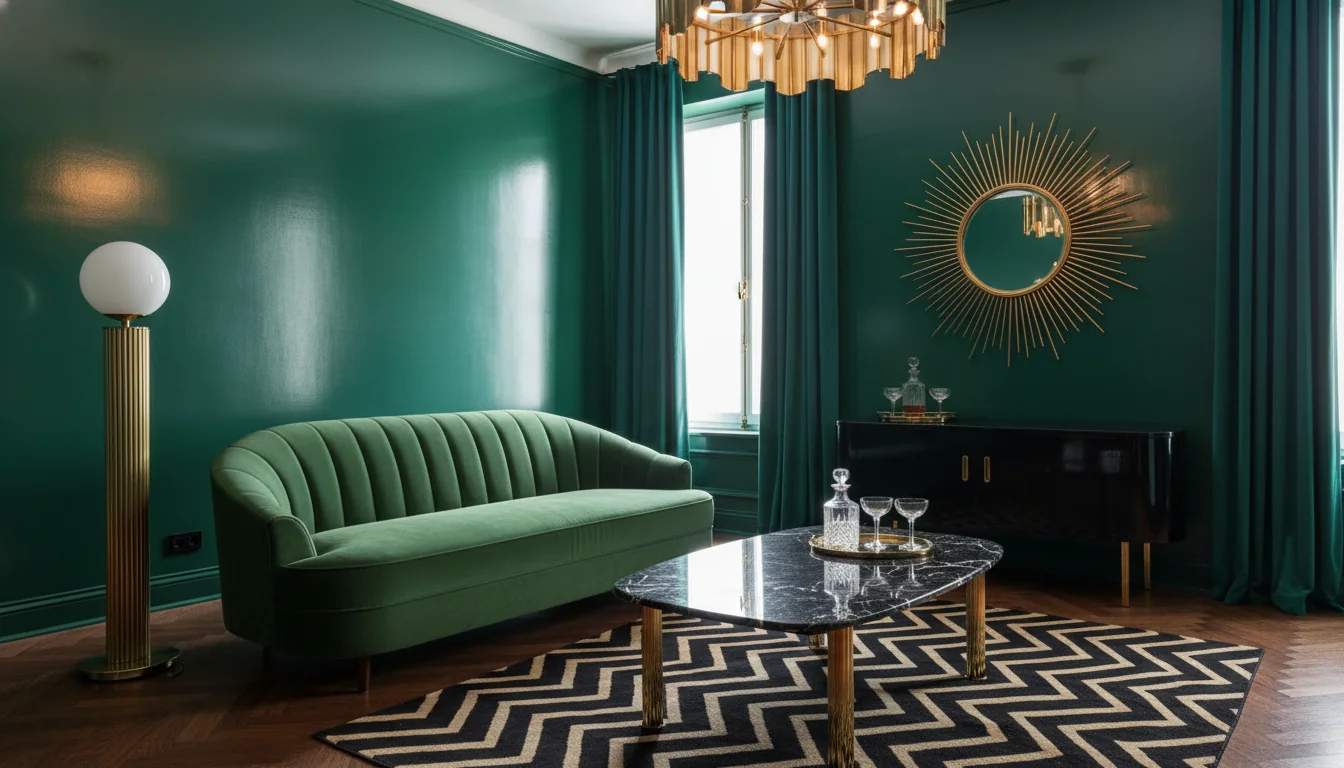
Art Deco is the style most people admire in photographs and lose nerve on before commissioning. The brass, the velvet, the marble, the lacquered cabinets, the geometry that announces itself the second you walk in — all of it is beautiful, and all of it costs real money to commit to. AI Art Deco interior design is the bridge: a way to see your own living room rendered in full Deco drama from a single phone photo, decide whether you can live with the boldness day after day, and only then start pricing the brass. The render carries no obligation. The decision it unlocks does.
This guide is the working tour — what actually defines Art Deco beyond the gold-and-black cliché, why AI handles the style’s strong geometry better than softer aesthetics, the material kit that anchors a real Deco room, the room-by-room moves, the three palettes that keep the look coherent, and the furniture pieces that turn a render into a buying plan.
What is AI Art Deco interior design? AI Art Deco interior design is the use of an AI room-rendering tool to transform a photo of an existing room into an Art Deco-styled version — dramatic, geometric, materially rich, and unapologetically glamorous. The render preserves the room’s architecture (walls, windows, ceiling) and replaces the decor layer with Deco hallmarks: bold geometric pattern (chevron, sunburst, stepped pyramid, zigzag), saturated jewel-tone walls or high-contrast monochrome, lacquered surfaces, polished brass, velvet and silk upholstery, marble counters, mirrored and sunburst accents, and statement lighting in fluted glass or fluted brass. AI handles Art Deco unusually well because the style’s strong, repeating geometry and disciplined material vocabulary give the model unambiguous patterns to render.
What defines Art Deco interiors
Art Deco was born at the 1925 Exposition Internationale des Arts Décoratifs in Paris and stayed culturally dominant from about 1920 to 1940 before quietly informing every subsequent moment of luxury-modern design from the 1970s revival to the present. It’s the style of the Chrysler Building lobby, the Queen Mary’s first-class smoking room, and roughly every glamorous hotel bar still operating in Miami, Shanghai, and London. A single corner of a Deco room — a fluted brass sconce, a chevron-parquet floor, a stepped-pyramid cabinet — reads as Deco even in isolation.
Four principles separate genuine Art Deco from generic “glam.” The first is geometric repetition: chevrons, sunbursts, stepped pyramids (the ziggurat motif), zigzags, and fan shapes aren’t decorative afterthoughts — they’re the structural language. A real Deco room repeats one or two motifs across floor, wall, cabinet, and rug. The second is material extravagance, used disciplined-ly. Deco loves brass, lacquer, marble, velvet, silk, and exotic veneers, but a successful Deco room picks two or three and repeats them — the restraint inside the lushness is what keeps Deco from tipping into casino. The third is strong silhouettes — curved low-back sofas, fluted columns, stepped cabinets, sunburst mirrors. You should be able to identify a Deco chair by its outline alone. The fourth is dramatic, directional lighting: fluted glass torchières uplight ceilings; brass sconces wash walls; cluster pendants of frosted globes hang low over dining tables. A flat-lit Deco render almost always reads wrong.
For broader context on where Deco sits among today’s named aesthetics, our different types of home interior design styles guide places it alongside its closest living relatives — Hollywood Regency, Maximalist, and Mid-Century Modern. Deco is the great-grandparent of all three.
Why AI renders Art Deco’s geometry convincingly
The conventional wisdom that AI struggles with “decorated” styles deserves a closer look. Diffusion models do struggle with eclectic, hand-collected aesthetics — boho, grandmillennial — because those styles ask the model to invent dozens of unique objects whose only common thread is a personal narrative it can’t access. Art Deco is the opposite problem, which is exactly why it renders well.
Four things compound. Repeating geometry: a chevron-parquet floor is one geometric primitive, repeated across the entire frame; a sunburst mirror is one primitive, repeated radially. Diffusion models render repeating, axisymmetric geometry with high confidence because the per-pixel guess is constrained by the pattern. Narrow material vocabulary: brass, marble, lacquer, velvet, mirror, and a couple of dark woods make up almost the entire Deco kit, and each is one of the most-photographed surfaces in luxury interiors. The model isn’t inventing what brass looks like — it’s recalling. Strong, predictable silhouettes: a curved channel-tufted velvet sofa is a clean shape; a fluted brass floor lamp is a clean shape. AI’s failure modes cluster around ambiguous outlines, and Deco’s sculptural-but-disciplined silhouettes sidestep that whole class of error. Staged, directional light: Deco’s wash-uplight-pendant language produces exactly the soft warm gradients diffusion models render most photorealistically.
The compounding effect is that all four fundamentals push the render toward the AI’s strengths. The same room photo run through “Art Deco” and “eclectic vintage maximalist” prompts will return a Deco render that looks like a credible high-end hotel bar and a maximalist render that looks like the model is improvising. The same principle is the throughline of our how to prompt AI interior design playbook: narrow the visual vocabulary, and the model’s job gets easier. Deco narrows it for you automatically.
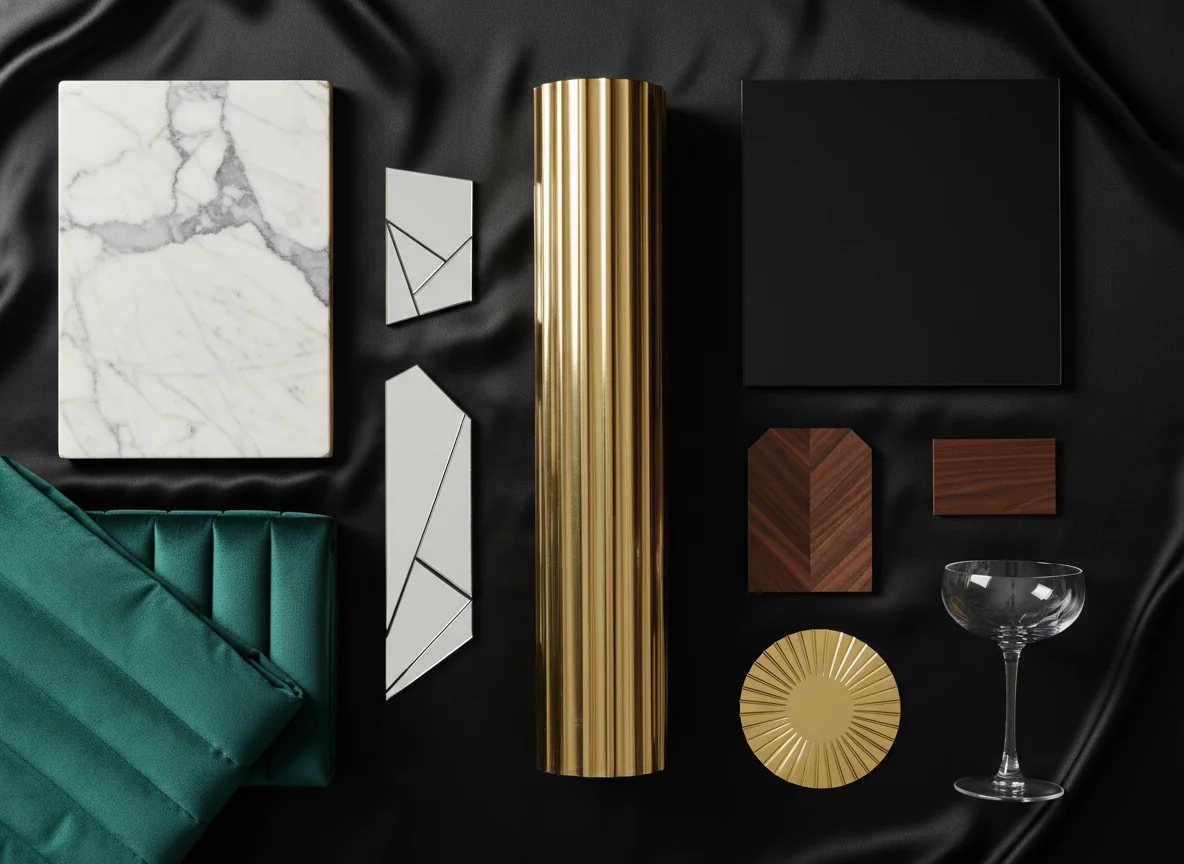
The material kit: brass, lacquer, velvet, marble, mirror
The reason a real Art Deco room reads as Deco — and not as generic glam or Hollywood Regency — is the disciplined material vocabulary underneath the apparent extravagance.
Brass, polished and fluted. The single most-defining Deco material. Polished (not antiqued) brass on fluted column lamps, sunburst mirrors, sconce arms, cabinet pulls, table legs, and chandelier frames. The polish matters — Deco brass shines. Specify “polished brass, mirror-finish” and the model returns the correct register.
Lacquer, black and jewel-tone. High-gloss lacquered cabinetry, lacquered walls (a real Deco move and still a striking one), lacquered consoles and bar carts. Signature finish is black, with deep-jewel-tone alternates: emerald, sapphire, oxblood. Matte and oiled finishes fight the language. “High-gloss lacquered finish” pushes the model to the right sheen.
Velvet and silk, jewel-toned. Silk velvet in emerald, sapphire, ruby, or bottle-green is the classic Deco sofa fabric. Channel tufting (vertical stitched channels) is canonical — distinguishing Deco from the diamond-tufted Chesterfield. Heavy silk drapery in matching jewel tones frames windows.
Marble, dramatically veined. Calacatta with bold gray veining, Nero Marquina (black with white veins), Verde Alpi (deep emerald with white). Coffee tables, console tops, bar tops, fireplace surrounds. The veining is the point — quieter stones (Carrara, soapstone) belong to other styles.
Mirror and mirrored surfaces. Mirrored panels on cabinet doors, mirrored bar carts, oversized sunburst mirrors, and one or two pieces of full-mirror furniture per room. Mirror is the Deco answer to “how do you make a small room feel grand.”
Exotic woods. Macassar ebony, burl walnut, zebrawood, satinwood — figured, dramatic veneers used as cabinet faces, headboards, and the occasional wall panel. AI renders their grain patterns convincingly enough that you can preview a wall of Macassar ebony before paying a real estimate for one.
If you’ve been browsing the high-impact-low-commitment side of glam wall treatment, our glam look self-stick art wallpaper guide is the companion piece — Deco-adjacent pattern without the lacquer-and-marble price tag.
Art Deco by room
Each room has a small handful of moves that decide whether the result reads as authentic Deco or generic-luxury-hotel.
Living room. Anchored by a curved low-back sofa in jewel-tone silk velvet with channel tufting, paired with a black or veined-marble coffee table on fluted brass legs. Side seating is a pair of tub chairs or a drum-shaped slipper chair in a contrasting jewel tone. A fluted brass floor lamp with a frosted glass globe stands at one end; a sunburst brass mirror hangs above a black lacquered console. The floor is chevron parquet in dark walnut under a black-and-gold geometric rug. Drapery is full-length silk, tone-on-tone with the sofa.
Dining room. Turns on its lighting. A fluted brass chandelier or a cluster of frosted-globe pendants hangs low — 30 inches above the table — over a marble or lacquered dining table with brass-banded edges. Chairs are tulip-back or low-back velvet in a single jewel tone, channel-tufted. A mirrored or lacquered sideboard runs the long wall, set with a brass tray and a pair of coupes. The wall behind it is often the most dramatic surface in the house — lacquered in a deep jewel tone or paneled in Macassar ebony with a stepped-pyramid inlay.
Powder room. The single best room to commit to Deco in real life — small enough to make the rich materials affordable, short enough use that the drama never tires. Walls are lacquered black or papered in fan-pattern Deco wallpaper. The floor is small-format black-and-white marble in a chevron or stepped layout. The vanity is a black-lacquered console with a polished marble top and brass fluted legs. The mirror is a brass sunburst, lit by two fluted sconces. The Deco project most people should start with.
Bedroom. Deco bedrooms run cooler than the entertaining rooms — the drama dialed back a half step to keep the room actually restful. The bed is upholstered in channel-tufted silk velvet in a single muted jewel tone (dusty emerald, deep sapphire, midnight blue) on a low platform with a curved or stepped headboard. Nightstands are Macassar ebony or black lacquer with brass pulls. Lamps are fluted brass with frosted globes. The room should read as a stateroom on a 1930s ocean liner: lush, but restful.
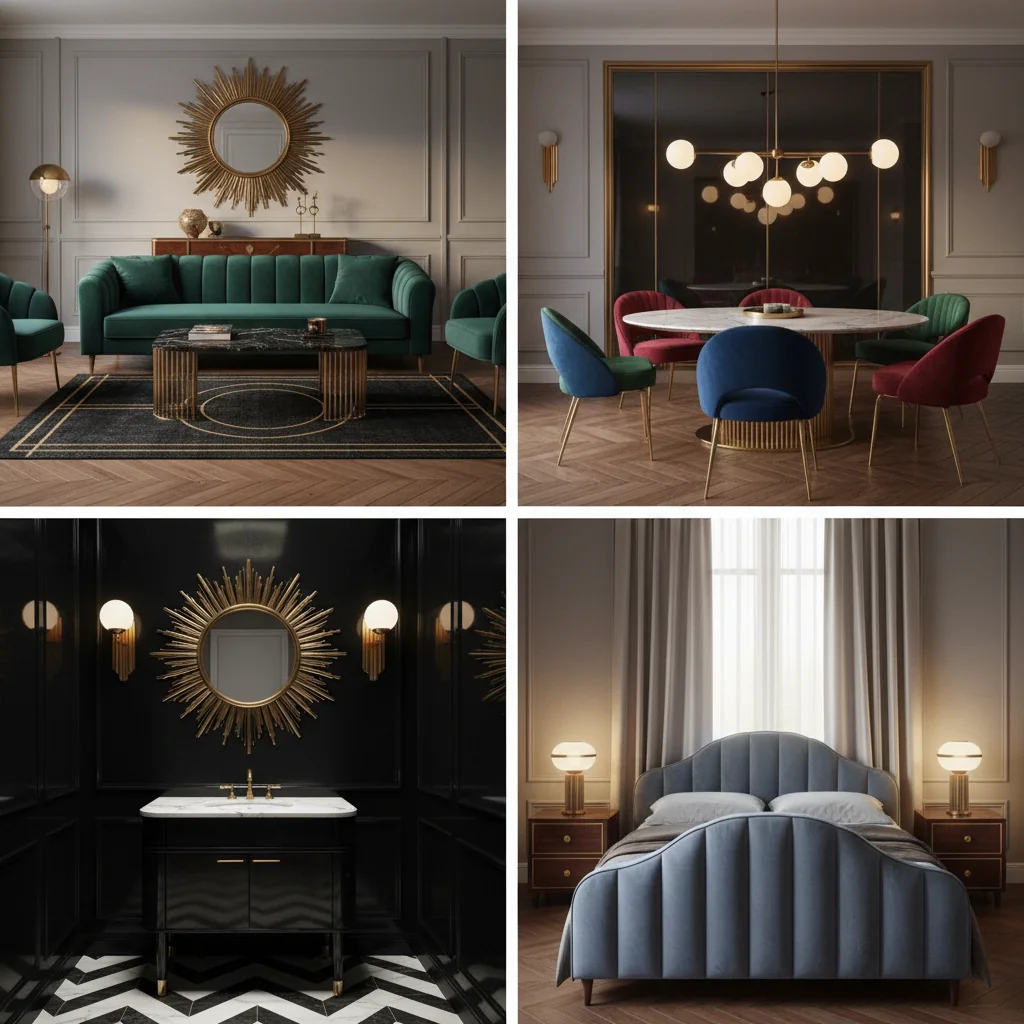
The through-line across all four rooms: one geometric motif repeated, polished brass as the dominant warm metal, one jewel-tone velvet or silk surface per room, a marble or lacquered hard surface as the room’s hero piece, and dramatic warm directional light. Hold those constants and the home reads as one continuous space.
Color palettes: jewel tones, black-and-gold, monochrome drama
A Deco room can run on one of three palette logics, and the choice sets the entire mood of the home. Pick one and execute it; mixing all three in a single room is the fastest way to land in generic-glam territory.
Jewel-tone-on-jewel-tone. Emerald walls, sapphire sofa, ruby cushion, brass and gold throughout. Saturated, dense, unapologetic — the highest-risk, highest-reward palette, and the one most people picture when they imagine Deco. Best in entertaining rooms (living, dining, powder) and small spaces where the saturation works because the room is small.
Black-and-gold. Black lacquered walls or deep charcoal, white marble floors with black veining, brass fittings throughout, and a single jewel-tone moment (one emerald velvet chair) as the focal accent. More graphic, more restrained, and the most legible Deco look for a contemporary interior — easier to live with over years.
Monochrome drama. A single jewel tone — emerald, sapphire, or oxblood — used across walls, drapery, and upholstery, with brass and marble as the only accents. The most architectural and most photogenic for a single-room statement (a den, a powder room, a home office). Harder to scale across a whole house.
| Palette | Mood | Best rooms | Risk | Photographs as |
|---|---|---|---|---|
| Jewel-on-jewel | Theatrical, dense | Living, dining, powder | High | Hotel bar |
| Black-and-gold | Graphic, restrained | Whole-house safe | Medium | Boutique hotel lobby |
| Monochrome drama | Architectural, controlled | Single-room statement | Medium-high | Editorial photoshoot |
For comparable depth on the disciplined-neutral side of Deco-adjacent palettes, our achromatic color scheme guide covers the black-white-gray logic the second palette inherits, and the what are muted colors explainer covers how to dial down jewel tones into more livable everyday versions for spaces that can’t sustain full saturation.
Matching statement Art Deco furniture
A Deco render is only as useful as the furniture you can actually buy to execute it. Deco splits cleanly into two tiers.
The first is mid-market reproduction. The Deco revival of the last fifteen years means most major retailers now carry Deco-leaning sofas (channel-tufted velvet on splayed brass legs), Deco lighting (fluted brass floor lamps with frosted globes), Deco mirrors (sunburst, octagonal, beveled), and Deco rugs (chevron and geometric). These reproductions sit in the $400–$2,500 range per piece and execute the look honestly. Most of a livable Deco room can be assembled from this tier.
The second is statement vintage. One or two vintage finds — a 1930s Macassar ebony cabinet, a true Deco sunburst mirror, an original fluted brass chandelier — elevate a reproduction-led room into a real Deco room. These pieces run $1,500–$15,000 each at auction or through specialty dealers, and they’re worth slow-shopping for. A render is an excellent way to test whether a vintage piece you’ve spotted at auction will work in your room before bidding.
The mental model: mid-market reproductions for the anchor pieces, one or two vintage statement pieces sourced more slowly, and high-quality velvet or silk on the largest upholstered piece regardless of where the rest of the budget lands. That sequencing keeps a Deco living room in the $6,000–$12,000 range at mid-market prices. Powder rooms can land a full Deco look for $1,500–$3,000.
For how the furniture-matching layer works in practice, our AI furniture matching app post covers the mechanics. Outside the AI workflow, the V&A’s Art Deco overview is the best museum-grade introduction to the period, and the Architectural Digest primer on Art Deco interiors is a reasonable mainstream contemporary read.
Common Art Deco rendering mistakes
Antiqued brass instead of polished. Default AI brass skews warm-aged, which is right for transitional or boho rooms but wrong for Deco. Specify “polished brass, mirror-finish” and the render returns to the bright register. Diamond tufting instead of channel tufting. The AI sometimes interprets “tufted velvet sofa” as a Chesterfield. Specify “vertical channel tufting” and the upholstery returns to the Deco silhouette. Flat overhead lighting. A bright, evenly lit Deco render almost always reads wrong; specify “dramatic warm directional lighting, low warm pendant, brass wall sconces.” Gold-everything. Real Deco uses brass and gold as accent, not as the dominant material. If a render comes back too gold, add “brass accents only, balanced with marble and lacquer.” Too much geometry. A real Deco room repeats one or two motifs. The AI sometimes invents a chevron floor, a sunburst mirror, a stepped cabinet, and a zigzag rug in the same render — costume territory. Specify “one repeating geometric motif” and the render returns to disciplined Deco.
FAQ
Is Art Deco the same as Hollywood Regency or Mid-Century Modern?
No, though they’re related. Art Deco (1920–1940) is the original — geometric, materially rich, sculptural. Hollywood Regency (1930s–1960s) is Deco’s lighter, more theatrical American cousin — softer silhouettes, more pastels. Mid-Century Modern (1945–1965) is what came next when designers reacted against Deco’s extravagance — leaner lines, lighter woods, less ornament. A Deco room reads heavier, more geometric, and more dramatically lit than either.
What rooms is AI Art Deco design worst at?
Rooms with weak or insufficient lighting in the source photo. Deco depends on staged, directional, warm light, and a bright midday photo of a room with no light fixtures gives the AI almost nothing to work with. The render comes back materially correct but emotionally flat. The fix is to either shoot the source photo at dusk with existing lamps on, or to specify “dramatic warm directional lighting, dim ambient” in the prompt. Heavily contemporary architecture (floor-to-ceiling glass, minimal trim) also resists Deco — the style needs walls to do its work on.
Can Art Deco work in a small apartment?
Surprisingly well, especially in single-room doses. A small bedroom in monochrome jewel tones, a powder room in full lacquer-and-brass, or a small home office in black-and-gold each work better at small scale than at large because the drama compounds in tight quarters. Pick one or two rooms to commit to and keep the rest quieter.
What’s a realistic budget for a whole-home Art Deco conversion?
At U.S. mid-market prices, $15,000–$35,000 if you stick to reproductions and lean on the AI render to avoid expensive mistakes. The number climbs fast if you commit to vintage statement pieces. The biggest single line item is usually the upholstery — channel-tufted silk velvet sofas in jewel tones run $2,500–$6,000 even at mid-market.
How long does an AI Art Deco render take from a phone photo?
Between 30 and 90 seconds in a modern consumer app. Deco prompts converge fast because the style’s repeating geometry and disciplined material vocabulary give the model less variance to resolve. Plan to generate three to five variants per room; one is almost always a clear keeper.
Try the Art Deco drama before you buy the brass
Art Deco is the style most people admire and almost no one commits to, and the reason is honest: brass, velvet, marble, and lacquered cabinetry cost real money, and the look is bold enough to live with for years. AI is the missing rehearsal step. A single phone photo and a “full Deco” prompt returns a render that tells you, in 90 seconds, whether you can live with emerald velvet walls and chevron floors — and, if the answer is yes, which version of the look suits your room best.
RoomGenius is the AI room design app that handles Art Deco natively, with the polished brass, jewel-tone velvet, dramatic lighting, and disciplined geometric vocabulary baked into how the style renders. The free tier covers your first few rooms, and the furniture-matching layer ties each rendered piece — the channel-tufted sofa, the fluted brass floor lamp, the sunburst mirror, the marble coffee table — to something you can actually order. Try it on the App Store or Google Play. Try the Art Deco drama before you buy the brass.