Teen Bedroom Design Ideas: Rooms That Grow Up With Them
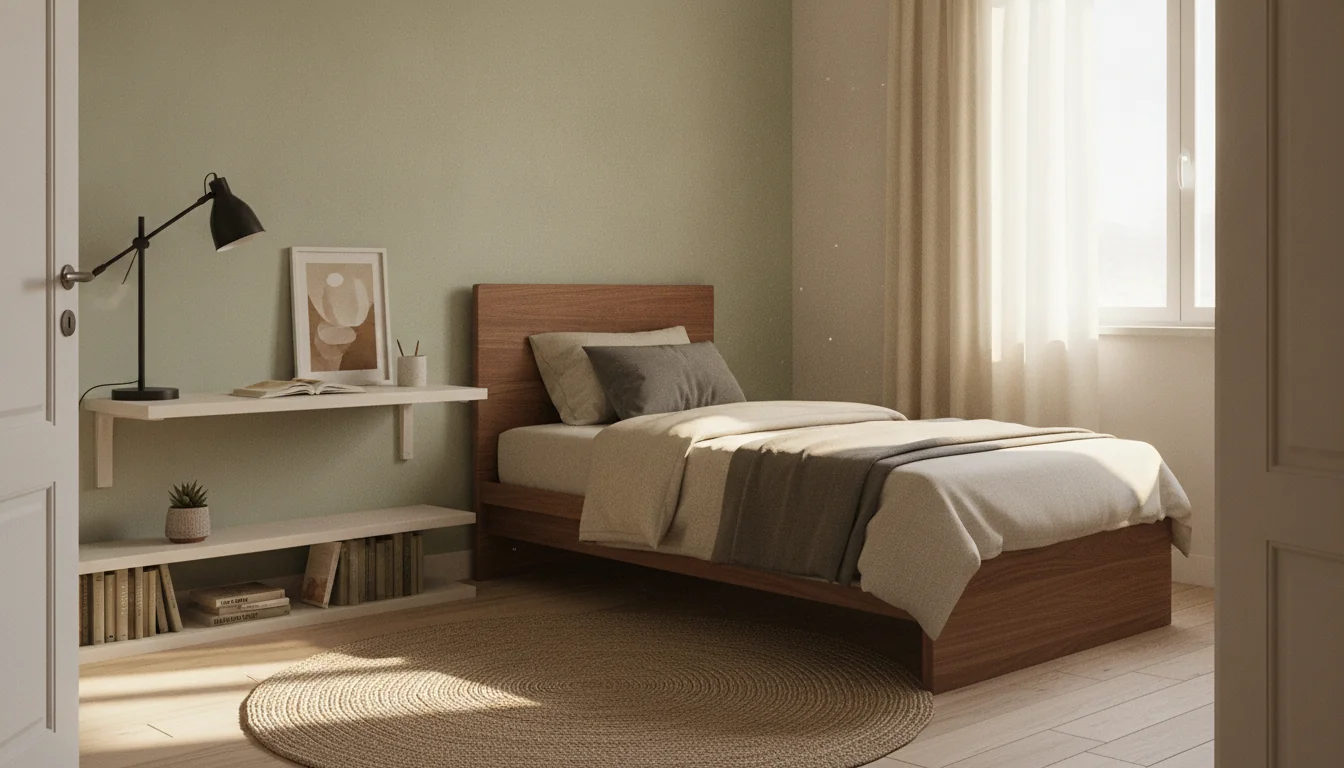
The teen bedroom is the most redesigned room in any house. The bed that was adorable at ten reads childish at fourteen. The desk big enough for a tablet is too small for a laptop and a textbook. A full redesign cycle hits every two to three years, costing furniture, paint, and arguments. AI teen bedroom design breaks the cycle — not by predicting what a teen will want next year, but by designing the room to flex around whatever comes next, and by letting the teen co-design every iteration in the app before you spend a cent.
This guide covers why teen bedrooms get redesigned so often, how to design for flexibility, the three-zone framework (sleep, study, and hang-out), why letting teens co-design with AI reduces arguments, storage that survives the teen years, and style strategies that don’t require a renovation every eighteen months.
What is AI teen bedroom design? AI teen bedroom design uses an AI room-rendering tool to transform a photo of an existing bedroom into styled redesigns tailored for a teen’s needs — a sleep zone with age-appropriate bedding, a study zone with proper desk and task lighting, a hang-out zone with seating and personal display, and storage scaled for electronics, textbooks, and clothing that changes seasonally. The workflow is the same as any interior redesign: snap a photo, pick a style, and the AI returns a photoreal preview in under two minutes, but the output is optimized for the specific demands of a teen’s daily life, which are fundamentally different from an adult bedroom or a child’s nursery.
Why teen rooms get redesigned too often
The average American teen bedroom gets a full redesign every two to three years — more frequently than kitchens (15–20 years), adult primary bedrooms (5–8 years), and even playrooms (3–5 years). At twelve, the room needs a homework desk and a display shelf. At fifteen, it needs a laptop workspace, charging stations, and a seating zone for friends. At seventeen, it needs a full study setup and college-application-ready maturity. The room that fits one year is wrong the next.
The problem isn’t that teens change — it’s that most bedrooms are designed as finished statements rather than flexible frameworks. A bed with a built-in shelf headboard works at twelve and blocks the best desk spot at fifteen. A desk that fits seventh-grade homework is wrong by tenth grade. A color chosen by an eleven-year-old is regretted by thirteen.
The AI fix isn’t to design the perfect teen room — it’s to let the family iterate cheaply. A redesign that used to cost a weekend and hundreds of dollars now costs a few minutes in an app. When the teen declares their room “boring,” open the app, snap the room, and generate three looks together. The only thing that made the cycle unsustainable was the cost per cycle. The same insight drives our approach to AI bedroom design — for teens, the iteration isn’t optional, it’s developmental.
Designing for flexibility, not this year’s trend
The single most useful design principle for a teen bedroom: the room should survive a complete change of taste without a renovation. Paint is cheap and reversible. A new duvet cover costs forty dollars. The furniture — the bed, desk, and storage — needs to stay for five to seven years, which means it needs to be style-agnostic enough to work with the all-black phase, the minimalist phase, and the maximalist gallery-wall phase that may follow both.
| Furniture piece | Buy for | Avoid | Lifespan target |
|---|---|---|---|
| Bed frame | Simple wood or metal platform / loft | Themed headboards, built-in shelves, canopy frames | 5–7 years |
| Desk | 48” × 24” minimum with cable management | Small “student” desks, fragile glass tops | 5–7 years |
| Desk chair | Ergonomic adjustable in neutral color | Cheap unadjustable task chairs, trendy accent chairs | 5–7 years |
| Shelving / storage | Modular, reconfigurable systems | Single-purpose built-ins | 5–7 years |
| Seating (hang-out) | Floor pouf, low armchair in neutral | Anything too small or unmovable | 3–5 years |
| Rug | Neutral low-pile wool or polypropylene | Themed prints (sports, characters) | 3–5 years |
The neutral furniture base makes the teen’s evolving style layer cheap. They want a galaxy room? A new duvet cover and an LED strip behind the desk — $60. A boho room? A macramé wall hanging and a new rug — $120. An all-white minimalist room? Remove the accessories and swap the duvet — $40. The furniture was never the source of the style problem; the bedding, wall decor, and accessories were.
This is where AI previews earn their keep. Parent and teen sit with three renderings of the same base room in three different accessory layers and pick the one that feels right. Next time the style changes, they generate new renders of the same base room with a new layer. The furniture investment is done once; the style investment is done in the app before anything is bought.
For more on using color to build flexible rooms, our best color scheme for bedrooms guide covers which hues survive theme changes and which lock you in.
Zoning: sleep, study, and hang-out space
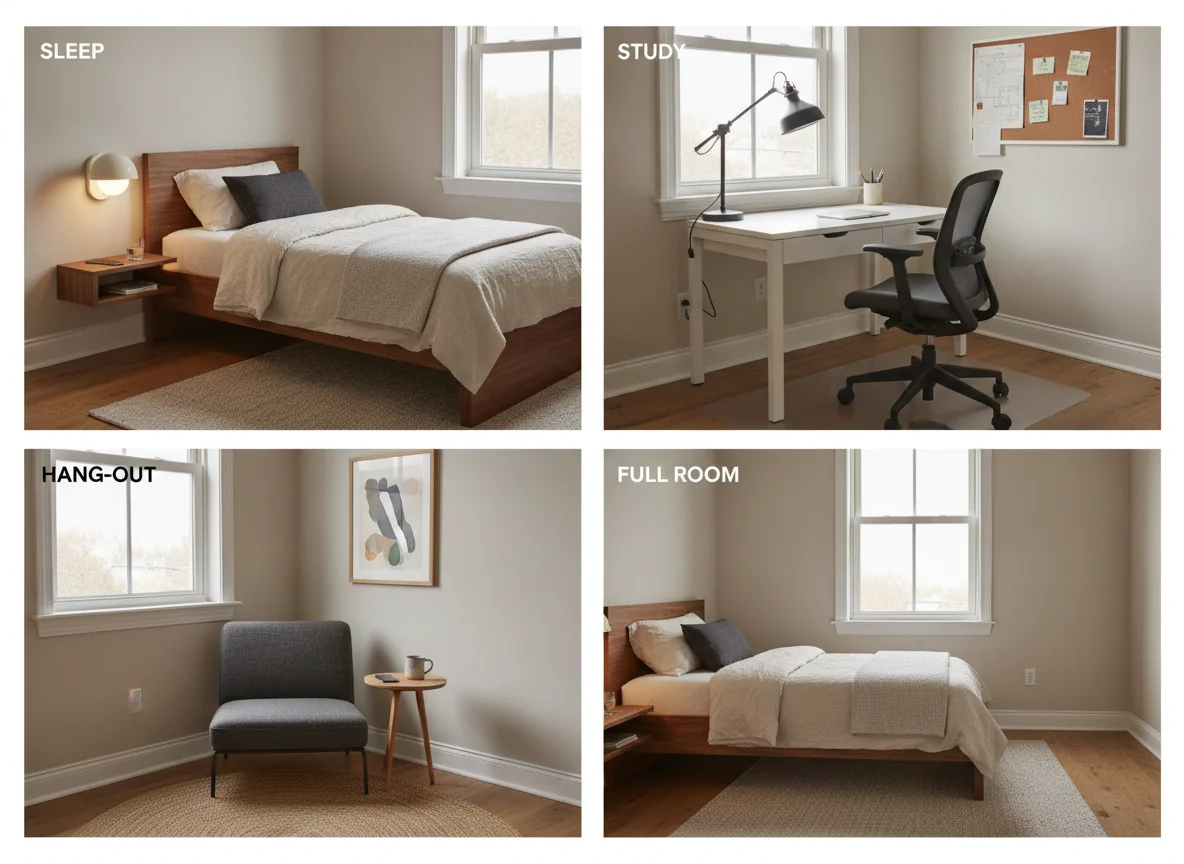
Teen bedrooms need three distinct zones, and the most common design failure is conflating them. A room that collapses sleep, study, and hang-out into one piece of furniture — the bed — is a room that never fully serves any of them.
The sleep zone is the bed and its perimeter. A twin XL mattress is the practical standard — long enough for a growth spurt, compact enough to leave floor space. A simple frame on a neutral wood or metal base anchors the room without dominating it. A small bedside surface for a phone and a glass of water is important, but it doesn’t need to be a full nightstand. The sleep zone should sit on the quietest wall, away from the door and window if the room allows. The AI renders this correctly when you specify “twin XL” rather than defaulting to an adult queen.
The study zone is the highest-leverage area in the room, and the one most teen bedrooms get wrong. The desk needs a clear surface of at least 48 by 24 inches — large enough for a laptop and a textbook side by side — plus a task light that illuminates the work surface without casting a shadow from the user’s head. The chair needs adjustable height and lumbar support because the same chair that fits a 5’2” fourteen-year-old won’t fit them at 6’0” three years later. A power strip mounted under the desk handles the charging tangle for a laptop, phone, tablet, and headphones. For decorate bedroom ideas, the study zone is where functional constraints are tightest, and a render that tests desk position and chair clearance before you buy saves the most time.
The hang-out zone is the part that feels most optional and turns out to be the most impactful. A room with no hang-out zone is a room where the teen sits on the bed to text friends, which means they’re also on the bed during homework, which means the bed never reads as a sleep-only space — exactly the sleep-hygiene problem that keeps teens awake at night. A low chair or floor pouf, a beanbag, or even a stack of oversized floor cushions in an unused corner is enough. A small side table for a drink and a phone completes it. The hang-out zone is also where the teen’s personal style lives most visibly, making it the cheapest zone to update when the aesthetic shifts.
The AI renders all three zones together when the prompt describes the room as a multi-zone space. Without that description, the model tends to center the bed and treat everything else as an afterthought — which works for a primary bedroom and is wrong for a teen.
Letting the teen co-design with AI previews
The second most common source of teen-bedroom friction — after the cost — is the parent-teen taste gap. AI previews change the format of the negotiation from abstract to concrete. Instead of describing a style or pointing at Pinterest photos, parent and teen stand in the actual room, snap a photo, and generate renders. The conversation shifts from “would you like a navy accent wall?” to “which of these two reads better with your desk in the corner?” The teen sees their actual room rendered three different ways, and picking a direction takes ten minutes instead of a weekend.
There’s a secondary advantage: teens who co-design with AI previews tend to make more conservative choices. A teen flipping through Pinterest will pin the black-walled maximalist room with a neon sign. A teen looking at that same room rendered onto their actual beige-carpeted bedroom often backs off. The render shows the gap between aspiration and reality, and the teen’s instinct for what will actually feel comfortable tends to pull toward something more functional.
Storage that survives the teen years
Teen storage sits between child storage (low and open) and adult storage (closed and hidden), and it shifts over the years. The right strategy: buy systems that can change their storage mode. A modular shelving unit with adjustable shelves handles the transition from toys-in-bins (age twelve) to books-and-decor (age fourteen) to mixed storage (age sixteen) just by repositioning shelves. A closet system with adjustable hanging rods lets the ratio of hanging to folded storage shift as the wardrobe evolves.
Electronics storage is where most teen rooms fall down. Three things need a home: a laptop (on the desk), a phone (charging next to the bed), and headphones (somewhere accessible). A desk with an under-mounted cable tray keeps the charging tangle out of sight. A small bedside shelf handles the phone. A wall-mounted hook keeps headphones off the floor. These aren’t design statements — they’re friction removers, and they matter more than the paint color.
The height rule: no storage unit taller than the teen can reach on tiptoe. A seven-foot bookshelf looks great in a catalog and is functionally useless because the top two shelves become dead space. A five-foot unit with open cubbies gets used because everything on it is reachable.
Style without permanent commitment
The style layer — the part that changes every two years — should cost almost nothing to update. The strategy borrows from rental apartments: every decorative decision should be reversible in under an afternoon.
Paint is the biggest lever. An accent wall costs about $40 and an hour of work, and AI rendering shows exactly how it reads against existing furniture — information a paint swatch can’t give you.
Wall decor is the cheapest lever. A gallery wall of inexpensive frames with printable art costs under $50. Swap the prints out and the room changes again. A $50 gallery wall the teen designed themselves is meaningful personal space; a $500 one from a store is a purchase resented when replaced.
Lighting is the most underused lever. A warm floor lamp in the hang-out zone, an articulated task lamp on the desk, and string lights behind the bed create three distinct layers. The same room with a single overhead light reads as a cell. Cost: under $100, all moveable.
For renters who can’t paint, removable wallpaper on a single wall, fabric wall hangings, or a command-strip gallery wall achieve the same effect. Our nature themed bedroom ideas cover many of these renter-friendly moves in detail, and the principles transfer directly.
| Style change | Cost | Time | Reversible? | AI value |
|---|---|---|---|---|
| Accent wall paint | $40–$60 | 1 hour | Yes | Very high |
| Duvet cover + pillowcases | $40–$80 | 5 min | Yes | Medium |
| Gallery wall | $40–$80 | 1 hour | Yes | High |
| Rug swap | $50–$150 | 5 min | Yes | Very high |
| String lights / LED strip | $20–$50 | 30 min | Yes | Medium |
The formula in practice: neutral furniture base + renter-friendly style layer + AI preview before every change = a teen bedroom that costs a fraction of the traditional redesign cycle and lets the teen’s identity evolve naturally rather than in expensive, argument-adjacent bursts.
FAQ
What size bed is best for a teen bedroom?
Twin XL is the most practical choice for most rooms. It’s long enough for a full-height teenager (80 inches, same as a queen) but narrow enough to leave floor space for the study and hang-out zones. Full beds work in rooms over about 120 square feet. Queen beds are almost always too large — they dominate the footprint and push other zones into corners.
How should I handle the desk and screen setup for a teen who does homework on a laptop?
The desk needs a minimum of 48 by 24 inches of clear surface to hold a laptop, an open textbook, and a notebook side by side. Add an articulated task lamp with adjustable brightness, and a cable management tray under the desk. The chair must be adjustable in seat height and lumbar support — the same chair that fits a 5’2” freshman will still fit a 6’0” junior.
Should I let my teen choose the paint color themselves?
Yes, but only after they’ve seen it rendered onto their actual room in the AI app. The most common parent-teen paint negotiation ends with a color chosen from a swatch that reads entirely differently on a real wall. Generate renders with two or three accent wall colors and let the teen pick from the renders. The result is almost always more conservative than the swatch pick, and both parties feel heard because the decision is visual rather than emotional.
How can AI help with a shared teen bedroom?
For siblings sharing a room, the AI workflow becomes a conflict-resolution tool. Generate renders where the room is divided into two clearly defined halves — by rug boundaries, a low shelf as a room divider, or furniture orientation — and let each sibling choose the decor for their half from the render. The visual preview showing exactly how much space each sibling gets tends to settle the boundary arguments that cause most shared-room friction. Specify “two-zone symmetrical layout” in the prompt for the cleanest results.
What storage system works best for a teen’s electronics?
A three-location system: the desk handles the laptop charger and cable management; a small bedside charging shelf handles the phone; a wall-mounted hook or shallow desk drawer handles headphones. The specific hardware matters less than the principle that every device has a designated charging home. Without that, the floor and the bed become the charging stations.
How do I transition from a childhood bedroom to a teen bedroom without a full renovation?
Phase one (ages 12–14): swap themed bedding for a neutral duvet, add a proper desk and task light, replace themed wall decor with a gallery wall of frames. Phase two (ages 14–16): introduce a real desk chair, add a hang-out zone, swap the gallery prints for the teen’s current interests. Phase three (ages 16–18): consider a bed frame upgrade if it’s still from childhood, and let the teen’s style layer dominate. Each phase costs a fraction of a full redo, and AI renders preview each phase before you spend.
Let your teen co-design their room — preview every idea first
A neutral furniture base that survives five to seven years, a study zone that fits the laptop-and-textbook workflow, a hang-out zone that gives the teen a place to exist off the bed, and a style layer that changes cheaply every couple of years — that’s the formula, and the only thing that was missing was a cheap way to preview every iteration before committing.
RoomGenius is the AI room design app that lets you and your teen snap the room, pick a style, and see three rendered versions of the idea on your actual room in under two minutes. The free tier covers the first several renders per session, and the furniture-matching layer surfaces real products — the twin XL frame, the 48-inch desk, the articulated task lamp — that match the pieces in the rendered image. Try it on the App Store or Google Play. Let your teen co-design their room — preview every idea first, and save the arguments for something that matters.