Pendant vs Chandelier vs Flush Mount: Which Fixture, Which Room?
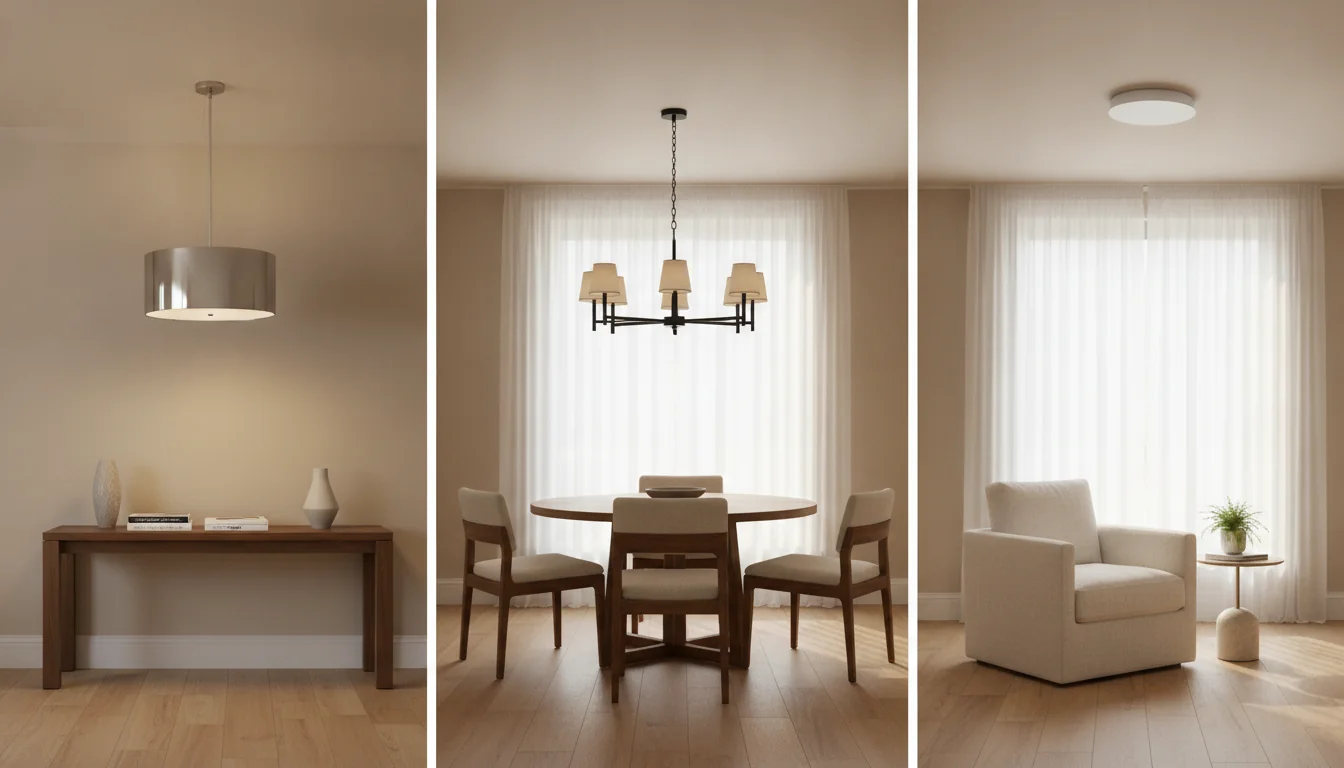
A ceiling fixture is the one lighting decision most people make in five minutes with the wrong question. They see a pendant they like, buy it, install it, and discover within a week that the fixture is either too high (it disappears), too low (it blocks sightlines), or the wrong type entirely — a chandelier under an 8-foot ceiling looks like a hanging hazard, and a flush mount in a 10-foot dining room looks unfinished.
Pendant vs chandelier vs flush mount is not a style question. It is a ceiling-height question, a room-function question, and a scale question — in roughly that order. The style comes last, after you know which fixture family the room can actually support. This guide defines the three families, shows which ceiling heights and room functions each one serves, covers the sizing rules that prevent the most common mistakes, and demonstrates how modern AI preview tools let you see each fixture type in your actual room before you buy.
What are the three ceiling fixture families? Pendants are single-source fixtures suspended from the ceiling by a cord, rod, or chain, typically used for task or accent lighting over a specific surface. Chandeliers are multi-arm fixtures that spread light outward and downward, serving as a room’s primary decorative light source. Flush mounts sit directly against the ceiling with no drop; semi-flush mounts have a short stem of 3 to 12 inches. Both are designed for rooms where ceiling height is limited. The three families overlap in some rooms, but each one has a height, a function, and a room where it clearly outperforms the other two.
The three fixture families, defined
The industry distinguishes fixture families by how they mount to the ceiling, and that mounting mechanism determines everything else — how far the light drops into the room, how it distributes its beam, and what ceiling height it requires.
Pendants mount on a single cord, rod, or chain that drops the fixture 12 to 48 inches below the ceiling. The light source is enclosed in a single shade — glass, metal, fabric, rattan, or acrylic — that directs the beam downward (for task lighting) or diffuses it (for ambient). Pendants are the most flexible family because the drop length, shade size, and material can all be customized independently.
Chandeliers have multiple arms or multiple light sources arranged around a central hub. A typical six-arm chandelier spans 30 to 48 inches in diameter, and the light distributes both downward and outward. Chandeliers are the most decorative fixture family and the most height-dependent. A chandelier that hangs too low is a hazard; one that hangs too high reads as undersized.
Flush mounts and semi-flush mounts are the low-ceiling solution. A flush mount sits pressed directly against the ceiling, dropping zero inches. A semi-flush mount has a short stem — typically 3 to 12 inches — that creates a small gap. Both distribute light downward and some ambient light upward, bounced off the ceiling. Flush mounts are invisible until you look up; that is their superpower in low rooms where a pendant would intrude.
| Fixture family | Drop below ceiling | Typical diameter | Ceiling height min | Best for |
|---|---|---|---|---|
| Pendant | 12–48 in | 6–24 in shade | 8.5 ft (task), 9 ft (clearance) | Kitchen islands, dining tables, reading nooks |
| Chandelier | 24–42 in | 24–60 in | 9 ft comfortable, 10 ft ideal | Dining rooms, entry halls, bedrooms |
| Flush mount | 0 in | 8–24 in | Any height above 7 ft | Hallways, closets, low basements |
| Semi-flush mount | 3–12 in | 10–30 in | 8 ft minimum | Bedrooms, living rooms, stair landings |
Ceiling height: the deciding factor
Ceiling height is the single variable that eliminates fixture families before you consider style, finish, or budget. A room with a ceiling under 8 feet cannot accept a pendant or chandelier without creating a clearance hazard. A room with a ceiling over 10 feet looks naked with a flush mount.
8-foot ceilings. This is the most common height in US homes built before 2000. An 8-foot ceiling limits you to flush mounts and semi-flush mounts only. A pendant with even a 12-inch drop puts the fixture at 84 inches above the floor, and building codes require 90 inches of clearance (except over a work surface, where 78 inches is acceptable). A chandelier in an 8-foot room hangs at eye level — a visual and physical obstacle. Choose a semi-flush mount with a 3- to 6-inch stem and a wide, shallow shade.
9-foot ceilings. Nine feet is the threshold where all three families become viable. A pendant with a 15- to 24-inch drop clears the 90-inch code threshold. A chandelier works but must be scaled conservatively — 24 to 30 inches in diameter, not the 36 to 48 you might choose in a 10-foot room. Semi-flush mounts still work well here for bedrooms and hallways.
10-foot ceilings and above. This is the chandelier’s native territory. A chandelier at 10 feet hangs with a 30- to 36-inch drop and reads as grand rather than intrusive. Pendant clusters also excel — three mini-pendants over a 10-foot kitchen island creates a layered ceiling gesture. Flush mounts in a 10-foot room look undersized unless very wide (20 to 24 inches in diameter).
| Ceiling height | Pendant | Chandelier | Recommendation |
|---|---|---|---|
| Under 8 ft | No — clearance violation | No | Flush mount only |
| 8 ft | Over counters only | No | Semi-flush with 3–6 in stem |
| 9 ft | Yes (15–24 in drop) | Yes (24–30 in diameter) | All three viable |
| 10 ft | Yes (24–36 in drop) | Yes (30–48 in diameter) | Chandelier or pendant cluster |
| 12 ft+ | Yes (36–48 in drop) | Yes (48–60 in diameter) | Statement chandelier |
Pendants — where they shine, where they don’t
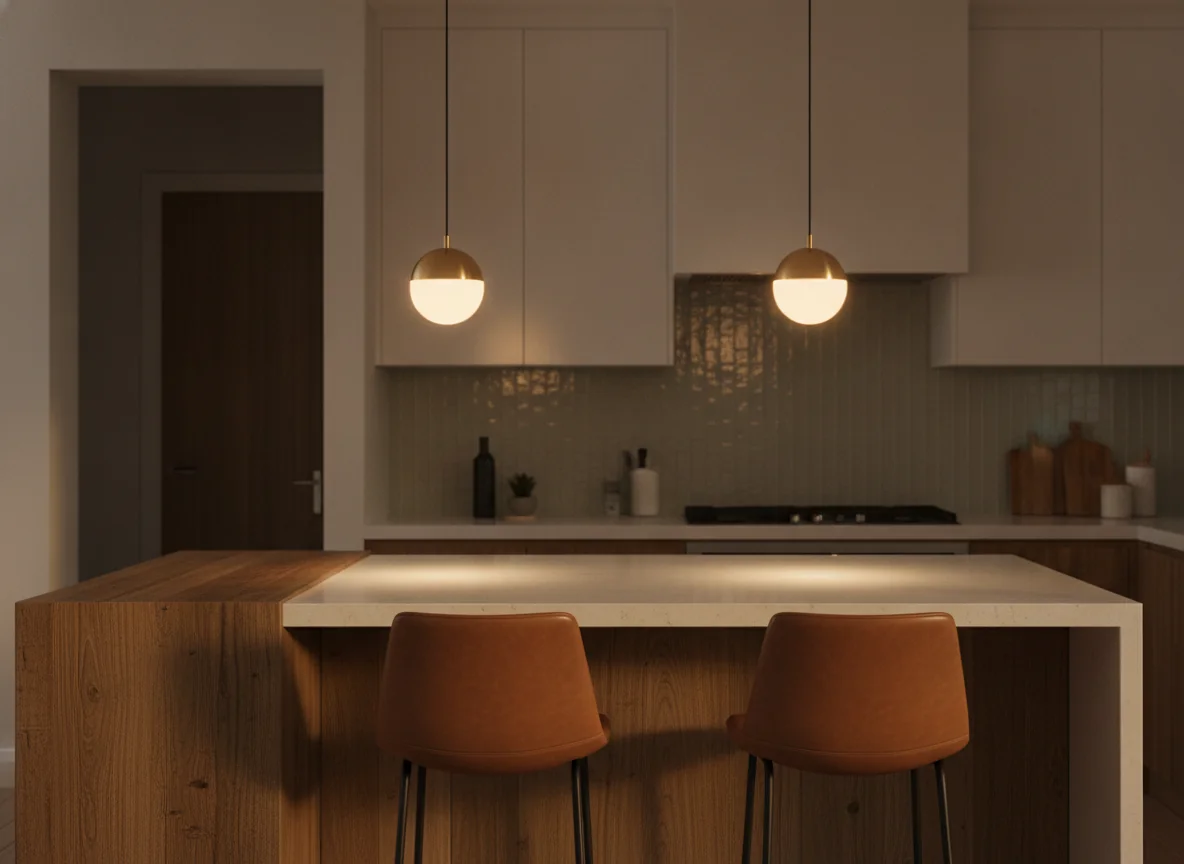
A pendant’s core strength is directional light over a defined surface — a kitchen island, a dining table, a desk. When positioned directly above a surface and hung at the right height, it creates a pool of focused light that makes the surface feel intentional.
Where pendants excel. The kitchen island is the pendant’s natural habitat. A 7-foot island supports two pendants spaced 30 inches apart, hung 30 to 36 inches above the counter surface. A 9-foot island supports three pendants spaced 28 inches apart. The rule: pendants should not overlap the island edge by more than 2 inches on either side. Pendants also work well over dining tables in open-plan rooms, where a pendant cluster marks the dining zone without requiring a ceiling-height change.
Where pendants fall short. A single pendant cannot illuminate an entire room. Pendants struggle in rooms with sloped ceilings, where the cord length becomes uneven and the fixture reads as tilted. And pendants over a bed are a common mistake — the fixture hangs at head level and creates visual weight that competes with sleep.
For a deeper look at fixture placement in dining spaces, our ai dining room design guide covers pendant positioning within a broader room-scale framework.
Chandeliers beyond the dining room
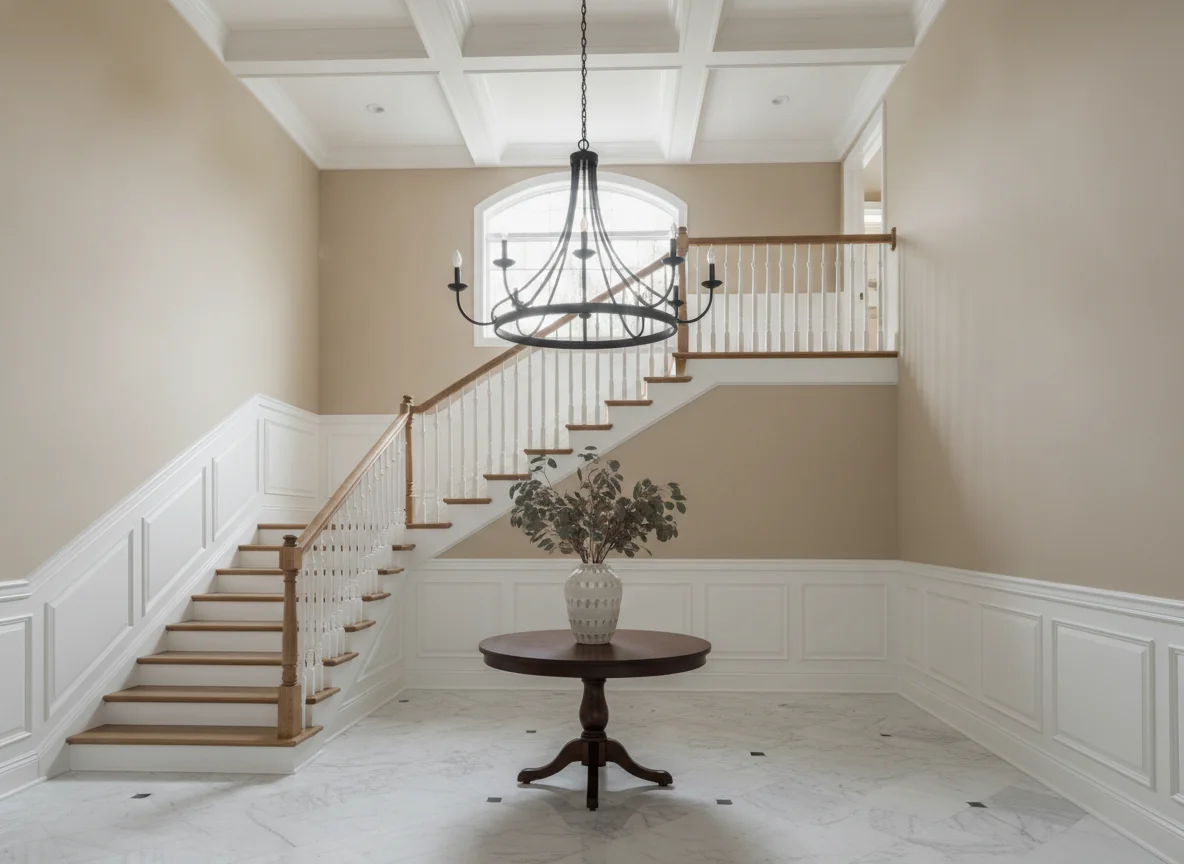
Chandeliers are so strongly associated with dining rooms that most homeowners never consider them elsewhere. A chandelier in an entry hall, a primary bedroom, a bathroom, or a walk-in closet creates the same kind of visual anchor — a moment of deliberate ceremony in a space where a flush mount would disappear.
Entry hall. A chandelier in a two-story entry is the most impactful single fixture choice in a house. Minimum 24 inches in diameter for a standard entry, 36 to 48 inches for a two-story space, hung so the bottom clears 84 inches above the floor.
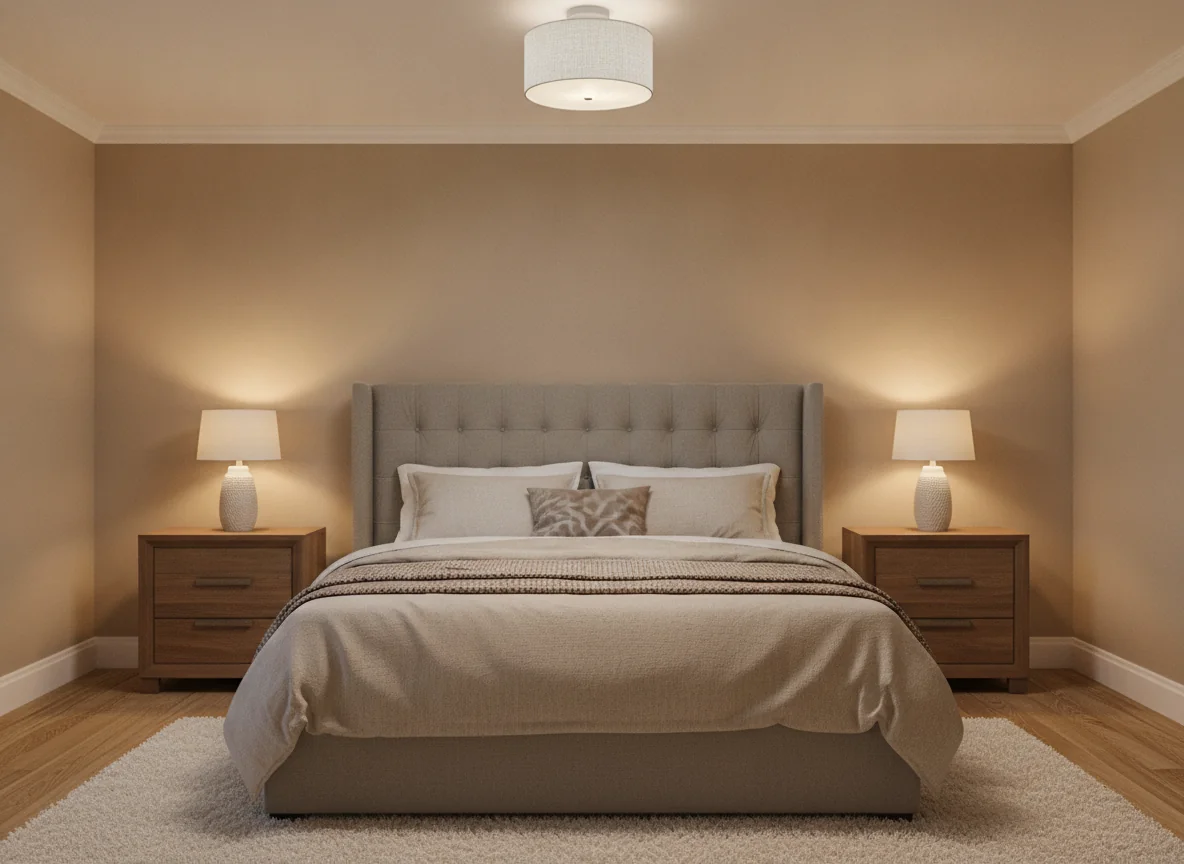
Primary bedroom. A chandelier in a bedroom creates the same hotel-suite feeling that makes boutique hotels memorable. Choose a smaller fixture than you would for a dining room — 20 to 28 inches for a standard 12-by-14-foot bedroom — and hang it higher, 84 to 90 inches above the floor, so it does not compete with the bed.
Bathroom. A small chandelier (16 to 22 inches, damp-rated) centered over a freestanding tub creates a warm focal point. Keep it at least 6 feet from water sources and use only damp-rated fixtures.
Walk-in closet. A small chandelier (14 to 18 inches) in a walk-in closet is a luxury that costs less than a pair of shoes and changes how the space feels every time you enter it.
The common constraint: a chandelier needs 9 feet of ceiling in a bedroom and 9.5 to 10 feet in a dining room to read as proportional. If the ceiling is 8 feet or under, choose a semi-flush mount with a wide, decorative shade instead. Our furniture types and styles guide covers chandelier pairing with room furniture scales.
Flush and semi-flush mounts for low ceilings
Flush and semi-flush mounts are the fixture family that gets the least design attention, which means they are also the most commonly chosen wrong.
Flush mounts sit directly against the ceiling. Their strength is invisibility — they provide ambient light without claiming visual territory. They are the right choice for hallways, closets, laundry rooms, and basements where clearance is the only priority.
Semi-flush mounts are what most homeowners should default to for 8- and 9-foot ceilings. A semi-flush mount with a shallow drum or bowl shade — 4 to 6 inches deep, 14 to 20 inches in diameter — on a 4- to 8-inch stem provides ambient light, a small amount of upward bounce that makes the ceiling feel higher, and a decorative element that a flush mount does not. In a bedroom with an 8-foot ceiling, a semi-flush mount with a linen shade in a warm neutral tone reads as intentional and finished.
Style considerations. Semi-flush mounts come in the same finishes as pendants — brass, matte black, white glass, rattan — and choosing one that echoes the living room’s design vocabulary ties the low-ceiling room into the house’s broader aesthetic. For more on coordinating finishes across rooms, our interior design tips for beginners guide covers material and finish coordination.
Sizing a fixture to the room
Fixture sizing is the most common source of lighting regret. A chandelier that is too small for a 12-foot table looks stingy; a flush mount too large for a 5-by-8-foot hallway reads as a ceiling tumor. The industry has a simple formula that works for all three families.
Diameter formula. Add the room’s length and width in feet, and the sum in inches is the recommended fixture diameter. A 12-by-14-foot dining room gets a 26-inch fixture. A 10-by-12-foot bedroom gets a 22-inch fixture. For flush and semi-flush mounts, go 10 to 15 percent smaller because the fixture does not drop into the room’s visual field.
Height formula. A hanging fixture’s bottom should clear the floor by at least 90 inches in walkable areas. Over a surface — dining table, kitchen island — the bottom should be 30 to 36 inches above that surface.
Width rule for tables. A chandelier or pendant over a table should be 12 to 16 inches narrower than the table’s width. A 48-inch-wide dining table calls for a 32- to 36-inch-wide fixture.
| Room | Dimensions | Recommended diameter | Fixture type |
|---|---|---|---|
| Dining room | 12 × 14 ft | 26 in | Chandelier or single pendant |
| Kitchen island | 7 ft island | Two 10–12 in pendants | Pendants (pair) |
| Living room | 14 × 18 ft | 32 in | Chandelier or semi-flush |
| Bedroom (8 ft ceil) | 12 × 14 ft | 22 in | Semi-flush mount |
| Entry (two-story) | 10 × 10 ft | 36–48 in | Statement chandelier |
| Hallway | 4 × 12 ft | 16 in | Semi-flush or flush |
| Bathroom | 6 × 8 ft | 14 in | Semi-flush (damp-rated) |
For a broader look at how fixture sizing works with room proportions, our how to design drawing room guide covers the scale relationships that govern every major piece.
Previewing fixtures before you buy
Spec sheets cannot convey how a 26-inch chandelier will look hanging 36 inches above your dining table, at your ceiling height, against your wall color. The gap between the spec and reality is where fixture regret happens.
The render workflow. RoomGenius’s AI preview accepts a description of the fixture you are considering and generates a photoreal render of it in a photo of your actual room — scaled to your dimensions, hung at your specified drop height, and lit with your room’s natural light.
Side-by-side comparison. For the pendant vs chandelier vs flush-mount decision specifically, the preview tool lets you render all three in the same room in under five minutes. See how the pendant’s drop reads against the dining table. See whether the chandelier’s outward spread fits your ceiling height. See whether a flush mount leaves the room underlit while a semi-flush mount completes it.
Scale confirmation. The most common feedback from users who preview a fixture is “I thought it would be larger” or “I thought it would be smaller.” The render eliminates that guesswork. A 26-inch chandelier on paper sounds moderate; a 26-inch chandelier rendered above your actual table tells you instantly whether it is the right fixture for the space.
FAQ
Can I use a pendant light in a room with an 8-foot ceiling?
Yes, but only over a counter, island, or work surface where the pendant can hang at 78 inches above the floor. In traffic areas — a dining table, a hallway — the pendant must clear 90 inches, which an 8-foot ceiling cannot provide. Use a semi-flush mount instead.
How do I choose between a pendant and a chandelier for my dining room?
The table shape decides. A round or square table pairs better with a single pendant or a chandelier. A long rectangular table pairs better with a chandelier at center or a pair of pendants at the endpoints — never a single pendant at the center of a long table, which leaves the ends in shadow.
What size chandelier do I need for a two-story entry?
Minimum 36 inches in diameter for a standard entry. For a wider or two-story entry, push to 42 to 60 inches. If the entry is narrow but tall, a multi-tier chandelier with a smaller diameter provides height drama without crowding the walls.
Is a flush mount ever the right choice for a living room?
Rarely. Even with an 8-foot ceiling, a semi-flush mount with a 3- to 6-inch stem provides significantly more visual presence than a flush mount. The only exception is a very wide flush mount (18 to 24 inches) with a decorative shade — linen, rattan, or glass.
Can I mix pendant, chandelier, and flush mount finishes across rooms?
Yes, but limit to two finishes across the whole house. A common strategy: matte black for visible fixtures (pendants, chandeliers) and matte white or brushed nickel for invisible fixtures (flush mounts in hallways, closets).
How do damp-rated fixtures differ from standard fixtures?
Damp-rated fixtures are sealed against moisture and are required for bathrooms and covered outdoor spaces. Dry-rated fixtures are for dry indoor spaces only. Installing a dry-rated fixture in a bathroom creates a safety hazard — always check the rating.
What is the most common ceiling fixture mistake?
Buying based on style alone without checking ceiling height and table width. The most frequently returned fixture is the chandelier that looked perfect in a showroom photo and looked ridiculous in the buyer’s 8-foot dining room. Check ceiling height first, table width second, then shop by style.
See pendant, chandelier, and flush mount in your room — side by side
Choosing a ceiling fixture is a three-variable decision: fixture family, ceiling height, and room function. A chandelier that looks stunning in a catalog makes no sense under an 8-foot ceiling. A flush mount in a 10-foot room leaves the space feeling unfinished. A pendant hung wrong above a table creates a clearance hazard that no finish choice can fix.
RoomGenius is the AI room design app that lets you see each fixture family in your actual room before you buy. Snap a photo from the doorway, describe the fixture you’re considering, and a photoreal render appears in under two minutes. See how the pendant reads against the kitchen island. See whether the chandelier’s diameter fits the dining table. The free tier covers your first few fixture previews. Try it on the App Store or Google Play. Preview before you wire — it’s the fastest way to get the fixture right the first time.