AI Outdoor Living Room Design: Bring the Indoors Out
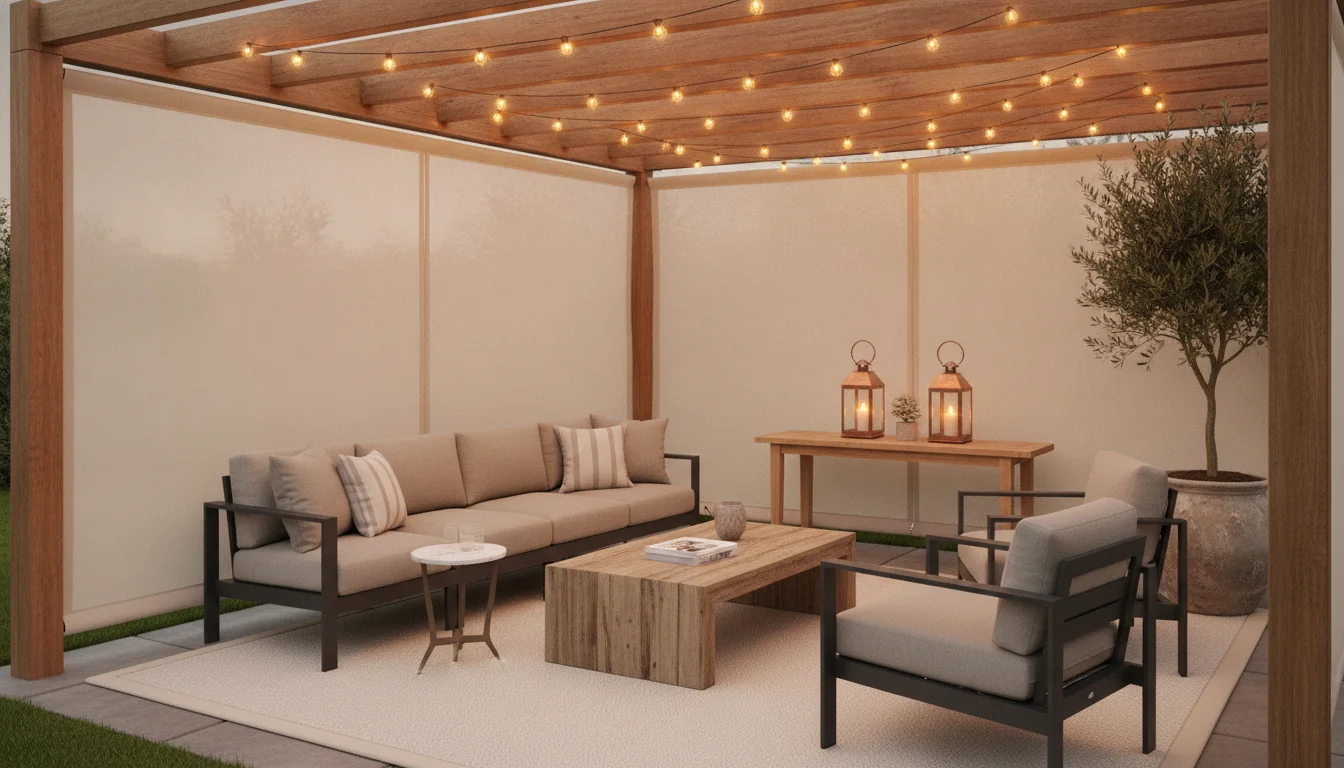
An outdoor living room is not a patio with a sofa. It’s a room that happens to have a roof made of something other than drywall — a covered porch, a pergola, a screened-in veranda, a three-season room, or a deep awning that extends the living area past the sliding door. The difference matters because once you treat the space as a room rather than as outdoor furniture sitting on a slab, the design decisions change: you buy for 5,000 hours of use a year instead of 12 cookout Sundays. AI outdoor living room design is the fastest way to see what your covered outdoor space would look like as a real, livable room — before you buy a single piece of furniture.
This guide covers the transition from patio mindset to living-room mindset for the highest-value outdoor upgrade most homes can make: what separates an outdoor living room from a patio, why AI is especially good at indoor-to-outdoor translation, how to anchor the space with the right seating and rug, the weatherproof material vocabulary that makes the render shoppable, the difference between covered and uncovered layouts, and the furniture-matching layer that ties it all to real products. If you have a covered patio, a porch, or a three-season room that’s currently holding a single folding chair and a grill cover, this is the post that shows you what it could be.
What is an outdoor living room? An outdoor living room is a covered or sheltered outdoor space designed for year-round relaxation and hosting — furnished with the same attention to layout, comfort, lighting, and materials you’d give an indoor living room. It’s distinct from a patio or deck in three ways: it has a defined overhead element (pergola, roof, awning, or canopy), it’s anchored by comfortable seating (sectional, sofa, or deep-seating set), and it uses an area rug to define the space visually. The difference isn’t architectural — it’s intentional. An outdoor living room is a patio that someone decided to finish.
What makes an outdoor living room (vs a patio)
The dividing line between a patio and an outdoor living room is not square footage, budget, or climate. It’s the presence of a treatment. A patio is a surface with furniture on it. An outdoor living room is a surface that was arranged, layered, and lit like the room it connects to — with a ceiling, a floor covering, a lighting plan, and at least one anchored piece of furniture that you’d hesitate to call “outdoor furniture” in the traditional sense.
A patio has a table. An outdoor living room has a sectional that faces the view. A patio has a string light stapled to one corner. An outdoor living room has a lighting layer — overhead, task, and accent — planned around how the room is used after dark. A patio has a grill and a chair. An outdoor living room has a sofa, a coffee table, a rug, accent seating, side tables, and at least one thing that grows in a pot.
The data that matters for this upgrade is the time-to-money ratio. A standard dining patio gets used maybe 8–12 weekends a season for meals and the occasional party. An outdoor living room gets used 3–4 evenings a week from May through October — for reading, for conversations, for the kind of low-key hosting that doesn’t involve a full meal. That’s roughly 400–600 hours a year versus 60–80. The furniture cost per hour of use drops by a factor of about six. That’s the argument for treating the space like a room.
For the architectural companion to this thinking — how the indoor living room arranged itself in the first place — our how to arrange living room furniture walkthrough covers the anchor-and-traffic-lane logic that transfers to outdoor rooms almost verbatim.
Why AI is great for indoor-to-outdoor translation
Indoor-to-outdoor translation is a surprisingly hard design problem. The rules you know from decorating an indoor room — rug anchors the seating, sofa faces the focal point, lighting in three layers — all still apply, but the material vocabulary changes completely. The sofa that looks beautiful indoors will disintegrate outdoors in 18 months. That’s where AI’s value shifts from visualization to material translation.
An AI room-design tool trained on both indoor and outdoor imagery understands the mapping between the two vocabularies. When you say “L-shaped sectional,” it renders an outdoor-rated version: powder-coated aluminum frame, solution-dyed acrylic cushions, quick-dry foam, rustproof hardware. When you say “coffee table,” it renders teak, powder-coated steel, or marble-topped aluminum rather than the MDF-and-veneer choices an indoor model would default to. The prompt that works indoors — “lounge seating, large rug, two accent chairs, coffee table, floor lamp, side table” — maps to an outdoor prompt: “outdoor L-sectional in Sunbrella, 8x10 wool-look polypropylene rug, powder-coated aluminum accent chairs, teak coffee table, floor-standing lantern, galvanized steel side table.”
The AI handles this mapping because it’s seen thousands of examples of both. For the person writing the prompt, it means you can describe the room you want in standard interior-design vocabulary and trust the render to return the weather-resistant equivalent.
This translation capability is especially useful for the first outdoor room. Most people have strong indoor design instincts from years of living in apartments and houses. They know what a good living room looks like. But those instincts don’t automatically extend outside, and the shopping mistakes are more expensive. The AI render is the bridge between the room you can visualize and the room that survives the weather.
Anchoring the space: rug, seating, coffee table, lighting
The outdoor living room anchors in the same sequence as an indoor living room. Four purchases — in order — decide whether the room works or feels like furniture in a yard.
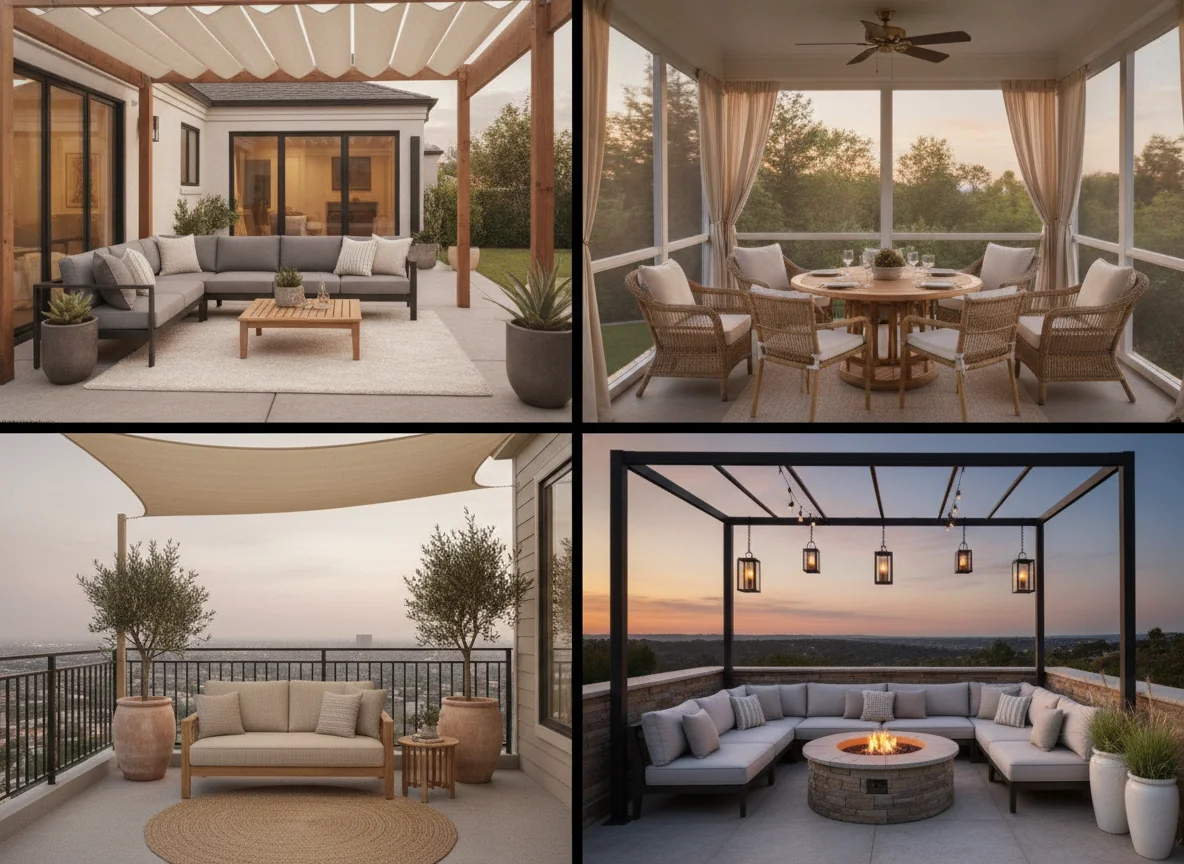
| Priority | Element | What it does | Outdoor-specific spec | Budget range |
|---|---|---|---|---|
| 1 | Rug | Defines the zone; softens the floor visually | Wool-look polypropylene; 8x10 or 6x9 depending on footprint | $150–$400 |
| 2 | Seating anchor | Establishes the room’s primary use | Powder-coated aluminum frame; Sunbrella cushions; L-sectional or sofa | $1,500–$4,500 |
| 3 | Coffee table | Anchors the seating cluster visually | Teak or powder-coated steel; minimum 48 inches for a sectional | $400–$1,200 |
| 4 | Lighting | Draws the ceiling down; makes the room usable after dark | Three layers: overhead (string lights or pergola fixture), task (table lanterns), accent (uplighting on planters) | $100–$600 |
The rug goes first. An outdoor rug on a covered patio does the same thing it does indoors: it signals where the room is. Without it, the seating cluster floats. Most covered patios can take an 8-by-10 rug under an L-sectional or a 6-by-9 under a straight sofa. The material is polypropylene with a wool look — it drains, doesn’t mildew, and costs a fraction of what a sisal rug would.
The seating anchor goes second. For an outdoor living room, the right anchor is not a dining table. It’s an L-shaped sectional or a deep sofa with enough depth — 36 inches minimum — to actually lounge. The frame should be powder-coated aluminum. The cushions should be solution-dyed acrylic (Sunbrella or similar). The foam should be quick-dry with a mesh core. You will spend more on this piece than on anything else in the room. Spend it correctly.
For indoor spaces with tight square-footage constraints, the best furniture for small apartments guide covers the scaling logic that also applies when an outdoor living room footprint is smaller than ideal.
Weatherproof material choices in AI renders
The single biggest difference between an AI outdoor living room render that’s usable and one that’s fantasy is whether the materials in the render are materials that survive outside. A render with a velvet sofa and a wool rug is a pretty picture. A render with a Sunbrella sectional and a polypropylene rug is a shopping plan.
The AI needs to be prompted with weather-conscious vocabulary. Here’s the material mapping that produces shoppable renders:
- Frames: “Powder-coated aluminum” reads as modern and clean. “Teak” reads as warm and classic. “All-weather wicker over aluminum” reads as traditional porch. “Rattan” reads as indoor and should not be used.
- Cushions: “Sunbrella” is the only fabric name that reliably maps to a weatherproof seat. “Polyester” will fade. “Cotton” will mildew. “Velvet” will ruin.
- Rugs: “Wool-look polypropylene” is the only reliable outdoor rug material. “Jute” reads well but breaks down in wet climates. “Sisal” breaks down faster.
- Tables: “Powder-coated steel” reads as modern and slim. “Teak” reads as substantial and warm. “Marble-top” works only when the room is covered — marble etches in rain.
- Accents: “Galvanized steel” gives industrial warmth. “Ceramic” gives Mediterranean warmth. “Wrought iron” gives traditional weight. “Plastic/resin” should not be prompted.
Specify the material before the piece. “A teak L-sectional in Sunbrella oatmeal” produces a tighter render than “an outdoor sectional.” The AI has more reference images for the specific combination.

For expanding the indoor color vocabulary that translates best to outdoor applications, our good living room paint colors guide covers the warm-neutral palette that anchors both indoor and outdoor living rooms.
Covered vs uncovered: what changes
The difference between a covered and an uncovered outdoor living room is not small. It changes the furniture spec, the flooring, the lighting, and the render itself.
Covered (pergola, porch roof, solid awning, three-season room). The material constraints are relaxed. A covered room can use teak without worrying about constant rain soak. It can use marble-top tables. It can use woven accents that wouldn’t survive full exposure. The lighting plan becomes more important because the overhead structure blocks ambient light from the sky. Pergola-mounted fixtures, hanging lanterns, and directional string lights are the standard solution. The AI render should specify the covering material explicitly: “cedar pergola with two cream canvas drop shades” produces a room that looks intentional rather than shaded.
Uncovered (open patio, deck, rooftop with no overhead structure). The material constraints are full-exposure. Everything must be rated for UV, rain, wind, and temperature swings. The “ceiling” is a cantilevered umbrella, a stretched shade sail, or nothing. If it’s nothing, the render should compensate with strong vertical planting — large urns, tall grasses, a trellis with climbing jasmine — to create the visual enclosure that a roof would provide structurally. An uncovered outdoor living room without strong verticals reads as furniture on a lawn.
The render that most first-time buyers need is the covered version. It produces higher-emotional-response images, and the material translation is closer to indoor buying habits. If your space is uncovered, prompt for the treated version anyway — the furniture spec and the vertical-planting layer are the same, just with a shade element overhead.
For the indoor design thinking that maps most directly to outdoor room decisions, the ai living room design page covers the style-selection workflow that transfers outside with a single material swap.
Matching outdoor sofas and sectionals
The purchase most people make first — and regret most often — is the outdoor sofa or sectional. It’s the largest piece, the most expensive single item, and the one most likely to look wrong in a render versus right on the porch. AI matching helps here because the render shows the piece in your actual footprint before you commit.
Three frame types produce the best match-to-render results. Powder-coated aluminum L-sectionals are the modern default: light enough to rearrange, heavy enough to hold position, rustproof in any climate. They render best in charcoal or dark bronze. Teak sofa sets are the premium option: heavier, warmer, requiring a sealed surface underneath to prevent the teak from staining pavers. They render best in natural or honey finish. All-weather wicker over aluminum is the most forgiving for traditional porch aesthetics but reads as less intentional in modern renders — specify it only when the house style is explicitly traditional.
Cushion depth matters more than most buyers realize. Outdoor sofas and sectionals with less than 34 inches of seat depth produce seated renders but not lounging renders. Deep seating — 36 to 40 inches — changes the room from “a place to sit” to “a place to be.” Every render should specify deep seating if the room is intended as a living room rather than a conversation area.
The anchoring logic is the same as indoors: if the room is built around a sectional, the coffee table should be 48 inches minimum to scale with the sectional’s length. If the room is built around a straight sofa, the coffee table can be 40 to 44 inches. The rug extends 12 to 18 inches past the front edge of the sofa on all three exposed sides — the same rule that applies indoors.
| Seating type | Best for | Footprint needed | Depth (seat) | Price range |
|---|---|---|---|---|
| L-sectional (aluminum) | Modern outdoor rooms | 10x12 ft min | 36–38 in | $2,500–$5,000 |
| Deep sofa (teak) | Traditional / classic | 8x10 ft min | 34–36 in | $2,000–$4,000 |
| Wicker over aluminum | Traditional porch | 9x11 ft min | 34–36 in | $1,800–$3,500 |
| Modular sectional | Custom layouts | 12x14 ft min | 36–40 in | $3,500–$6,500 |
| Daybed / lounger | Single-purpose | 6x8 ft min | 38–40 in | $1,200–$2,500 |
For reliable long-term durability research on specific outdoor brands, frame materials, and cushion warranties, Wirecutter’s outdoor furniture guide is the most thorough independent resource, and the American Society of Landscape Architects’ residential project gallery provides professional-grade context for how outdoor rooms integrate with the surrounding landscape.
FAQ
Can AI outdoor living room design work with any covered space?
Yes — the AI adapts to the footprint regardless of the existing covering. The key prompt input is the covering type itself: a pergola, a porch roof, a metal awning, a shade sail, or a screened enclosure. Each one changes the lighting, the vertical enclosure, and the appropriate furniture materials. Specify the covering explicitly in the prompt for the best-adapted render.
What’s the minimum size for an AI outdoor living room design?
About 100 square feet. Below that threshold the room compresses into a seating arrangement that looks more like “two chairs and a side table” than a living room. If your covered space is smaller, it’s still worth generating a render — the AI might show you that a daybed or a built-in bench reads more like a room than a sofa-and-coffee-table combo.
How do I prompt AI for weather-resistant materials specifically?
Include the material vocabulary in every prompt. Replace “L-shaped sectional” with “powder-coated aluminum L-sectional in Sunbrella oatmeal.” Replace “round coffee table” with “teak round coffee table.” Replace “rug” with “8-by-10 wool-look polypropylene outdoor rug.” The model has more reference images for the specific material than it does for an underspecified room, and it returns a tighter, more accurate render as a result.
Should I generate renders for covered and uncovered versions?
Yes — generating both is the single best use of two credits in an outdoor project. The covered render shows the highest-potential use of the space. The uncovered render shows what you’d need to add (shade, vertical planting, stronger material specs) to close the gap. Most people discover they’d rather invest in the shade solution than compromise on the room itself.
Can I match outdoor furniture from a render to real products?
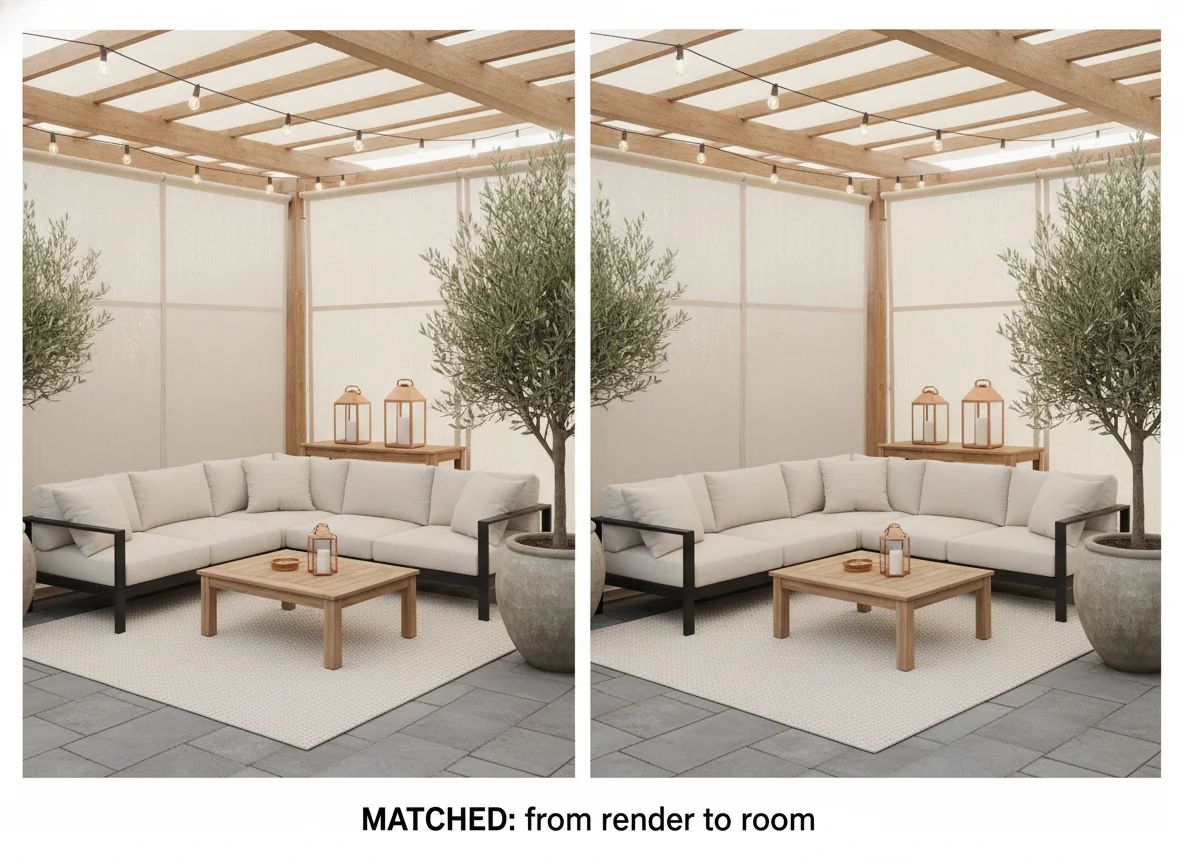
Yes — this is the step that turns the render into a purchasing plan. AI room design tools that include furniture matching, RoomGenius included, surface real outdoor products that approximate each rendered piece. The matching pass covers the sectional, the accent chairs, the coffee table, the rug, and the lighting — enough to build a complete room checklist.
Design an outdoor living room you’ll actually use all summer.
The covered patio doesn’t need to stay a holding zone for a folding chair and a grill cover. Treat it like a room — rug, sectional, coffee table, lighting, plants — and it becomes one of the most-used spaces in the house. The AI render is the fastest way to see that room before you spend on it.
RoomGenius is the AI room design app that treats indoor and outdoor spaces with the same material intelligence. It renders covered patios, porches, decks, and balconies as real living rooms — with outdoor-rated furniture, weatherproof materials, and a product-matching layer that turns each rendered piece into something you can actually buy. The free tier covers your first few rooms. Try it on the App Store or Google Play. Snap your patio, pick a style, design the outdoor room you’ll actually use all summer.