AI Mediterranean Interior Design: Warm, Earthy Rooms from a Photo
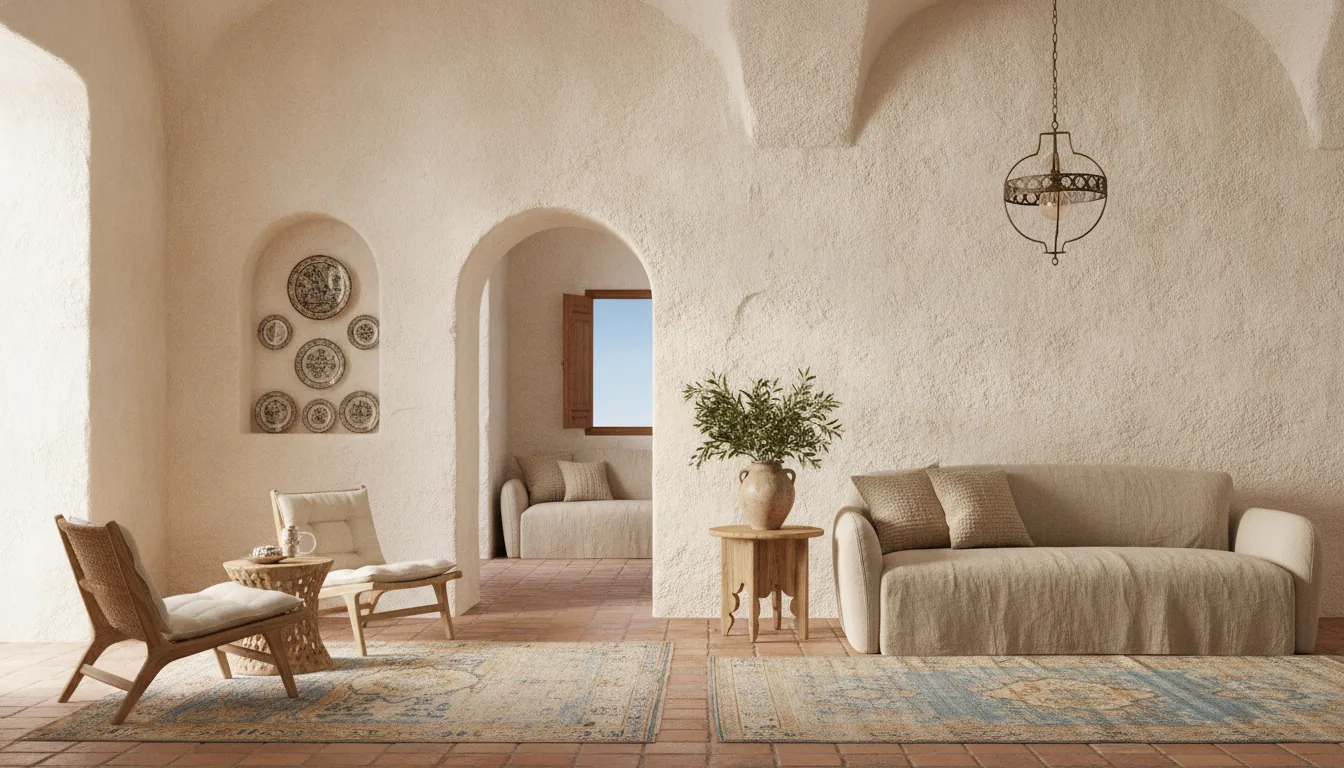
Mediterranean style is the one almost everyone recognizes the moment they walk into it — warm plaster walls, an arched doorway, terracotta underfoot, the smell of a space that feels sun-soaked even on a grey day — and the one almost nobody can describe well enough to brief a designer on. It sits in a crowded neighborhood of warm, earthy, old-world looks that bleed into each other: Moroccan, Tuscan, Spanish revival, coastal Greek. AI Mediterranean interior design is the fastest way to cut through that confusion: render your own room in the style from a single phone photo, see exactly which version of “Mediterranean” you actually mean, and decide on the plaster, the tile, and the arched furniture before any of it is ordered.
This guide is the working tour — what defines the style, how it differs from its close cousins, why AI is unexpectedly good at warm textural rooms, the material kit that does the heavy lifting, the room-by-room moves, the furniture categories that turn a render into a buying plan, and the questions people actually ask before they commit.
What is AI Mediterranean interior design? AI Mediterranean interior design is the use of an AI room-rendering tool to transform a photo of an existing room into a Mediterranean-style version — warm, earthy, textural, and sun-washed. The render keeps the room’s architecture and replaces the finish-and-decor layer with the style’s hallmarks: hand-troweled plaster or limewash walls in cream and warm white, terracotta or natural-stone flooring, arched openings and niches, wrought-iron and carved-wood details, woven rattan and rush, and a palette pulled from the coastline — terracotta, ochre, olive, sand, and sea blue. AI helps here specifically because Mediterranean style lives in texture and light rather than in any single statement piece, and texture is exactly what’s hardest to picture from a moodboard but easy to read in a photoreal render.
What Mediterranean interior design actually is
Strip away the Pinterest gloss and Mediterranean design is a regional vernacular, not a trend. It’s the shared building language of the warm-climate countries ringing one sea — Spain, southern France, Italy, Greece, coastal North Africa — where the same problems (heat, strong sun, local clay and stone) produced the same solutions for centuries. Thick masonry walls finished in lime plaster to stay cool. Small deep-set windows and shaded arcades. Floors of fired terracotta or quarried stone. Iron where wood would warp, rush and rattan where upholstery would bake. The look we now sell as a “style” is really a set of climate-driven choices that happen to read as deeply warm and restful.
That origin is why the style feels coherent even when it’s eclectic. Every material has a reason to be there, and every reason is the same one: durability and comfort in a hot, bright place. The palette comes straight from the landscape — the terracotta of roof tiles and pots, the ochre of dry hills, the olive of the trees, the bleached sand and whitewash of coastal towns, and the single hit of saturated blue from the sea and sky. You’re not decorating a room so much as bringing the outdoors of a specific region indoors.
The emotional target is ease. Where some styles aim to impress, Mediterranean aims to slow you down — heavy textures, rounded edges, low warm light, and surfaces that look better as they age. Patina is a feature. A plaster wall with a slightly uneven trowel finish, a terracotta floor worn smooth at the doorway, a wood table with a few dents — these aren’t flaws to design around, they’re the entire point.
Mediterranean vs Moroccan vs Tuscan vs Spanish
The single most useful thing AI does for this style is show you the differences between four looks that share a gene pool. They overlap heavily — same warm palette, same plaster, same arches — but each leans a distinct direction, and getting the wrong one is the most common way a “Mediterranean” room ends up feeling like a theme restaurant.
Mediterranean (broad/coastal) is the relaxed, sun-bleached parent style: airy, light-dominant, cream plaster, terracotta and blue, lots of negative space and natural light. Think Greek-island calm and southern-French ease.
Moroccan is the most ornate and saturated of the four — zellige tile, carved screens, brass lanterns, deep jewel tones, layered patterned textiles, and far more pattern density. It’s Mediterranean turned up and pushed toward the exotic. Our Moroccan-style living room guide is the sibling to this post; if your render is coming back heavy on patterned tile and brass lanterns, what you actually want is Moroccan, and that guide will serve you better.
Tuscan is the heaviest and most rustic — darker woods, ochre and burnt-sienna walls, wrought iron, grape-and-vineyard cues, and a more enclosed, old-farmhouse feel. It reads warmer and dimmer than coastal Mediterranean.
Spanish revival is the most architectural — red clay roof tiles, dramatic arches, dark carved wood, hand-painted talavera tile, and a heavier, more formal hand. It leans hacienda rather than beach house.
| Style | Palette | Signature materials | Mood | Pattern level |
|---|---|---|---|---|
| Mediterranean (coastal) | Cream, terracotta, olive, sea blue | Lime plaster, terracotta tile, rattan | Airy, sun-bleached, restful | Low |
| Moroccan | Jewel tones, saffron, indigo | Zellige tile, brass, carved wood | Ornate, layered, exotic | High |
| Tuscan | Ochre, sienna, deep wood | Wrought iron, heavy timber, stone | Rustic, enclosed, warm | Low–medium |
| Spanish revival | Terracotta, deep red, black iron | Clay roof tile, talavera, carved wood | Architectural, formal, hacienda | Medium |
The practical takeaway: tell the AI which one you mean. “Mediterranean” alone often returns a muddle of all four. “Coastal Greek Mediterranean, cream limewash, minimal pattern, lots of light” returns the airy version; “Spanish revival Mediterranean, talavera tile, dark carved wood, dramatic arches” returns the formal one. For the wider family tree, our different types of home interior design styles guide places all four in context alongside their neighbors.
Why AI renders earthy, textural styles well
Diffusion models have an uneven reputation across design styles, but warm textural styles like Mediterranean are squarely in their strong zone — for three concrete reasons.
First, the render makes texture legible in a way a moodboard never can. Mediterranean has almost no signature object — there’s no equivalent of the maximalist gallery wall or the mid-century sofa that signals the style at a glance. What signals it is texture and light: the trowel marks in the plaster, the slight irregularity of a handmade tile, the way warm directional sun rakes across a rough wall. Those are exactly the things you cannot picture from a flat swatch but immediately read in a photoreal render. The model is, in effect, showing you the lighting and the surface finish — the two variables that decide whether the room reads as “warm and alive” or “beige and flat.”
Second, the style is forgiving of the model’s instincts. AI room tools default toward warm, softly lit, slightly idealized interiors — which is a problem for styles that need hard edges and cool restraint, but a gift for Mediterranean, which wants exactly that warm, sun-washed, lived-in quality. You’re working with the model’s bias instead of fighting it.
Third, the palette is tight and recurring, which is the single biggest predictor of a clean render. A five-color earthy palette that repeats across walls, floor, textiles, and pottery gives the model a clear target and keeps the output coherent. The same logic drives our how to prompt AI interior design playbook: hand the model a disciplined palette and a clear material list, look at the output, and refine the prompt rather than re-rolling blindly.
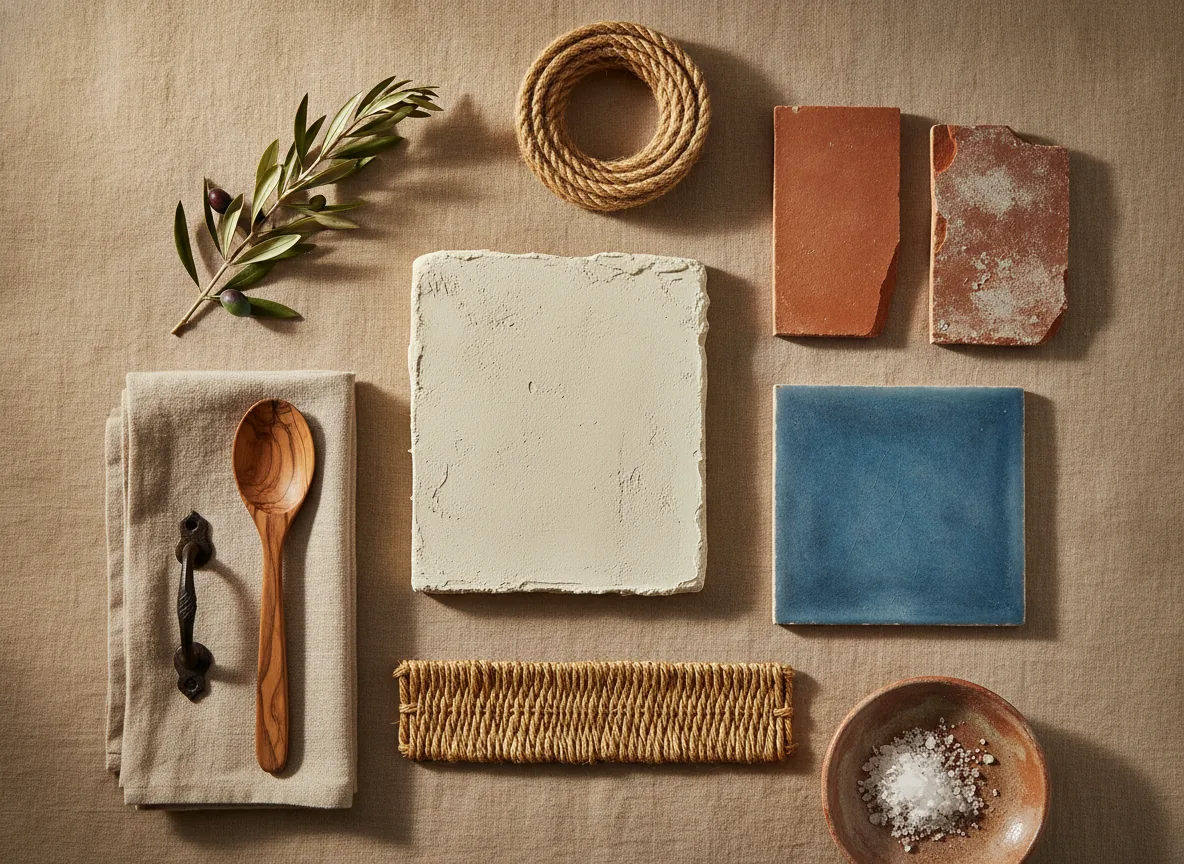
The material kit: terracotta, plaster, wrought iron, natural stone
Mediterranean rooms are built from a small, repeatable set of materials. Get these right and the style is most of the way there; get them wrong — glossy tile, flat paint instead of plaster, chrome instead of iron — and no amount of styling rescues it. Five materials carry the look.
Lime plaster and limewash walls are the foundation. The defining surface is hand-troweled plaster (Venetian plaster, tadelakt, or a simpler limewash) in cream, warm white, or the faintest blush or ochre. The slight tonal movement and trowel texture are what separate it from flat drywall paint — it catches light unevenly and looks softer at every hour. When you can’t replaster, a limewash paint over existing walls gets eighty percent of the effect for a fraction of the cost. For the warm neutrals that read as plaster, our good living room paint colors guide covers the creams, sands, and soft ochres that take this look best.
Terracotta and natural-stone flooring ground the room. Fired terracotta tile — in classic square, hexagon, or elongated plank — is the signature floor, ideally with the irregular tone and worn edges of a handmade or reclaimed lot. Travertine, limestone, and tumbled marble are the stone alternatives. The common thread is a matte, warm, slightly imperfect surface; polished porcelain reads instantly wrong.
Wrought iron is the metal. Forged black iron shows up in light fixtures, stair rails, window grilles, curtain rods, table bases, and hardware. It’s the dark structural accent that keeps an otherwise pale, soft room from going formless. Use it sparingly and let it draw the line work.
Natural wood, aged and carved. Olive, oak, walnut, and chestnut in chunky, slightly rustic forms — turned legs, carved detail, live edges, visible joinery. Wood here is warm and matte, never high-gloss.
Woven natural fiber. Rattan, rush, cane, jute, and seagrass appear as seating, pendant shades, rugs, and baskets. They add the airy, breathable texture that keeps the heavy plaster-and-stone base from feeling weighty.
The fabric layer sits on top: undyed and naturally dyed linen, cotton, and wool in oatmeal, sand, and faded indigo, with the occasional block-printed or striped accent. Together these materials are the entire vocabulary — every Mediterranean room is a recombination of the same handful.
Mediterranean by room
Each room has a few moves that decide whether it reads as authentically Mediterranean or as a generic warm-neutral space.
Living room. The hero surface is the wall — limewashed in warm cream with visible texture, ideally framing an arched doorway, niche, or window. The seating is low and relaxed: a slipcovered linen sofa in oatmeal with rounded arms, paired with a pair of rattan or rush lounge chairs. Floors are terracotta softened by a faded Turkish or kilim rug. A carved-wood or wrought-iron coffee table anchors the center; glazed terracotta urns with olive or eucalyptus branches sit in the corners. Light comes from a wrought-iron pendant and a couple of ceramic table lamps with linen shades — warm, low, and directional, never flat overhead.
Kitchen. The most transformative room for the style. Plaster or limewash walls, terracotta floors, and either a hand-glazed zellige-style backsplash in sea blue or a simpler limestone slab. Cabinetry is wood with a matte finish or plaster-fronted, paired with open shelving holding stacked ceramic ware. A farmhouse stone or fireclay sink, unlacquered brass or wrought-iron hardware, and a thick wood or honed-stone counter complete it. An arched range alcove is the signature architectural flourish if the layout allows.
Bedroom. Mediterranean dialed toward calm. Limewashed walls in cream or the softest ochre, a wood or wrought-iron bed frame, and bedding layered in undyed linen — oatmeal, sand, faded indigo. A jute rug underfoot, a carved-wood or rush bench at the foot, and ceramic table lamps with a warm glow. Keep the palette earthy and the textures natural and the room reads restful by default. The same outdoors-in logic drives our nature-themed bedroom ideas guide, which pairs naturally with this style.
Courtyard-style and transitional spaces. Mediterranean design barely distinguishes indoor from outdoor, so entryways, sunrooms, loggias, and covered patios are where it shines hardest. Terracotta or stone underfoot continues from inside, plaster walls carry through, and the furnishings are weather-tolerant: rattan and teak seating, wrought-iron café tables, glazed pots overflowing with olive, citrus, lavender, and rosemary, and a wall fountain or tiled niche as the focal point. A string of simple iron-and-glass lanterns finishes it. Of all four “rooms,” this is the one that most defines the style’s relaxed, indoor-outdoor soul.
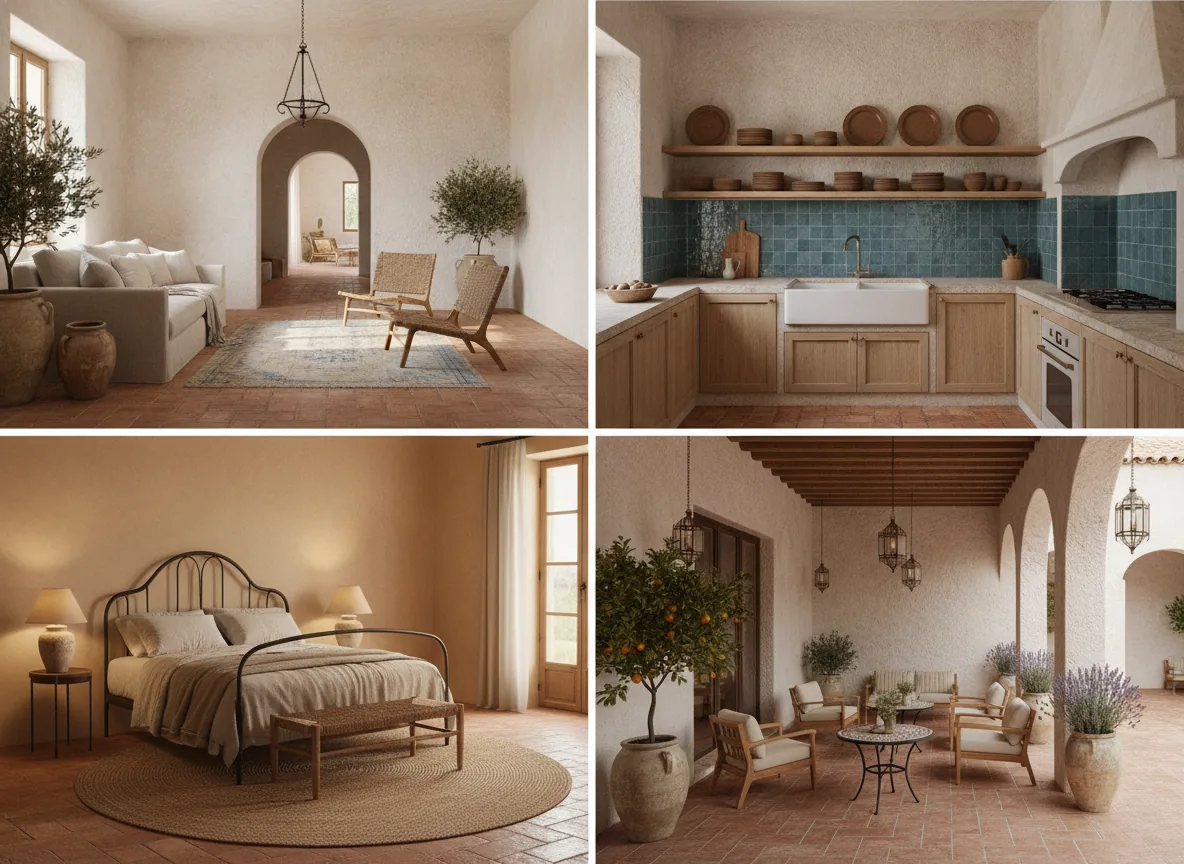
The through-line across all four: textured plaster or limewash walls, terracotta or natural-stone floors, arches and niches wherever the architecture allows, wrought iron as the dark structural line, warm aged wood, woven natural fiber for lightness, an earthy five-color palette anchored by terracotta and a single sea blue, and warm low directional light. Hold those constants and a Mediterranean home reads as one continuous, sun-soaked environment rather than a set of disconnected warm rooms.
Matching arched, organic furniture
A Mediterranean render is only as useful as the furniture and finishes you can actually buy to execute it. The style splits cleanly into three sourcing tiers.
The first is the architectural finishes, which are the highest-impact and the least swappable: the plaster or limewash on the walls, the terracotta or stone floor, the arched openings, the tiled backsplash. These are renovation-line items, not shopping-cart items, and they’re where the render earns its keep — seeing the room in finished plaster and terracotta before committing to a contractor is worth more than any single piece of furniture. Limewash paint and peel-and-stick terracotta-look tile are the budget routes when full materials aren’t in scope.
The second is the anchor furniture, organic and arched in form. Mediterranean furniture favors rounded, low, slightly weighty silhouettes — curved slipcovered sofas, arched-back rattan chairs, round pedestal tables, carved-wood consoles, and headboards with a gentle arch echoing the architecture. Slipcovered linen seating runs roughly $1,400–$3,800 mid-market; quality rattan and rush lounge chairs $400–$1,200 each; a solid carved-wood or stone-topped table $800–$2,500. Buy these new or vintage for silhouette and durability, and let the color stay in the neutral, earthy register.
The third is the textural and ceramic layer, accumulated widely. This is where the style comes alive and where the budget is small and the sourcing eclectic: glazed terracotta pots, hand-thrown ceramic ware, faded Turkish and kilim rugs from vintage dealers, linen textiles in oatmeal and indigo, woven baskets, wrought-iron lanterns, and olive branches in a simple vase. Per-piece costs are low ($20–$300), and mixing makers, markets, and vintage is what keeps the room from looking like a single catalog order. The render shows what the finished, layered room will look like; the actual collection accumulates over time.
For where Mediterranean sits among its warm-earthy neighbors, the different types of home interior design styles guide is the map, and the Moroccan-style living room post is the right next read if your taste runs more ornate and saturated. Outside the AI workflow, the Wikipedia overview of Mediterranean Revival architecture is a solid primer on the style’s structural roots, and Architectural Digest’s Mediterranean design coverage is the best mainstream source for current interpretations.
Common Mediterranean rendering mistakes
Flat paint instead of plaster. AI sometimes returns smooth, evenly painted walls, which kills the style. Specify “hand-troweled lime plaster, visible texture, warm uneven light.” Polished tile instead of matte terracotta. Glossy or modern porcelain reads instantly wrong; specify “matte fired terracotta, slightly irregular, worn edges.” Cold or grey neutrals. If you don’t anchor the palette, the model can drift toward grey-beige; add “warm earthy palette — terracotta, ochre, olive, cream, sea blue.” Too much pattern. Coastal Mediterranean is low-pattern; if the render comes back heavy on tile pattern and lanterns, you’ve drifted into Moroccan — either embrace it or specify “minimal pattern, airy, lots of negative space.” Chrome or brushed-nickel metal. Specify “forged wrought iron and unlacquered brass” to keep the metals warm. Flat overhead lighting. Mediterranean needs warm raking light; specify “warm low directional light, table lamps and iron sconces, no flat overhead.” No arches. The arch is the style’s architectural signature; if your room has none, ask for “an arched niche or doorway” where the layout allows.
FAQ
What’s the difference between Mediterranean and Moroccan interior design?
They share a palette and a love of plaster and arches, but Moroccan is far more ornate and saturated — zellige tile, carved screens, brass lanterns, jewel tones, and dense layered pattern — while coastal Mediterranean is airy, light-dominant, and low on pattern, built on cream plaster, terracotta, and a single sea blue. If your render keeps returning patterned tile and lanterns, you actually want Moroccan; our Moroccan-style living room guide covers it directly.
Can I get a Mediterranean look without renovating?
Yes, and it’s one of the more renter-friendly styles to fake. Limewash paint over existing walls delivers most of the plaster effect; peel-and-stick terracotta-look tile or large terracotta-toned rugs stand in for stone floors; and the textural layer — rattan seating, linen, glazed pots, kilim rugs, wrought-iron lanterns, olive branches — does the rest without touching the building. The render is useful here precisely because it shows whether the no-reno version reads as Mediterranean or falls short.
What colors define Mediterranean style?
A tight earthy palette pulled from the coastline: warm cream and whitewash for walls, terracotta and ochre as the dominant warm tones, olive green from the landscape, sandy neutrals, and a single saturated sea blue as the accent. Five to six colors that recur across walls, floor, textiles, and ceramics. Keep the neutrals warm — grey-based neutrals are the fastest way to lose the sun-baked feel.
Does AI Mediterranean design work for a whole house?
It works especially well whole-house, because the style is defined by continuous materials — the same plaster, the same terracotta, the same warm palette flowing room to room, with the indoor-outdoor boundary deliberately blurred. Render each room against one shared five-color palette and one material kit, and the home reads as a single coherent environment. That continuity is the whole point of the style.
How long does an AI Mediterranean render take from a phone photo?
Usually 30 to 90 seconds. Generate three to five variants per room and expect a keeper rate around half. Because the style lives in texture and light, the most productive tweaks are to the surface and lighting language — “more visible plaster texture,” “warmer raking light,” “more worn terracotta” — rather than re-rolling the whole prompt.
See your room reimagined with Mediterranean warmth
Mediterranean is the style people fall for in a single photo and then struggle to brief, because what makes it work isn’t an object you can point to — it’s texture, light, and a tight earthy palette, all of which are nearly impossible to picture from a swatch and instantly obvious in a finished room. That gap is exactly where AI earns its place. A phone photo and a clear prompt — “coastal Mediterranean, hand-troweled cream plaster, matte terracotta floor, wrought iron, rattan, warm sea-blue accent, minimal pattern” — returns a render that tells you which version of Mediterranean you actually want, and lets you settle the plaster, the tile, and the arched furniture before a contractor or a single pot is ordered.
RoomGenius is the AI room design app that handles Mediterranean natively, with the plaster textures, terracotta floors, arched detailing, and warm earthy palette built into how the style renders. The free tier covers your first few rooms, and the furniture-matching layer ties each rendered piece — the linen sofa, the rattan chair, the wrought-iron pendant, the glazed urn — to something you can actually order. Try it on the App Store or Google Play. See your room reimagined with Mediterranean warmth.