AI Maximalist Interior Design: More Is More, Made Manageable
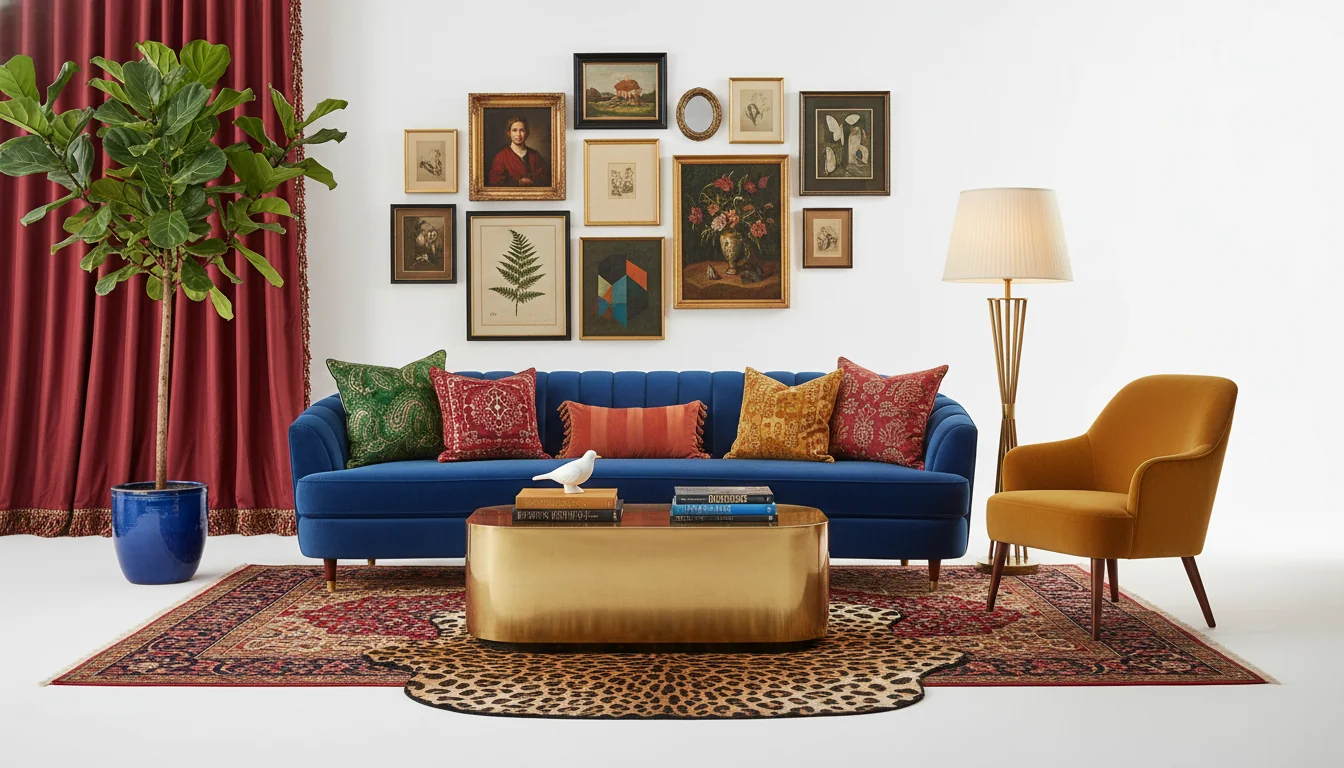
Maximalism is the style every confident decorator says they want and almost no one executes well. The line between curated maximalism and visual chaos is real, narrow, and easy to cross — and the reason most attempts fail isn’t taste, it’s that maximalism has to be edited as you build it, not after. AI maximalist interior design is the missing rehearsal step: a way to see your own room rendered in full, layered, pattern-mixed maximalism from a single phone photo, decide whether the density holds together, and refine it before any of the furniture, art, or rugs are actually bought.
This guide is the working tour — what separates maximalism from clutter, why AI is unexpectedly useful here, how to handle pattern mixing and gallery walls and color drenching, the room-by-room moves, the palette logic underneath, and the furniture and art categories that turn a render into a buying plan.
What is AI maximalist interior design? AI maximalist interior design is the use of an AI room-rendering tool to transform a photo of an existing room into a maximalist version — densely layered, pattern-rich, color-saturated, art-heavy, and intentionally unrestrained. The render preserves the room’s architecture and replaces the decor layer with maximalism’s hallmarks: deeply pigmented walls (often color-drenched), three to five mixed patterns, a salon-style gallery wall, layered rugs, abundant textiles, statement furniture in saturated upholstery, dense bookshelf styling, plants, and warm directional lighting. AI helps maximalism specifically because the style’s failure mode is clutter, and seeing the room rendered in advance is the fastest way to catch density that has tipped past intentional into noisy.
Maximalism vs clutter — the real difference
The most useful sentence about maximalism is Iris Apfel’s: “More is more, and less is a bore.” The most useful second sentence, which almost no one quotes: every object in a maximalist room is there because the designer chose to keep it. Maximalism is not the absence of editing — it’s the presence of dense, deliberate editing applied to a high object count.
That distinction is the entire game. A cluttered room is accumulation without curation: pieces that arrived through inertia, no through-line of color, surfaces that hold whatever landed there last. A maximalist room is accumulation plus curation: every object earns its display, the palette is coherent across thirty pieces, patterns mix by rule, the gallery wall is composed, the rugs are layered intentionally, and the room reads as one designed environment rather than a yard sale.
Four diagnostics separate the two. Palette discipline — a cluttered room has 12 colors and no anchor; a maximalist room has 4–6 that recur across walls, upholstery, rug, and art. Pattern rules — clutter mixes whatever was bought; maximalism mixes by scale and family (one large, one medium, one small; rarely three of the same family). Surface composition — cluttered surfaces are catch-alls; maximalist surfaces are still-lifes grouped by height, material, and color. Negative space — cluttered rooms have no rest points; maximalist rooms, paradoxically, do — one undecorated stretch of wall, one breath of solid color amid the pattern.
Our modern minimalist home decor guide is the opposite pole. The underlying discipline is closer than it looks: both styles fail in the absence of editing — minimalism into sterility, maximalism into clutter — and both rely on the same skill applied to opposite ends of the object-count spectrum.
Why AI helps maximalism stay curated
Diffusion models have a reputation for struggling with maximalism, and there’s truth to it. Highly idiosyncratic collector maximalism — rooms built around one person’s specific obsessions — resists AI rendering because the model can’t access the personal narrative that holds the collection together. But most people aren’t asking for that. They’re asking for the much more tractable problem of layered, pattern-rich, color-saturated rooms that feel intentional — and on that problem, AI is genuinely useful, in three specific ways.
First, the render makes density visible before the density is committed. You can imagine a minimalist room in your head — three pieces, white walls, done. You cannot imagine a maximalist room with four patterns, a gallery wall, layered rugs, color-drenched walls, and twenty-five styled objects on a bookshelf, because working memory can’t hold that many variables at once. The render holds them for you. Generate the room, look at it, and you immediately see whether the density is curated or noisy.
Second, the render reveals palette failures fast. Maximalism’s most common failure mode is that the color count expanded faster than the color discipline. A real maximalist room is built on four to six colors that recur, and every new object slots into that palette. Without the render, designers add a “great find” piece in a seventh color and only realize at install that it broke the system. With the render, the seventh color shows up before purchase.
Third, the render gives you the gallery wall in five minutes. Laying out twenty-seven framed pieces on the floor with brown paper templates is real work. The AI does the rough composition in seconds, and even if you change every frame later, the layout grammar — what hangs where, how the negative space breaks, where the visual weight lands — is now visible and editable. Same logic as our how to prompt AI interior design playbook: hand the model the dense problem, look at its output, refine.
Pattern mixing, gallery walls, and color drenching
Three execution skills account for most of the gap between an aspirational maximalist room and one that actually lands. Each has rules. The rules are simpler than they look.
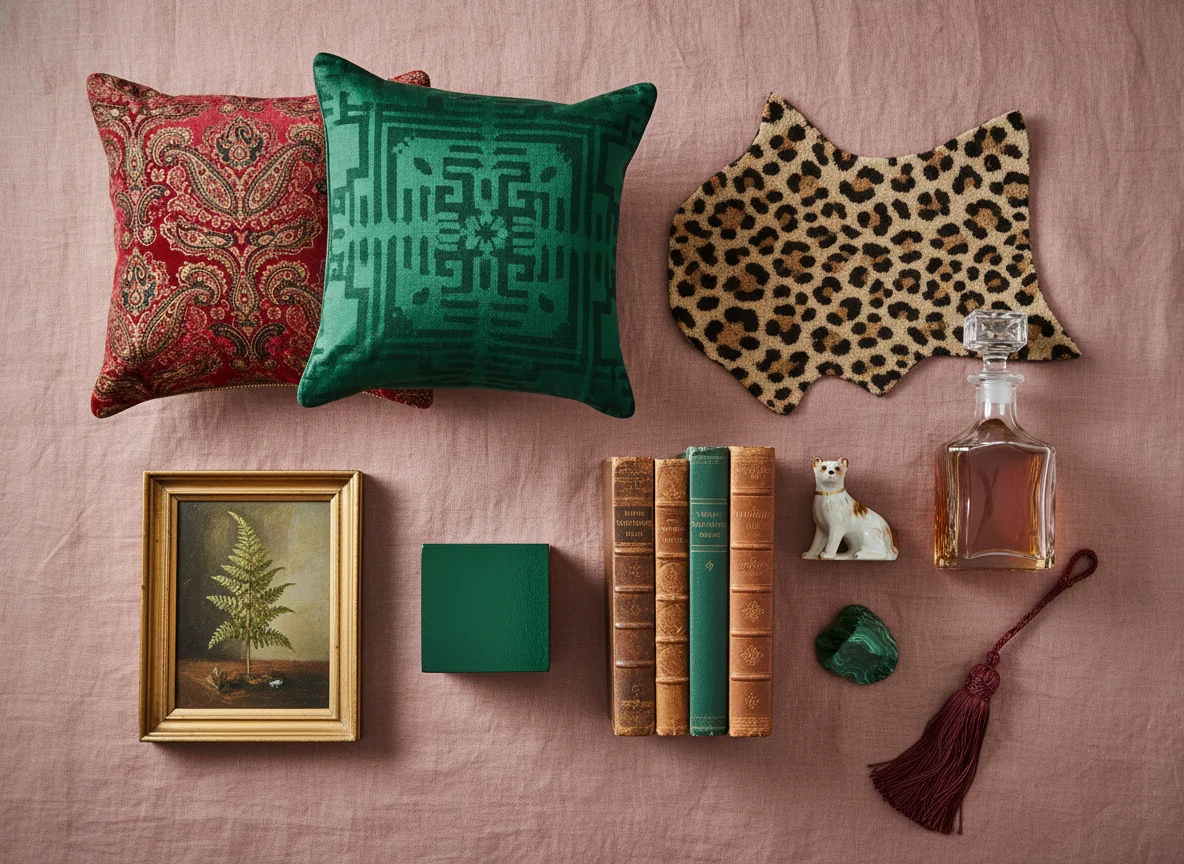
Pattern mixing. One rule resolves 80 percent of pattern questions: vary the scale and limit the family count. Three patterns in a room should be one large-scale (a bold floral on drapery), one medium-scale (a paisley pillow), and one small-scale (a ditsy print on a lampshade). Family-wise, two patterns from related families — say, two florals — read as a duo; three from different families read as a trio; four or more in unrelated families starts to read as competition. Color discipline holds the stack together: every pattern shares at least two colors from the room’s master palette.
Gallery walls. The salon-style hang — frames stacked floor-to-ceiling in mixed sizes — is maximalism’s signature wall move and the easiest to botch. Three rules. First, frame palette: pick two or three frame finishes (gilt, black, walnut) and repeat them; mixing six finishes reads as garage-sale. Second, visual weight: the heaviest pieces (largest frame, darkest art) go in the bottom third, with weight tapering up. Third, negative-space rhythm: keep frame-to-frame gaps tight (1.5–2.5 inches), but allow one or two slightly wider gaps as visual breaths. Mathematically identical gaps read as a grid; random gaps read as chaos; tight gaps with one or two intentional breaths read as composed.
Color drenching. The newest of the three skills and the highest-return single decision. Color drenching means painting walls, trim, ceiling, and sometimes built-ins all the same saturated color — emerald, oxblood, deep ochre, midnight blue — eliminating the visual interruption of contrasting trim. The result is a saturated container that lets patterns, art, and upholstery layer against a coherent backdrop instead of fighting white trim for attention. Most-overlooked tip: drench the ceiling in addition to the walls; a white ceiling above a saturated wall undoes half the effect. For the underlying logic on palettes that take saturation well, our decorating color schemes guide covers the schemes that work hardest in maximalism.
Maximalism by room
Each room has a tight set of moves that decide whether the maximalism reads as confident or as costume.
Living room. The style’s signature stage. Walls are color-drenched in a saturated jewel tone — emerald, oxblood, deep navy — including trim and ceiling. The hero piece is a curved or tufted velvet sofa, layered with four to six pillows mixing scale and family (one large paisley, one medium block-print, one small stripe, plus a fringed bolster). The floor is layered rugs — a large Persian-style base with a smaller animal-print or geometric overlapping at the seating area. A salon-style gallery wall runs above the sofa or fills one full wall, mixing oil portraits, botanicals, abstract prints, mirrors, and objects in gilt and black frames. Brass and gilt accents recur: a brass coffee table piled with art books, a gilt floor lamp, brass picture frames. Plants — a fiddle-leaf fig, a fern, a trailing pothos — soften the saturation.
Bedroom. Maximalism dialed one notch quieter — the eye needs somewhere to rest at night. The wall behind the bed is the dramatic surface, either papered in a small-scale floral or paisley, or color-drenched in a deep dusty tone (oxblood, sage, midnight). The bed itself is upholstered in a tone-on-tone velvet, dressed in mixed-scale prints: large-scale duvet, medium-scale pillows, small-scale ditsy throw. Bedside lamps are sculptural — gilt or ceramic, with fringed or pleated silk shades. Nightstands are skirted or vintage wood, stacked with books and a single objet.
Hallway. Maximalism’s secret best room. Hallways are short use-windows — you pass through, you don’t dwell — which means they can carry density that would exhaust you in a living room. Color-drench floor to ceiling (oxblood, peacock, deep teal). Hang a tight gallery wall along the full length: vintage portraits, botanical prints, small mirrors, decorative plates, framed silk scarves. Add a runner in a Persian or kilim pattern. Light it with two or three brass picture lights or sconces, never overhead. The hallway turns a transitional space into one of the home’s most photographed rooms, with no flooring or furniture investment required.
Dining room. Second-best room to commit to full maximalism — you sit at the table for ninety minutes at a time, faces toward each other, walls in peripheral vision. Color-drench in a deep saturated tone (emerald, oxblood, plum). One wall gets a salon-style gallery; the opposite wall gets a single oversized statement piece — a tapestry, large oil portrait, antique mirror. Chairs in mixed upholstery: four matching tone-on-tone velvet, two contrasting accent chairs at the heads. A fringed silk pendant or a clustered chandelier hangs low.
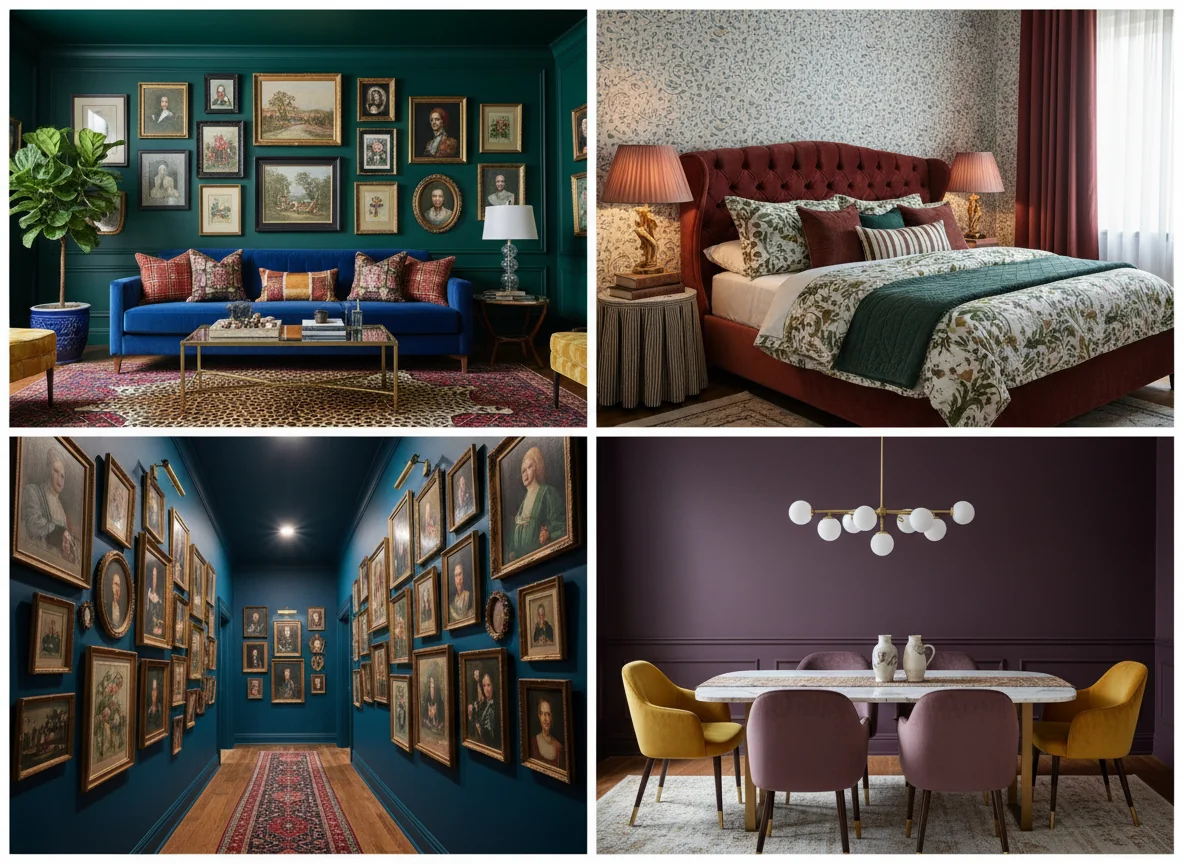
The through-line across all four rooms: color-drenched walls including trim and ceiling, one master palette of four to six colors recurring everywhere, three patterns mixed by scale, layered rugs, a gallery wall or oversized statement piece, brass-and-gilt as the dominant warm metal, fringed or heavy textile drapery, plants for softening, and warm directional light. Hold those constants and a maximalist home reads as one continuous designed environment rather than a series of moods.
Building a cohesive maximalist palette
The single biggest predictor of whether maximalism lands is the palette. Three palette logics dominate the style; pick one and let it govern every purchase.
Jewel-tone-on-jewel-tone. Emerald walls, sapphire sofa, ruby velvet pillow, ochre accent chair, brass and gilt throughout. The densest, most-photographed maximalist palette and the most likely to fail without discipline. Works in entertaining rooms (living, dining, hallway), best with strong directional light. Six-color cap; hit a seventh, displace.
Earthy maximalism. Terracotta, ochre, deep olive, oxblood, cream, walnut, brass. The palette that has dominated 2024–2026 maximalism on Instagram. Warmer, more livable, more forgiving of mixed pattern because the tones share a warm-saturated register. Excellent for whole-house consistency. The lowest-risk palette to commit to.
Dark-and-jewel. Black or near-black walls (a real maximalist move — see Abigail Ahern’s whole career) with jewel tones as accents: emerald velvet, ruby silk, brass throughout. The most graphic and architectural maximalist palette, and the one that photographs most dramatically. Best in rooms with strong natural light during the day so the dark walls don’t make the space feel cave-like.
| Palette | Mood | Best rooms | Risk | Photographs as |
|---|---|---|---|---|
| Jewel-on-jewel | Theatrical, dense | Living, dining, hallway | High | Cinematic |
| Earthy maximalism | Warm, livable | Whole-house safe | Medium-low | Magazine editorial |
| Dark-and-jewel | Graphic, architectural | Single-room statement | Medium-high | Atmospheric, moody |
The mistake people make is sampling one room from each palette across the house — emerald living, terracotta bedroom, black-walled dining. The rooms read as unrelated because the master palette never persists. Pick one palette, let it govern every room, and let the moves within each room vary instead. The home reads as one designed environment rather than three.
Matching bold furniture and art
A maximalist render is only as useful as the furniture, rugs, and art you can actually buy to execute it. The style splits cleanly into three sourcing tiers.
The first is statement upholstery, bought new. The sofa and the largest upholstered chair are the room’s anchors and should be sourced new to get fabric, scale, and durability right. Saturated velvet sofas (channel-tufted, button-tufted, or curved) run $1,800–$4,500 mid-market. The pattern budget is spent on pillows, drapery, and rug instead — the upholstery’s job is saturated color in a confident silhouette.
The second is pattern textiles, sourced widely. Pillows, drapery, throws, runners, and small upholstered items (ottomans, bench cushions) are where the pattern lives. Mix retailers, makers, and vintage to keep the palette from going homogeneous — block-print pillows from artisan retailers, fringed silk drapery from heritage houses, kilim ottomans from vintage dealers. Per-piece budget runs $80–$400; you’ll want fifteen to thirty pieces across a maximalist living room.
The third is art and objects, accumulated over time. Maximalism’s gallery walls and styled surfaces are slow-built — vintage oil portraits from estate sales, botanical prints from flea markets, framed silk scarves from travel, plates from grandmother’s cabinet. The render shows what the wall will look like with twenty-seven framed pieces; the actual collection accumulates. Budget for picture framing ($80–$200 per frame at a pro framer) and don’t try to fill the gallery wall in a single shopping trip.
For a fuller view of where maximalism sits alongside its style neighbors — boho, eclectic, Art Deco, English country — our different types of home interior design styles guide places it in context, and our easy home decor ideas post is useful for the lower-cost individual moves that build a maximalist look gradually rather than all at once. Outside the AI workflow, the Architectural Digest primer on maximalism is the best mainstream contemporary read, and House Beautiful’s color drenching coverage is the standard reference on the technique.
Common maximalist rendering mistakes
Too many unrelated patterns. Default “maximalist” prompts sometimes return six patterns from six different families — costume territory. Specify “three patterns mixed by scale, two from related families.” White trim against saturated walls. AI defaults to white trim; in color-drenched rooms it breaks the effect. Specify “trim and ceiling painted same color as walls, full color drenching.” Sparse gallery wall. AI sometimes hangs four pieces and calls it a gallery. Specify “dense salon-style gallery, 15–30 pieces, mixed sizes, gilt and black frames, tight 1.5–2.5 inch gaps.” Flat overhead lighting. Maximalism needs warm directional light from lamps, sconces, and low pendants. Specify “warm directional lighting, lamps and sconces, no overhead.” Beige creep. If the prompt doesn’t specify saturation, the model defaults to washed-out tones. Add “saturated jewel tones” or “deep earthy tones” explicitly. No negative space. Counter-intuitively, maximalist rooms need one or two visual rest points; specify “one undecorated stretch of wall as visual breath.”
FAQ
Is maximalism just clutter rebranded?
No, and the distinction is the entire skill. Clutter is accumulation without curation — objects that arrived through inertia, no palette discipline, surfaces as catch-alls. Maximalism is accumulation with curation — every object earns its display, the palette is tight, patterns mix by rule, surfaces are composed still-lifes. The two looks have similar object counts and entirely different visual logic. A render is the fastest way to test which one your version is heading toward.
What rooms is AI maximalist design worst at?
Heavily idiosyncratic collector maximalism — rooms built around one person’s specific obsessions like vintage cameras or sixteenth-century maps — resists AI rendering because the model can’t access the collection. If you’re aiming for that, use the render for the base layer — walls, upholstery, rugs, lighting — and overlay your actual collection on top in real life.
Can maximalism work in a small apartment?
Yes, and arguably better than in a large house. Density compounds in small rooms — the saturated paint, the gallery walls, the pattern stack — and a small room dressed in full maximalism reads as a jewel box. The cap is floor space: small rooms can take dense walls but need clearer floor circulation. Layer the rugs, but keep a one-foot clear walking lane. Our how to decorate small spaces coverage applies — every move scales.
What’s a realistic budget for a full maximalist conversion?
At U.S. mid-market prices, $8,000–$20,000 for a maximalist living-and-dining conversion. Largest single cost is the velvet sofa ($2,000–$4,500); second is the rug layer ($800–$2,500); third is gallery-wall framing if you use a pro ($80–$200 per frame across 20–30 pieces). Paint is the lowest-cost, highest-impact line — $300–$600 for a color-drenched room including trim and ceiling.
How long does an AI maximalist render take from a phone photo?
Between 45 and 120 seconds — the high end of AI room rendering, because maximalism has more visual variables to resolve than minimalist styles. Generate four to six variants per room (one or two more than for a quieter style); keeper rate is usually 50 percent. Tweak the prompt for palette and pattern count rather than re-rolling blindly.
Generate a maximalist room that feels curated, not chaotic
Maximalism is the style most people admire and most people try and abandon, and the honest reason is that the density is impossible to hold in your head before it exists in front of you. The pattern stack, the palette, the gallery wall, the layered rugs, the styled surfaces — every one is a judgment that can only be made against the finished room, and the finished room costs real money and a weekend of labor to build. AI is the rehearsal step. A phone photo and a “full maximalism, three-pattern stack, color-drenched, salon gallery” prompt returns a render that tells you whether the density holds — and lets you refine it before any of the velvet, paint, or framing is ordered.
RoomGenius is the AI room design app that handles maximalism natively, with the pattern-mixing discipline, color-drenched walls, salon-style gallery walls, and layered textiles baked into how the style renders. The free tier covers your first few rooms, and the furniture-matching layer ties each rendered piece — velvet sofa, brass coffee table, patterned drapery, Persian rug — to something you can actually order. Try it on the App Store or Google Play. Generate a maximalist room that feels curated, not chaotic.