AI French Country Interior Design: Rustic Elegance, Generated
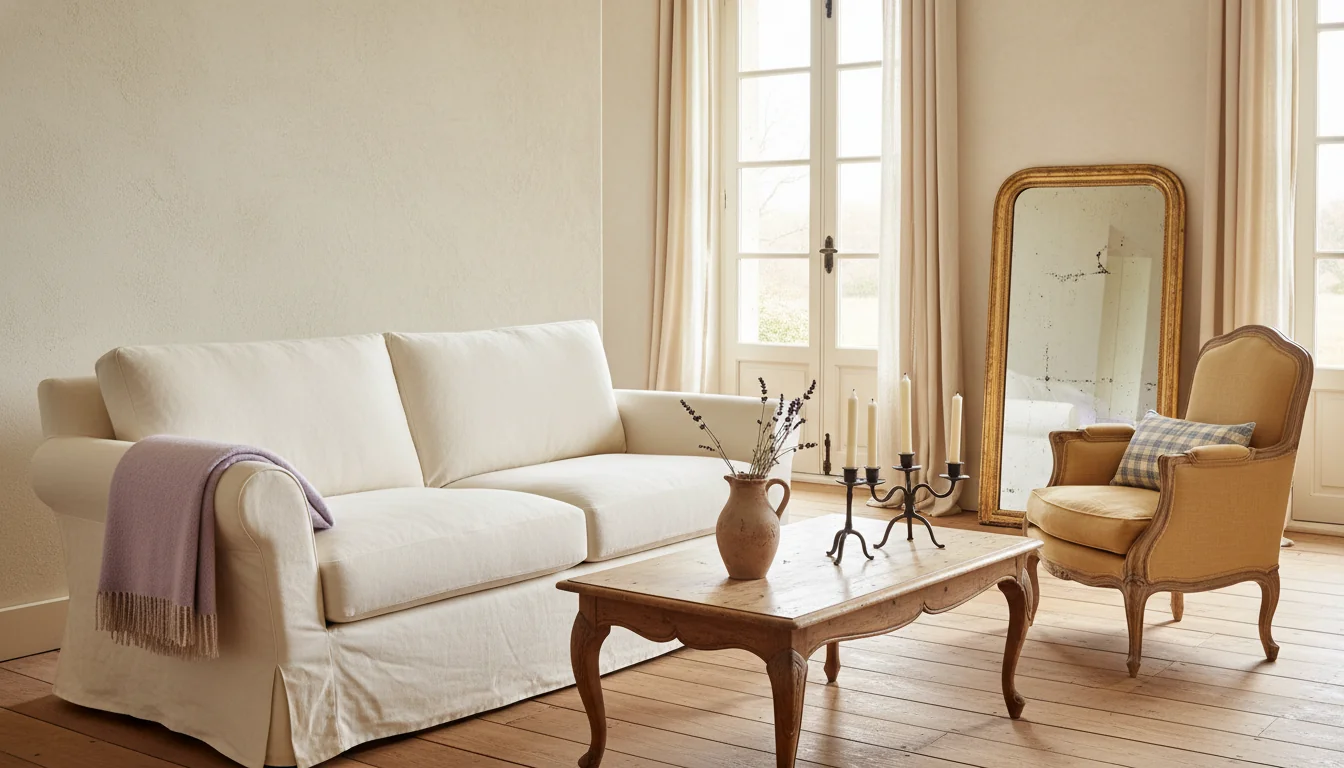
French country is the style that asks you to commit to fifty small decisions before the room reads right — the chalky lime-washed wall, the toile cushion, the distressed oak armoire, the wrought-iron sconce, the linen drape, the clay pitcher, the gilt mirror with the patina nobody is going to fake on purpose. Each piece is individually findable; sourcing forty at once is what stops most people from ever starting. AI French country interior design flips that problem on its head: the model proposes a coherent forty-element base layer in a single render, and the only thing left is to decide which three or four pieces to actually buy. The savings aren’t aesthetic — they’re logistical.
This guide is the working tour: what French country actually is, how it differs from modern farmhouse and pure Provençal, why detail-dense styles are where AI rendering becomes more than a novelty, the palette to internalize, the room-by-room moves that decide whether the render reads as French country or as costume, and the small handful of pieces that anchor the look.
What is AI French country interior design? AI French country interior design is the use of an AI room-rendering tool to transform a photo of an existing room into a French country–styled version — a rustic-but-refined aesthetic drawn from the rural homes of Provence, Normandy, and the Loire valley. The render preserves the room’s architecture (walls, windows, ceiling) and replaces the decor layer with French country hallmarks: limewashed cream and ochre walls; distressed and waxed-oak furniture; wrought-iron sconces, beds, and candelabra; toile de Jouy textiles in soft cornflower or faded sage; linen drapes; gilt-framed mirrors with honest patina; and a layered set of small objects — clay pitchers, dried lavender, hand-painted faïence — that together read as a home lived in for two centuries. AI handles French country well because it can resolve a dense vocabulary of small details in a single pass that a human shopper would otherwise spend months sourcing.
What French country style actually is
French country isn’t a single style so much as the rural domestic vernacular of a few regions of France, idealized through two centuries of literature and shelter magazines. Its hearth is Provence — lavender fields, limewashed stone farmhouses, sun-bleached shutters — but it borrows from Normandy’s heavier oak and the Loire’s more refined country-house tradition. What unites them is a working-home logic: rooms that function as kitchens and parlors at once, finished in materials that age into beauty rather than out of it.
The defining principle is earned patina. Floors are wide-plank oak walked on for a hundred years. Walls are lime-washed plaster settled into uneven warmth. Furniture has been re-painted, scuffed, refinished, and finally left alone. Nothing in a real French country room looks new, and a freshly distressed-on-purpose piece reads as a tell. The style asks you to either find the patina or generate it convincingly — which is where AI earns its keep.
The second principle is soft formality. There is always at least one piece that came from a town rather than a farm: a gilt-framed mirror, a crystal chandelier with a few missing prisms, a chair with cabriole legs. The interplay between rough-hewn (the table, the floor, the walls) and refined (the mirror, the porcelain, the chair) is what separates French country from generic countryside-rustic. Lose either pole and the room collapses.
The third principle is curated maximalism. Unlike Scandinavian or Japandi, French country is detail-dense. A shelf has six things on it, not one. The mantel carries a cluster of porcelain. The style trusts the eye to organize abundance — harder to pull off than restraint, but it produces a room that feels permanent in a way minimalist rooms rarely do.
For broader context on where French country sits among traditional styles, our different types of home interior design styles guide places it alongside English country, traditional, and colonial revival.
French country vs farmhouse vs Provençal
The three styles get conflated in every Pinterest board, and the conflation matters because the AI prompt you feed your room app will return three meaningfully different renders.
Modern farmhouse is American. Its roots are in the 19th-century American farmhouse and its 2010s revival was driven by the Fixer Upper aesthetic and a wave of shiplap. The palette is white, black, gray, and a single warm wood. Hardware is matte black. Furniture is angular. The mood is fresh and clean. There’s no real patina — distressing, when it appears, looks deliberately done.
French country is the regional cousin: rural domestic France, idealized. The palette is warmer (ochre, cream, soft lavender, faded blue), the materials older (waxed oak instead of painted pine), and the hardware antique (aged brass and wrought iron instead of matte black). Furniture is curved where farmhouse is straight — cabriole legs, bergère chairs, carved aprons. Patina is genuine and abundant.
Provençal is a tighter subset of French country, scoped to Provence in the south of France. The palette intensifies: deeper ochres, sun-bleached lavenders, terracotta, olive green. Wrought iron is everywhere. Provençal is what most Americans picture when they hear “French country,” but a Norman farmhouse with carved oak and a copper batterie de cuisine is equally French country. Provençal is sunnier; Norman is heavier; Loire is more refined.
| Axis | Modern Farmhouse | French Country | Provençal |
|---|---|---|---|
| Origin | 19th-c American farmhouse, 2010s revival | Rural France broadly | Specifically Provence |
| Wall color | Bright white, soft gray | Cream, warm white, soft ochre | Limewashed ochre, soft terracotta |
| Primary wood | Painted pine, light oak | Waxed oak, walnut, fruitwood | Distressed oak, olive wood |
| Hardware | Matte black | Aged brass, wrought iron | Heavy wrought iron |
| Furniture lines | Angular, chunky | Curved, carved cabriole | Carved, sometimes painted faded blue |
| Textiles | Cotton ticking, linen, plaid | Toile, faded linen, soft florals | Provençal print, faded ticking |
| Mood | Fresh, clean, cheerful | Warm, lived-in, earned patina | Sun-bleached, rustic, herb-garden |
| Lighting | Industrial pendants, simple fixtures | Crystal, wrought iron, gilt sconces | Wrought-iron chandeliers, candle sconces |
Knowing which of the three you actually want — before the first render — is the single most consequential decision in the whole workflow. The companion piece on colonial revival interior design covers the parallel American heritage style for anyone who finds themselves drawn to the formal end of the country-house lineage.
Why AI helps with detail-dense styles
Diffusion-based AI image models pay the biggest dividend when the style has a high object count. A minimalist render is easy for a human to source — eight things in the room, all findable at any furniture store. A French country render contains forty objects, half of which are second-hand or specifically sourced. The render itself is harder for the model than minimalism, but the human time it saves is enormous.
Three things in particular make AI a working tool for French country rather than a parlor trick.
Coherent ensembles. Each piece in a French country room has to relate to the others in tone, age, and material. Buy a beautiful gilt mirror and a beautiful distressed armoire from two different sources and they often won’t sit together. A single render proposes the full ensemble in one go — the gilt frame matches the tone of the chandelier prisms which matches the warm cream of the linen drapes which matches the ochre of the wall. The render doesn’t have to be perfect; it just has to give you a coherent target to shop against.
Patina rendering. Modern diffusion models render aged surfaces — chipped paint, oxidized brass, sun-faded fabric, scuffed oak — surprisingly well, because aged surfaces are over-represented in their training data. The same model that struggles with brand-new high-gloss lacquer will render a hundred-year-old waxed-oak armoire convincingly.
The detail floor. Below a certain density of objects, a traditional-style render starts to look like a hotel lobby’s interpretation of country. Hand-painting forty objects into a mood board is a non-starter for most people. The model does it in fifteen seconds — and even when results aren’t directly usable, they show you the density you’re aiming for so you can hunt actual pieces against that target.
The result is that the AI render isn’t a substitute for design judgment — it’s a brief. You take it to the flea market and the salvage yard and you stop buying things that don’t fit. For more on prompting strategy, the how to prompt AI interior design post is the working playbook.
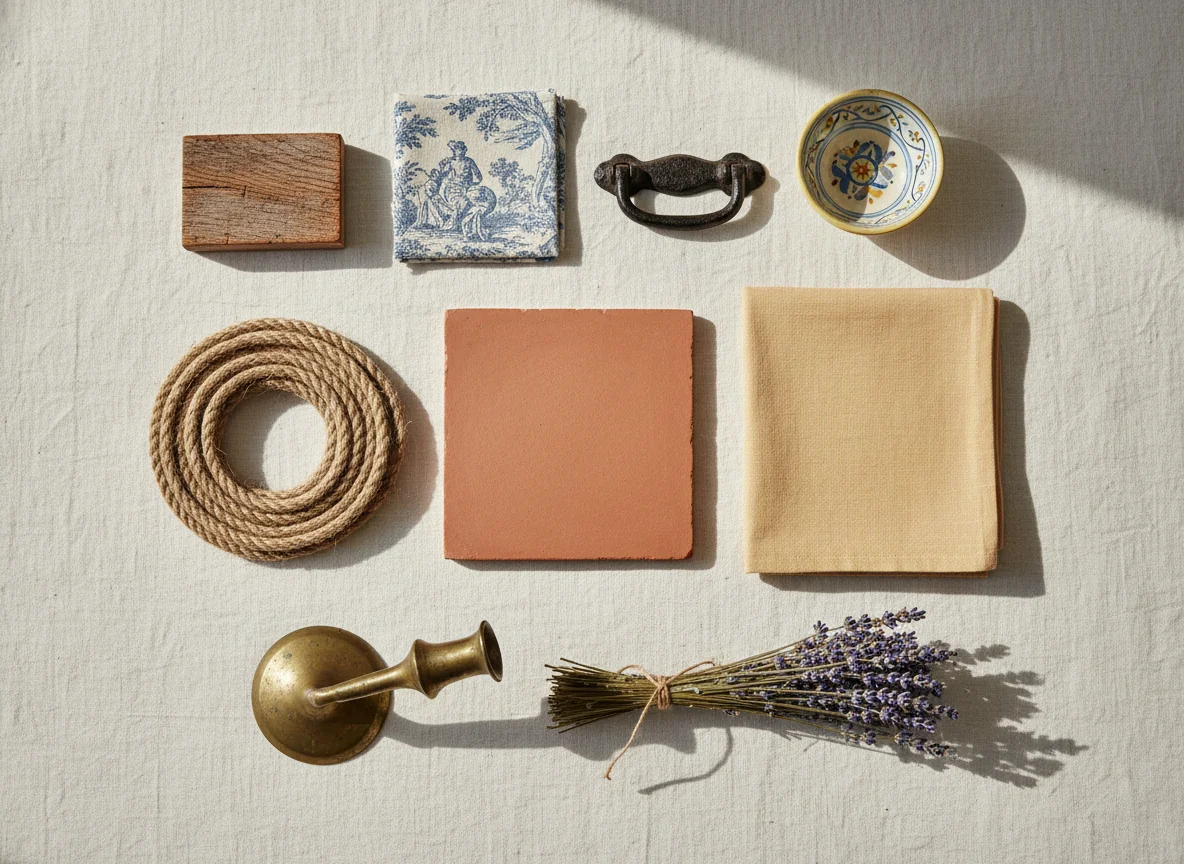
The palette: soft ochre, lavender, cream, aged wood
The French country palette feels generous at first glance — there’s clearly more color than in Scandinavian or Japandi — but it’s actually disciplined. Eight or nine entries deep, all soft, all warm-leaning, all faded by an implied century of sunlight.
The base layer is warm neutral. Walls are limewashed cream, soft pale ochre, or a chalky off-white that reads warmer than a Scandinavian white. Floors are wide-plank waxed oak in the medium-to-deep range, or honey-toned terracotta tile in kitchens and entries. Ceilings, if anything, match the cream of the walls — French country rarely uses cold white anywhere.
The soft accents carry the regional character: faded cornflower blue from toile de Jouy, sun-bleached lavender from Provençal textiles, soft ochre from saffron-dyed linen, faded sage from a kitchen wall in the Loire, dusty rose from old chintz. None of these are saturated. A bright royal blue cushion breaks the style; a faded cornflower toile reinforces it.
The grounding darks come from metal and wood. Wrought iron in every room — sconces, beds, candelabra, hardware — provides the contrast the off-white walls need. Waxed oak and walnut anchor the furniture. Aged brass appears in smaller doses on lamp bases, drawer pulls, and candlestick holders. Gilt — real gold leaf, worn unevenly — shows up on mirror frames and occasionally on a single more-formal piece.
The whole palette resolves around the principle that nothing is at full saturation. A French country room is a sun-faded room. The decorating color schemes post goes deeper on building warm-toned palettes from scratch.
French country by room
The style adapts cleanly to every room, but each room has two or three specific moves that separate a French country render from a generic rustic one. The list below is what to ask for in the prompt — or to look for when judging which generated variation to keep.
Kitchen. This is the room French country was effectively invented for. A stone or terracotta floor, limewashed walls, and exposed ceiling beams form the shell. Cabinetry is painted soft sage or warm cream over framed-panel doors, or left as waxed oak. Counters are honed limestone, warm marble, or thick butcher-block. Hardware is wrought iron or aged brass. A copper batterie de cuisine hangs above the stove. A long wooden trestle table sits in the center as both work surface and casual dining. Open shelves carry hand-painted faïence. One fireclay farmhouse sink replaces the stainless dual-bowl.
Dining room. French country dining splits the difference between the kitchen’s working ruggedness and the parlor’s soft formality. The table is solid oak or fruitwood — rectangular, with carved or turned legs and a single drawer in the apron. Chairs are mismatched on purpose: four ladder-backs with rush seats, two carved end chairs in painted faded blue, all united by shared scale. A wrought-iron chandelier hangs low — six to eight candle-style arms, no shades. A vaisselier — the open-shelved French sideboard — sits against one wall carrying the hand-painted dishes the room doesn’t quite need but always uses.
Bedroom. The bedroom leans hardest on the soft-formal pole. The bed is the anchor — a wrought-iron frame with curling scrollwork (Provençal) or carved oak with an upholstered headboard in faded linen (Loire). Bedding layers cream linen sheets, a quilted matelassé coverlet, a soft cornflower toile cushion or two, and a folded lavender wool throw across the foot. Nightstands don’t match — one a painted commode, the other a marble-topped antique side table. A gilt mirror leans against the wall opposite the bed.
Living room. A French country living room reads warmest with a slipcovered cream linen sofa, one or two caned-back chairs in a faded accent color, and a low waxed coffee table in reclaimed elm or stone-topped iron. A worn Aubusson or faded Persian rug grounds the seating. The fireplace, if any, is the focal point: stone or limewashed plaster surround, wooden mantel carrying a cluster of porcelain or candlesticks, oversized gilt mirror above. A freestanding armoire carries books, framed photos, and faïence in layered groupings.
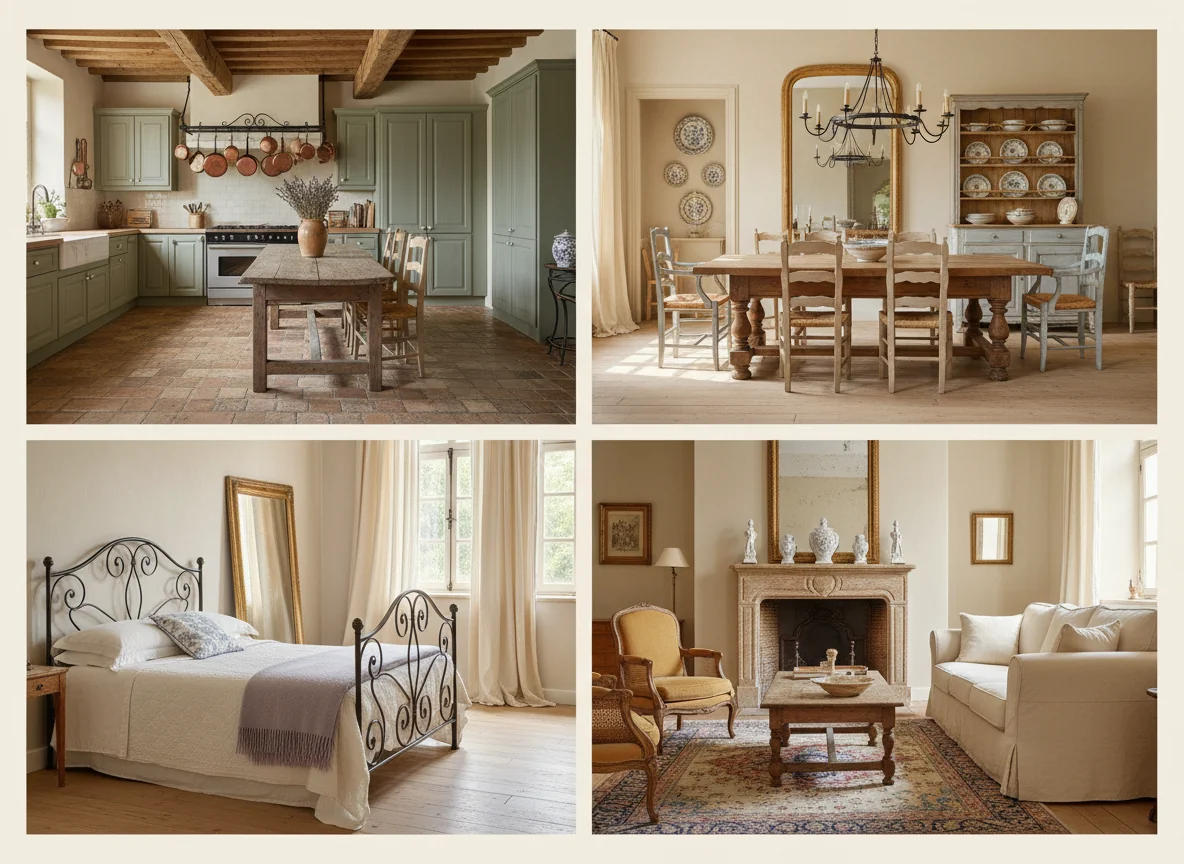
A consistent through-line across all four rooms: cream walls, waxed wood, wrought iron, one gilt accent per room, and the deliberate layered density of small objects on every shelf and mantel. Hold those five constants across a multi-room render and the home reads as one continuous farmhouse rather than four disconnected pastiches. For a related warm-and-layered Mediterranean approach, the Moroccan style living room guide is the closest cousin in the broader “warm-toned, detail-dense, layered textile” family.
Matching distressed and wrought-iron furniture
Generating a French country render is the easy half of the workflow. The harder half is buying the pieces — because the style depends on furniture that doesn’t reliably exist new, and the new pieces made to look old often read as costume.
Distressed oak armoires and buffets are the room-anchoring pieces. Look for 19th-century French provincial armoires at estate sales, regional auction houses, and dedicated French country dealers. Better reproductions cost almost as much as a real piece and the patina is rarely as convincing. Run your render through an image-similar search on a marketplace like 1stDibs to find originals that approximate the AI’s proposed shape.
Wrought-iron beds and chandeliers are still widely available because they were produced in enormous numbers between 1880 and 1920. King-size frames are scarcer than queen. Chandeliers — six-to-eight arm candle-style, often missing one or two arms — show up regularly at estate sales for a fraction of the cost of new reproductions. Look for hand-forged scrollwork; cast iron reads heavier and less period.
Bergère and slipper chairs with cabriole legs are the most French country–defining seats. Reupholstered in faded linen, a single bergère carries a room. Reupholstering an inherited or thrifted frame is usually the better value than buying new.
Hand-painted faïence and Provençal linens are the layer that pushes a render from generic to specifically French. Faïence from Quimper, Moustiers, or Gien shows up at estate sales and on eBay. Provençal block-printed cottons are still made by family workshops in the south of France — buying yardage and having it run up into cushions and table linens is the cheapest path in.
A reasonable budget rule: spend on the two or three pieces of furniture that anchor each room, and source the forty layering objects from flea markets and estate sales. The render’s job is to tell you what the forty objects look like together. For deeper context on the regional tradition behind the style, the Britannica entry on Provence is the cleanest short reference, and the V&A’s history of toile de Jouy covers the printed cotton that gives French country half its character.
FAQ
How does AI French country interior design differ from modern farmhouse AI renders?
The two styles share warm wood and rustic texture, but the renders diverge on hardware, line, and color temperature. A modern farmhouse render produces matte-black hardware, angular furniture, and a bright black-and-white palette. A French country render produces wrought-iron and aged-brass hardware, curved cabriole-leg furniture, and a soft palette of cream, ochre, and faded blue. If your render is reading too clean, you’re getting farmhouse — strengthen the prompt with “rustic French Provençal, distressed waxed oak, wrought iron, toile de Jouy, sun-faded patina.”
Will AI render the patina convincingly, or does everything look brand new?
Modern diffusion models render aged surfaces well because their training data is heavy with photographs of “rustic” interiors. They tend to render uniform factory-distressing less convincingly than the real thing. If your renders come back too pristine, push the prompt: “century-old wax-finished oak with visible saw marks, oxidized brass with verdigris, lime-washed plaster, sun-faded linen.”
Can I do French country in a small apartment, or do I need a farmhouse?
The style scales down. A 1920s urban apartment — plaster walls, hardwood floors, sometimes a non-working fireplace — is a closer fit to French country than to most contemporary styles. The moves that work in 200 square meters work in 60: limewashed wall color, one wrought-iron sconce, a slipcovered linen chair, a small gilt mirror, a clay pitcher of lavender on the table. AI rendering is especially useful at small scale because the layering instinct that powers the style is easy to overdo in a small room.
How many AI renders should I expect to generate before one is usable?
For French country, plan on three to six generations per room — twice as many as Scandinavian or Japandi. Every render makes a few choices that don’t quite cohere, and you’re iterating to get the ensemble to lock in. Keep the prompt stable and re-roll rather than rewriting; the variation between generations on the same prompt is usually where the working render lives.
Where to start
The fastest path into French country is the easiest room to convert and the one with the most regional character: the kitchen. Start with a phone photo, generate three to six French country variations, and read the renders for the moves that surprised you — the wall color you wouldn’t have picked, the open shelving the AI added, the wrought-iron pot rack. Take the moves that resonate, ignore the ones that don’t, and use the strongest render as your shopping brief.
Snap a room and see it reimagined in French country. RoomGenius runs on photo and sketch inputs, returns multiple style variations per generation, and surfaces shoppable furniture matches for the pieces it places in the render — exactly the workflow that French country, with its forty-object density, most needs. Download for iOS or Android and start with the kitchen, then the bedroom, then everything else.