AI Farmhouse Interior Design: Cozy, Warm, and One Photo Away
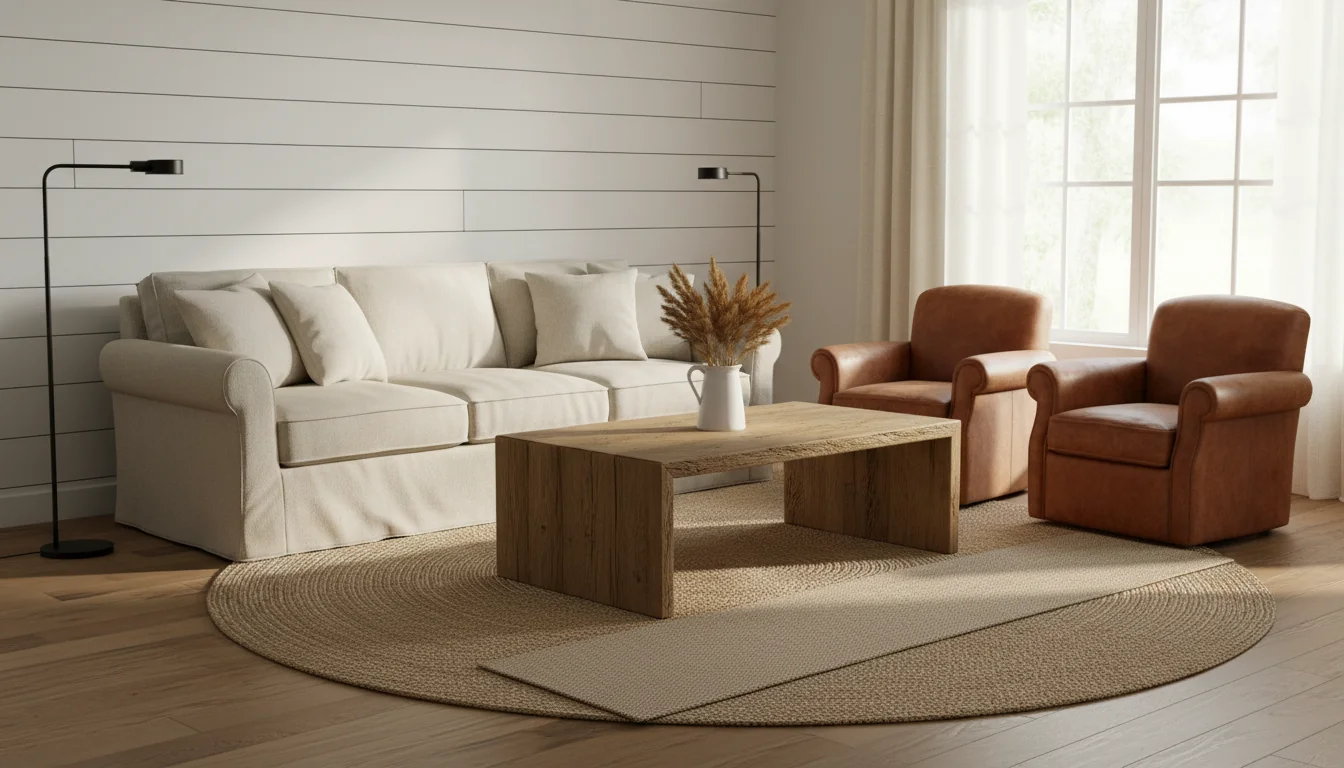
Farmhouse has been the most-searched American interior style for the better part of a decade, and the appeal is obvious: warmth, age, and a sense that someone actually lived in the room before you walked into it. It’s also the style most often complained about for tipping into cliché — mason jars on every shelf, sliding barn doors on rooms that don’t need them, and a wall of script-font signs that ask you to gather, dwell, and live-laugh-love. AI farmhouse interior design is useful exactly here: as the editor that proposes a warm, lived-in farmhouse base — shiplap, reclaimed wood, matte black, washed linen — without piling on the decade’s worst tropes. Snap a photo of your living room, prompt for “modern farmhouse,” and the render tells you whether the look reads warm or kitschy before you spend a dollar.
This guide is the working tour: what farmhouse style actually means in 2026 after a decade of Magnolia and a thousand HGTV spinoffs, the modern-vs-traditional split that decides how a render reads, why AI is unusually well-suited to keeping farmhouse from going twee, the room-by-room moves that determine whether the result lands, the material kit that defines the style, and the furniture-matching layer that turns a render into a buying plan.
What is AI farmhouse interior design? AI farmhouse interior design is the use of an AI room-rendering tool to transform a photo of an existing room into a farmhouse-styled version — warm, lived-in, and rooted in old American rural vocabulary updated for contemporary living. The render preserves the room’s architecture (walls, windows, ceiling) and replaces the decor layer with farmhouse hallmarks: shiplap or beadboard wall treatments used as accent, reclaimed or rough-sawn wood with visible patina, slipcovered linen or cotton upholstery, matte-black hardware and fixtures, jute or hand-knotted wool rugs, wide-plank floors, and a small set of handmade or vintage accents that signal age without performing it. AI is well-suited to farmhouse because it can propose a tasteful base that skirts the decade’s most overworked tropes — barn-door bathroom entrances, mason-jar pendants, chalkboard wall signs — and lets you add personal accents without inheriting the clichés.
What farmhouse style means in 2026
For most of the 2010s, “farmhouse” in American interiors meant one thing: white shiplap on every wall, sliding barn doors on interior rooms, mason-jar chandeliers, and a lot of script-font wall art. The style became so dominant — through Fixer Upper, Joanna Gaines’ Magnolia franchise, and the Pinterest-Instagram amplification machine — that by 2019 it had become its own joke, and by 2022 the design press was pronouncing it dead.
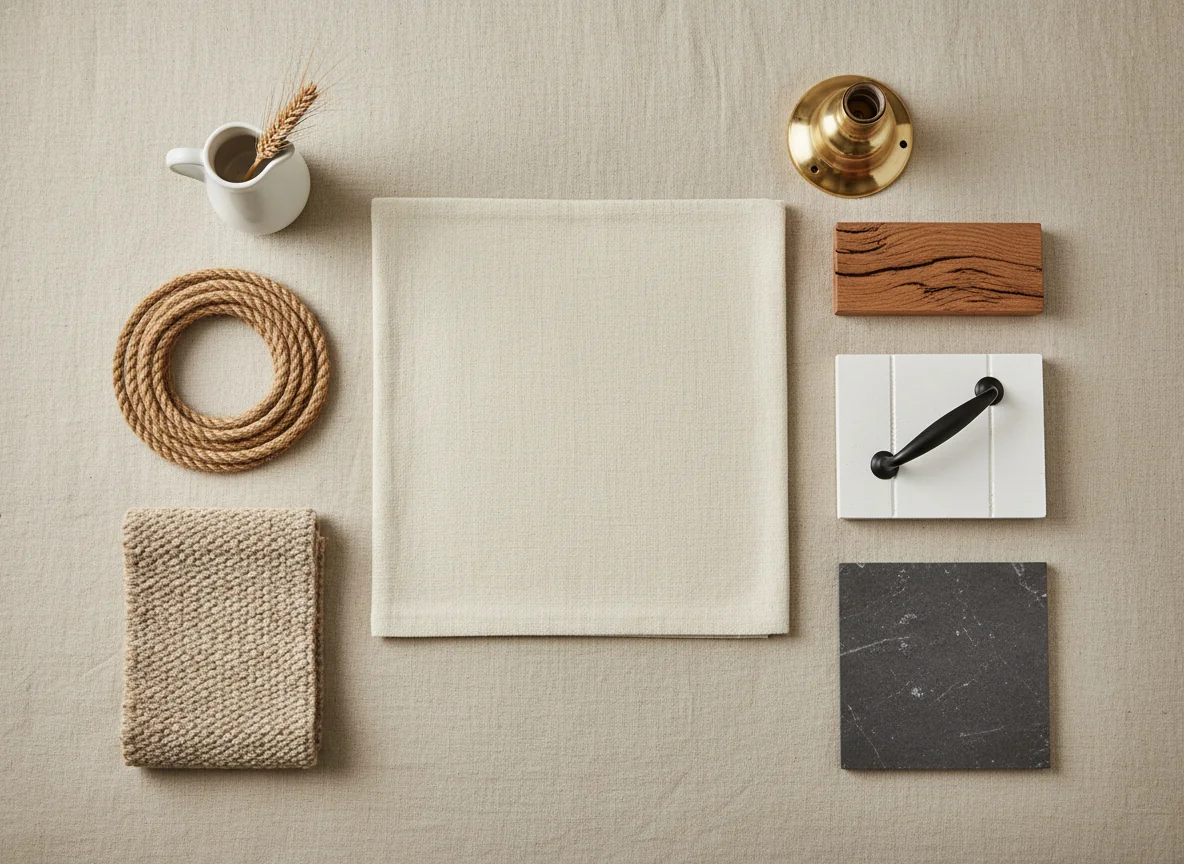
It’s not. What died was the costume-grade version: rooms that performed rural-American as a literal aesthetic, with reclaimed barn wood applied like wallpaper and corrugated metal repurposed as backsplash. What survived — and what most homeowners now mean when they say “farmhouse” in 2026 — is the underlying vocabulary: warm whites and creams, real and reclaimed wood, slipcovered upholstery, matte-black hardware, natural fibers, and a sense of considered age. The barn doors retreated. The Carhartt-cosplay accents got tossed. What’s left is a warmer, more livable interpretation that reads farmhouse without making the room a Cracker Barrel.
Modern farmhouse — the dominant 2026 variant — is what most renovations are reaching for. It pulls farmhouse’s material vocabulary into a cleaner-lined contemporary envelope: shaker cabinetry instead of inset rustic, matte-black sconces instead of mason jars, a single piece of vintage furniture rather than a curated junk-shop wall. Traditional farmhouse still has a following in renovations of actual old farmhouses where the architecture justifies it — open-beam ceilings, original wide-plank floors, true reclaimed wood — but most search volume for “farmhouse” today is people who mean the modern version, whether they say it or not.
For a wider view of where farmhouse sits among current American interior styles, our different types of home interior design styles guide places it alongside coastal, transitional, and modern minimalist — its closest mainstream cousins.
Modern farmhouse vs traditional farmhouse
The two-word distinction matters more than it sounds because the renders the AI returns are genuinely different rooms. Get the prompt wrong and the result skews toward the variant you didn’t want.
| Axis | Modern farmhouse | Traditional farmhouse |
|---|---|---|
| Cabinetry | Shaker or slab-front, painted white or pale sage | Inset rustic, raw or distressed wood |
| Wood tones | Wide-plank pale to mid-tone oak; walnut accents | Heavily reclaimed barnwood, darker patinas |
| Hardware | Matte black, brushed brass used sparingly | Wrought iron, oil-rubbed bronze, hand-forged |
| Wall treatment | Shiplap as accent only; mostly painted drywall | Full-room shiplap or beadboard common |
| Upholstery | Slipcovered linen, cotton, performance fabric | Linen, ticking stripe, often vintage |
| Lighting | Schoolhouse pendants, simple matte-black sconces | Mason-jar fixtures, wagon-wheel (declined) |
| Color palette | White, cream, warm gray, sage, soft black | Cream, butter, barn red, deeper greens |
| Decor density | Restrained — one or two vintage pieces per room | Layered — collected-over-time look |
| Mood | Clean, warm, light | Rustic, cozy, story-rich |
| Common failure | Reads “builder-grade” if under-edited | Reads “Cracker Barrel” if over-edited |
The render implication: if you prompt “modern farmhouse” the AI returns cleaner geometry, sparer surfaces, and more white. If you prompt just “farmhouse” or “traditional farmhouse,” expect more reclaimed wood, more layered accents, and more vintage signal. Most people want the modern version and don’t know to ask for it — leaving the word “modern” out is the single most common reason a first render comes back kitschier than the user wanted.
Why AI keeps farmhouse from going kitschy
The thing AI is unusually good at, in farmhouse specifically, is restraint. Not because the model has taste — it doesn’t — but because its statistical defaults pull toward the median rendering of a style, and the median modern-farmhouse render in 2026 is significantly more restrained than the median 2017 Pinterest pin. Train on millions of images and you average out the tropes; what’s left is the underlying language.
This works in the user’s favor for a specific reason. The hardest design decision in farmhouse is what to leave out. The style has accumulated so many signifiers over a decade that the home stager’s instinct is to add one of each. The AI doesn’t have that instinct. Given “modern farmhouse living room,” it returns a slipcovered sofa, a reclaimed-wood coffee table, a jute rug, matte-black sconces, a pair of linen curtains, and not much else. It under-includes by default. That’s the editing pass most farmhouse renovations actually need.
The second AI advantage is material accuracy. Real reclaimed wood has a specific look — saw marks, nail holes, irregular tone variation, patina that doesn’t repeat. Diffusion models render this convincingly because they’ve seen millions of reclaimed-wood examples in training. The render of a “reclaimed oak coffee table” comes back with believable patina; a stock photo of a “rustic” coffee table from a mid-market retailer often looks like printed laminate.
The third is proportion plus discreet editing. Farmhouse furniture skews oversized — chunky farm tables, deep-seated sofas, beefy chair frames — and the AI sizes these correctly to the room when prompted with the existing photo, which solves a real-world problem: it’s hard to look at a farm table in a showroom and know whether it will dwarf your dining room. And if a render comes back with one cliché too many (a chalkboard, a ladder, a row of mason jars), a follow-up prompt strips them out: “remove all signs, jars, and ladders; keep the room warm and lived-in but not themed.” For more on the prompt-and-iterate loop, our how to prompt AI interior design walkthrough is the working playbook.
Farmhouse by room — kitchen, living, bedroom
The style adapts to every room, but each has a small set of moves that decide whether the render reads as authentic modern farmhouse or as generic light-and-bright.
Kitchen. The farmhouse kitchen is the heart of the style — the room everything else takes cues from. The render should anchor on shaker-front cabinetry in a warm white, cream, or soft pale sage; an apron-front farmhouse sink in fireclay or stainless; matte-black or aged-brass pulls; a butcher-block or honed soapstone island top with a contrasting white quartz on the perimeter; wide-plank mid-tone oak floors; two or three schoolhouse pendants over the island; open shelving with a small set of white ironstone and a wood cutting board. A linen runner softens the floor. Plants on the sill — a herb pot, a trailing ivy — keep the kitchen reading lived-in. For a cost view of getting to this look in a real kitchen, our how to renovate kitchen cheaply guide breaks down where the dollars actually go.
Living room. A modern-farmhouse living room is anchored by a deep-seated slipcovered sofa in cream, oatmeal, or soft sand linen — the slipcover is the single most farmhouse-coded soft good in the room and it should be visibly mussed, not pulled tight. A reclaimed-wood coffee table sits low and substantial in front of it. A pair of leather club chairs in tobacco or saddle adds warmth and contrast. Matte-black or aged-bronze floor lamps flank the seating. A jute rug, layered under a smaller hand-knotted wool runner, grounds the floor. A simple painted shiplap accent wall — only one wall, never the whole room — backs the sofa or fireplace. Decor is restrained: one piece of vintage signage (no chalkboards), a small stack of weathered books, a ceramic pitcher with dried wheat or eucalyptus.
Bedroom. Farmhouse bedrooms lean into the slipcovered, the layered, and the soft. The bed is a substantial wood-framed platform or four-poster in mid-tone oak, walnut, or distressed pine — never high-gloss. Bedding is layered white and cream linen with a single textured accent: a matelassé coverlet, a chunky knit throw, or a vintage wool blanket folded at the foot. Nightstands match the bed or contrast with a painted finish, single drawer, low profile. Lighting is a pair of matte-black sconces above the nightstands rather than table lamps. A jute rug under the bed adds texture. A single piece of vintage art — a botanical print, an old framed map — backs the bed. Curtains are linen, floor-length, in cream or natural.
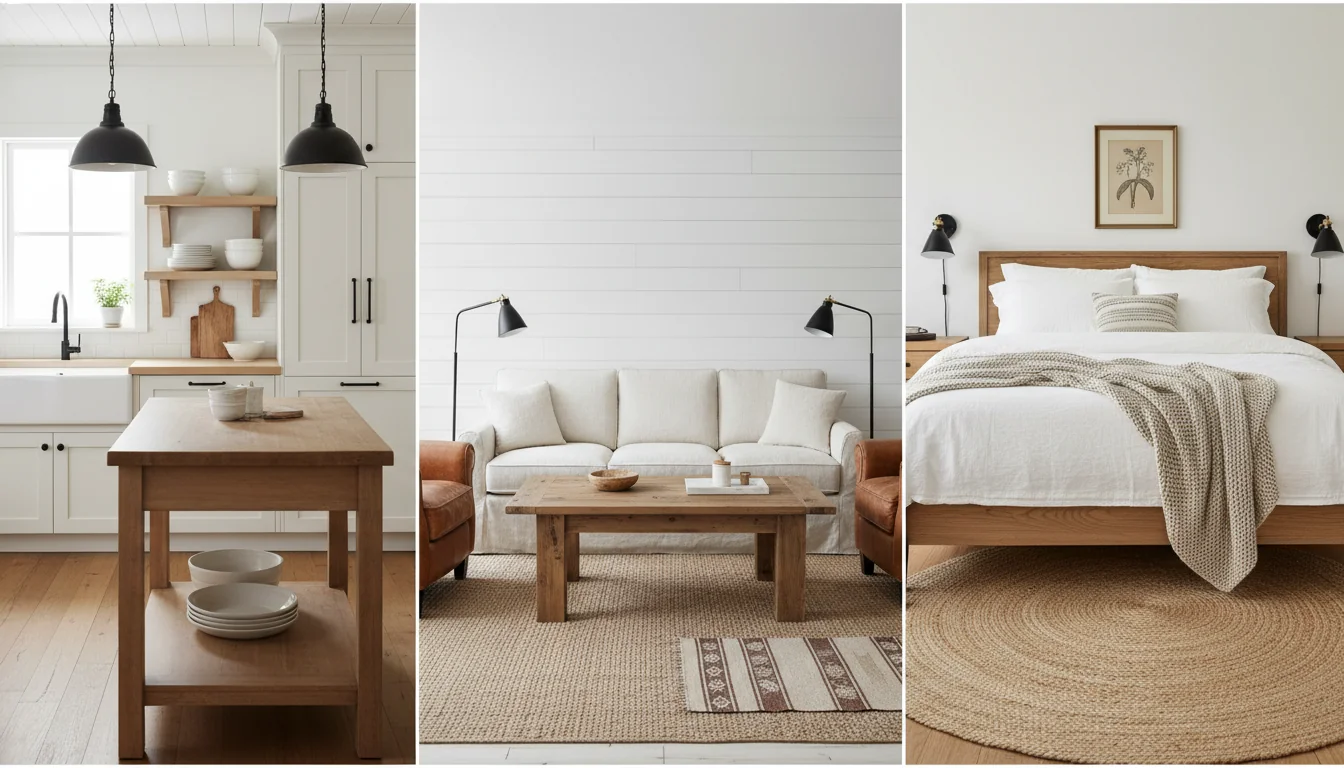
The through-line across all three rooms: warm-white walls with at most one shiplap accent; mid-tone wood as the primary warm material; matte-black hardware as the accent metal; washed linen and jute as the primary soft goods; one or two restrained vintage accents that signal age without performing it. Hold those constants and the multi-room render reads as one continuous home.
The material kit: shiplap, reclaimed wood, matte black, linen
Internalize the materials and you can both spot a real farmhouse render and write a prompt that returns one.
Shiplap, used as accent only. Shiplap is the most farmhouse-coded wall treatment and the one most commonly overdone. The 2026 rule of thumb is one wall, not four — typically behind the bed, the fireplace, or the kitchen range hood. Specify “shiplap accent wall behind sofa” and the render returns the controlled application. Leave the modifier out and the AI sometimes paneling-bombs the whole room.
Reclaimed and rough-sawn wood. The material backbone of farmhouse. Wide-plank flooring in oak, hickory, or pine with visible saw marks and tone variation; reclaimed beams, coffee tables, mantels, shelving. The patina should read genuine — saw marks, nail holes, irregular grain. Specify “reclaimed oak with visible saw marks and tone variation” rather than just “wood” and the render does the work.
Matte black, used as the hardware tone. Modern farmhouse standardized on matte black around 2018 and the choice has held. Cabinet pulls, faucet, sconces, the legs of an iron coffee table. Used as a hardware-only accent (not a wall color), matte black grounds the otherwise pale palette. Aged brass is the secondary metal, used sparingly on a single lighting fixture per room.
Linen, washed and slightly mussed. Slipcovers, curtains, bedding, table runners, lampshades — slightly wrinkled and slightly slubbed, not crisp, not pressed. The AI defaults toward “ironed linen” unless prompted otherwise; specify “washed and slightly wrinkled linen slipcover” and the result reads lived-in rather than catalog.
Jute, wool, and woven natural fibers. Jute rugs are the workhorse floor covering — affordable, textured, warm. Hand-knotted wool runners layered over jute add a second material layer that distinguishes a styled farmhouse room from a builder-grade one.
Ironstone, stoneware, and a small handful of vintage accents. Decor is the place most farmhouse renders go wrong; the rule is one or two vintage pieces per room, no more. A single piece of vintage signage. A small stack of antique books. A ceramic pitcher used as a vase. A botanical print in a simple wood frame. Avoid: chalkboards, sliding barn doors on interior rooms, mason-jar chandeliers, wagon-wheel anything, script-font wall art, and any phrase containing the words gather, bless, or live laugh love. The 2026 farmhouse render explicitly omits these.
Matching farmhouse furniture and fixtures
The render is the easy part; tracking down the matching pieces is the part that historically broke the workflow. Modern AI room apps with a furniture-matching layer solve this — the render is generated as a labeled bill of materials, and each piece links to a shoppable equivalent at a real retailer.
A typical modern-farmhouse living room render returns roughly twelve to fifteen matched pieces — slipcovered linen sofa, reclaimed-wood coffee table, tobacco-leather club chairs, jute rug, layered wool runner, matte-black floor lamps, linen curtains, ceramic pitcher with dried stems, a vintage botanical print, a wood-framed mirror. Most match to mid-market retailers most homeowners already shop: Pottery Barn, West Elm, Birch Lane, IKEA, Article, Rejuvenation, World Market, McGee & Co, Magnolia, Loloi, Ruggable, and Wayfair for the new pieces; Etsy, Chairish, and 1stDibs for the vintage signal pieces. The match isn’t always exact — the render’s specific cream-bouclé slipcover may not be in stock this week — but the price tier and silhouette match closely enough that the room you order looks like the room you rendered. For inexpensive farmhouse moves that don’t require a full furniture refresh, our easy home decor ideas post is a good complement; for the rustier, more industrial-leaning farmhouse cousin (raw steel, mixed-metal piping, reclaimed factory hardware), our rustic industrial interior design guide is the closest neighbor.
External sources worth reading alongside this: the Architectural Digest modern-farmhouse primer is a reasonable mainstream introduction, and House Beautiful’s ongoing farmhouse coverage is the best source for high-end projects that show how the style scales beyond the standard suburban application.
FAQ
Is farmhouse style dead?
The trope-heavy 2010s version is over. The vocabulary — shiplap as accent, reclaimed wood, slipcovered linen, matte black, wide-plank floors, considered age — is alive and well, and the modern-farmhouse variant remains one of the most-searched American interior styles year over year. What ended was the costume-grade interpretation; what stayed is the underlying material language, applied with more restraint.
What’s the difference between farmhouse and modern farmhouse?
Modern farmhouse keeps the material vocabulary (wood, linen, matte black, shiplap, jute) but applies it in a cleaner-lined contemporary envelope — shaker cabinets, fewer vintage pieces per room, more white space, single accent walls instead of full-room paneling. Traditional farmhouse leans heavier on reclaimed barnwood, layered vintage, deeper palettes, and rural-specific signifiers. Most search volume for “farmhouse” today means the modern variant; prompting “modern farmhouse” specifically is the single best way to skirt kitsch in an AI render.
Will an AI render include barn doors and mason jars by default?
Usually no — and that’s the upside. The 2026 statistical median for “modern farmhouse” renders has shifted away from the most-overworked tropes, so the default tends to skip them. If a render does come back with a sliding barn door or a mason-jar fixture you don’t want, a follow-up prompt to “remove the barn door, replace with a standard interior door” or “swap the mason-jar pendants for matte-black schoolhouse pendants” resolves it cleanly.
Can farmhouse work in an apartment or a city home?
Yes, and the modern variant scales down better than the traditional one. The cleaner-lined version — slipcovered linen sofa, reclaimed coffee table, matte-black sconces, jute rug, one shiplap accent wall — fits a 700-square-foot apartment cleanly. The traditional variant, with its open-beam ceilings and full-room paneling, depends on architectural features most apartments don’t have. For an apartment render, prompt explicitly: “modern farmhouse, apartment-scale, no barn doors, no full-room shiplap.”
What’s a realistic budget for a farmhouse refresh of one room?
At U.S. mid-market prices, a single-room farmhouse refresh runs roughly $1,500–$4,000 depending on whether you’re swapping just soft goods and decor or also replacing the sofa and coffee table. A true farmhouse kitchen renovation (shaker cabinets, apron sink, butcher-block island, matte-black hardware) is a $25,000–$60,000 project depending on size and finishes. The render is free, and seeing the result before committing usually saves a few thousand on wrong purchases.
Preview farmhouse before you commit to the shiplap.
Farmhouse is the style most often regretted after the shiplap goes up — because shiplap is hard to undo, and a room that reads warm and lived-in in a Pinterest board can read like a Cracker Barrel in the wrong space. The render is the cheap insurance: shoot a doorway photo of your living room, prompt “modern farmhouse, restrained, no barn doors, no mason jars, one shiplap accent wall,” and you’ll have a credible preview of the finished room in under two minutes. Try the kitchen next. Then the bedroom. The whole-home picture usually comes together inside fifteen minutes of phone time.
RoomGenius is the AI room design app that handles farmhouse natively, with the modern-2026 vocabulary baked into how the style renders — restrained shiplap, real-looking reclaimed wood, slipcovered linen, matte-black hardware — and a furniture-matching layer that ties each rendered piece to something you can actually order. The free tier covers your first few rooms. Try it on the App Store or Google Play. Preview farmhouse before you commit to the shiplap.