A Guide to Symmetrical Balance Interior Design
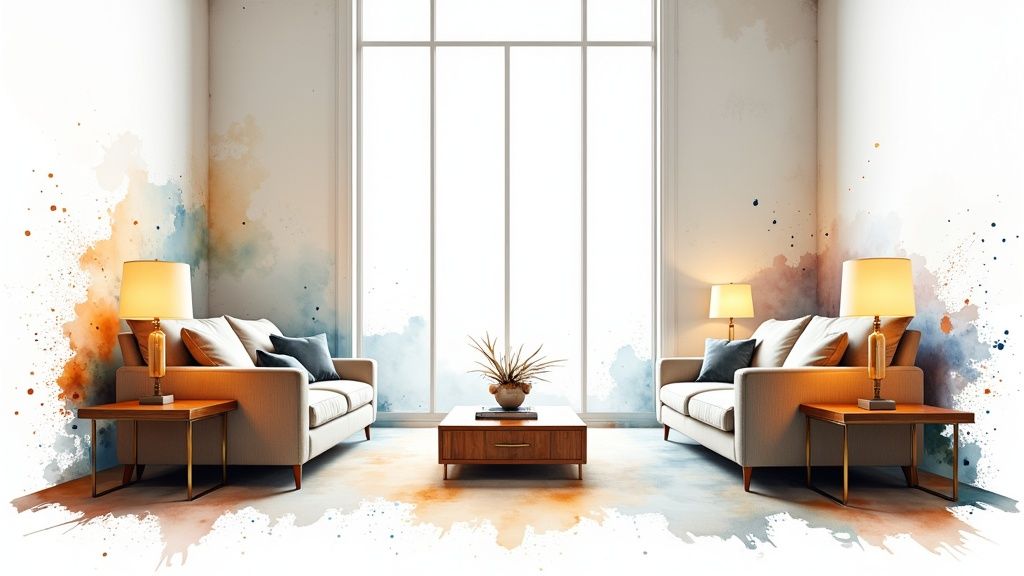
Ever walk into a room and feel an instant sense of calm? Chances are, you’re experiencing the subtle power of symmetrical balance. At its heart, symmetrical balance in interior design is all about creating a mirror image. Imagine drawing a line down the middle of a room—each side perfectly reflects the other, resulting in a space that feels intentional, stable, and incredibly harmonious.
The Enduring Appeal of Symmetrical Design
Symmetry isn’t just a design trend; it’s practically baked into our DNA. We’re instinctively drawn to balance because it signals order and predictability, making us feel at ease. In a home, this translates into rooms that feel grounded, organized, and visually restful.
Think about a classic, grand living room. You’ll often find a fireplace dead center, with two identical sofas facing each other, each flanked by a matching end table and lamp. This isn’t a coincidence. It’s a deliberate choice to create a clear visual path, guiding your eye and making the space easy to understand at a glance. Your brain isn’t working overtime to figure out a chaotic layout; it can just relax and take in the quiet order.
This is precisely why symmetrical layouts are a go-to for more formal spaces like dining rooms, entryways, and master bedrooms—places where you want to cultivate a sense of tranquility and elegance.
A Timeless Principle with Deep Roots
The love for symmetry is nothing new. It traces all the way back to the ancient Greeks around 500 BCE, who mastered it in their architecture to create a sense of perfect harmony. The principle made a huge comeback during the Neoclassical period (1750-1830), becoming a defining feature of elite European homes. In fact, an incredible 70% of surviving aristocratic homes from this era in France and Britain showcase perfectly mirrored room layouts.
Even today, a global survey found that 62% of formal living rooms in high-end residential projects still lean on symmetrical balance to communicate a feeling of tradition and stability. It’s a design technique that has truly stood the test of time.
To give you a clearer picture, let’s break down the core ideas behind this powerful design principle.
Key Principles of Symmetrical Balance
| Principle | Description | Visual Effect |
|---|---|---|
| Central Axis | An imaginary line that divides a space into two equal halves. This can be centered on a focal point like a fireplace, window, or large piece of art. | Creates the foundation for the mirror-image effect and provides a clear point of reference for the entire room. |
| Mirror Image | Placing identical objects (or objects with the same visual weight) at equal distances from the central axis. | Produces a sense of calm, predictability, and formal elegance. The repetition is soothing to the eye. |
| Visual Weight | The perceived “heaviness” of an object based on its size, color, and texture. Symmetrical balance requires matching visual weight on both sides. | Ensures that neither side of the room overpowers the other, maintaining a feeling of equilibrium and stability. |
| Focal Point | A central element that anchors the design and draws the eye. The entire symmetrical arrangement is built around this point. | Gives the room a clear purpose and hierarchy, preventing the symmetrical layout from feeling static or boring. |
These principles work together to create a cohesive and deeply satisfying aesthetic.
The real magic of symmetry is that it satisfies our innate craving for order. By mirroring elements, you’re essentially creating a visual conversation between the two halves of a room, which pulls the entire design together.
Getting a handle on foundational concepts like this is the key to creating spaces that don’t just look good, but feel right. For a deeper dive into other core principles that shape beautiful interiors, exploring various design concepts in interior design can give you the full picture. Symmetrical balance is just one powerful tool, but it’s one of the most effective for crafting an intentional and inviting home.
Creating a Perfectly Balanced Living Room
Your living room is the heart of your home, and it’s the perfect place to put the calming principles of symmetrical balance into practice. This approach is all about creating a feeling of stability and peace. The secret is to start by finding your room’s natural centerpiece and building everything out from there.
What’s the first thing you notice when you walk in? It might be a beautiful fireplace, a big picture window with a great view, or even a stunning piece of art. Once you’ve identified that anchor, the game begins. Imagine a line running right through the middle of it, and your job is to create a mirror image on either side. It’s a simple trick that instantly makes a room feel put-together and harmonious.
Anchoring Your Symmetrical Layout
First things first, let’s talk seating. This is the foundation of your entire layout. You can create a powerful symmetrical base by placing identical sofas directly across from one another or by flanking your focal point with a pair of matching armchairs. Getting this initial placement right sets the tone for the rest of the room.
With your main seating locked in, you can start building outwards. Flank your sofa (or sofas) with matching end tables, and top them with identical lamps for that classic, mirrored look. This kind of repetition is incredibly satisfying to the eye and reinforces the sense of order that makes symmetry so appealing. For a deeper dive into arranging these core pieces, we’ve got a whole guide on how to arrange living room furniture.
Interestingly, this love for symmetry isn’t new. It became hugely popular during the post-WWII housing boom. US Census data shows that a staggering 74% of suburban homes built between 1945 and 1960 had symmetrical living rooms built around a fireplace, reflecting the era’s desire for domestic order. And it’s still going strong—a recent Deloitte report found that 80% of millennial homeowners in major cities are drawn to symmetrical living spaces for that timeless, calming atmosphere.
The diagram below breaks down this fundamental process.
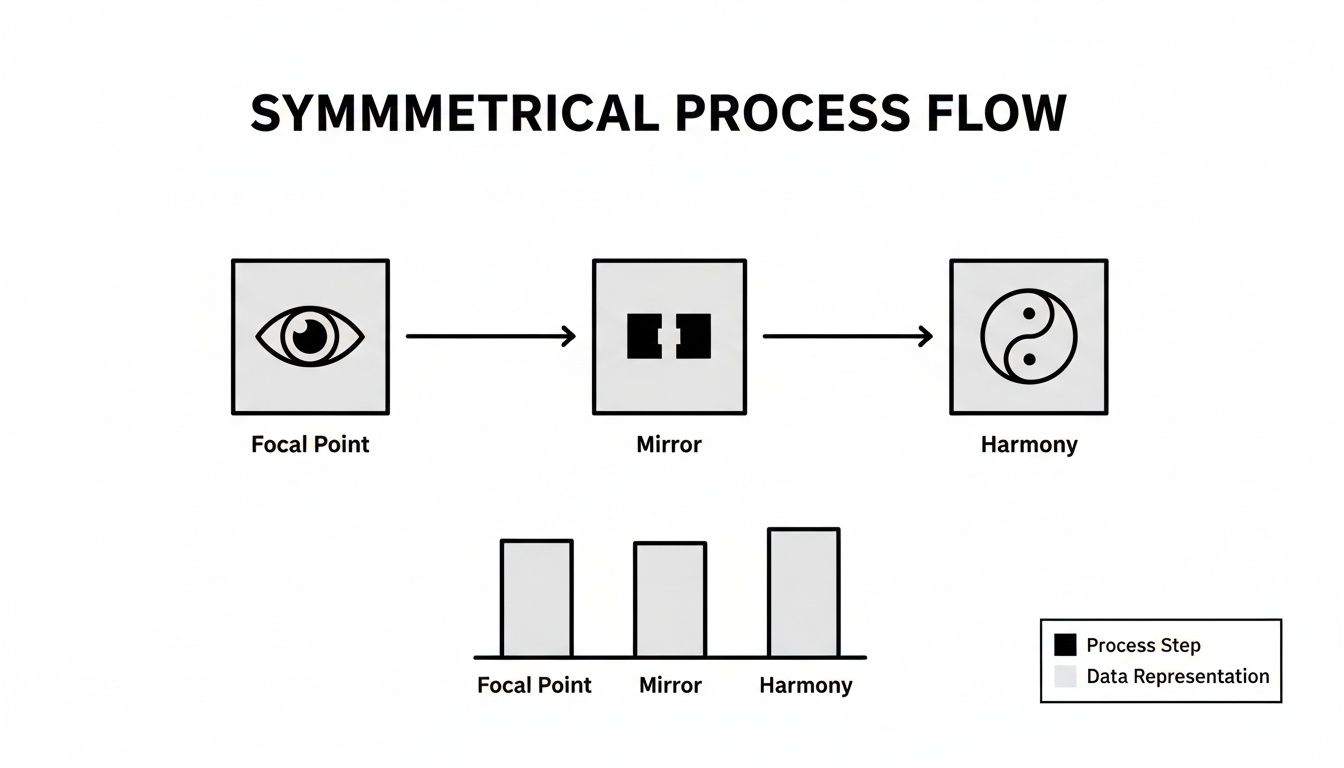
It really boils down to those three steps: find your focal point, mirror the key elements, and aim for an overall feeling of harmony. That’s the core of any great symmetrical design.
Fine-Tuning with Decor and Details
Once the big furniture is in place, it’s time for the fun part: the accessories. This is your chance to inject personality without throwing off the balance you’ve worked so hard to create.
- Cushions and Throws: Try arranging throw pillows in a mirrored pattern on your sofas. For instance, you could place one solid and one patterned pillow on each end.
- Wall Decor: Hang a pair of identical art pieces—or two with a similar theme and scale—at the same height on either side of your focal point.
- Accent Pieces: Use matching vases, sculptures, or even neat stacks of books on corresponding surfaces like a mantel or console table to complete the look.
Symmetry is not about creating a sterile, rigid space. It’s about providing a structured foundation that allows for moments of personality and comfort to shine through. The balance makes the room feel intentional, not boring.
Of course, knowing how to arrange furniture in your living room for ideal flow and comfort is about more than just mirroring objects. What happens if you have an off-center TV or some other architectural quirk? The key is not to force it. Instead, create a symmetrical zone where you can—like your main seating area—and then use visual weight to counterbalance the asymmetrical element. A tall plant or a bookcase can work wonders to balance out that TV.
Designing a Serene and Symmetrical Bedroom
Your bedroom should be your sanctuary—a personal retreat from the chaos of the outside world. This is exactly why it’s the perfect candidate for symmetrical balance, a design principle that naturally creates a feeling of tranquility and order. The great thing is, the bedroom is already set up for it; the bed is the undeniable star of the show, giving you a perfect canvas for a peaceful, mirrored layout.
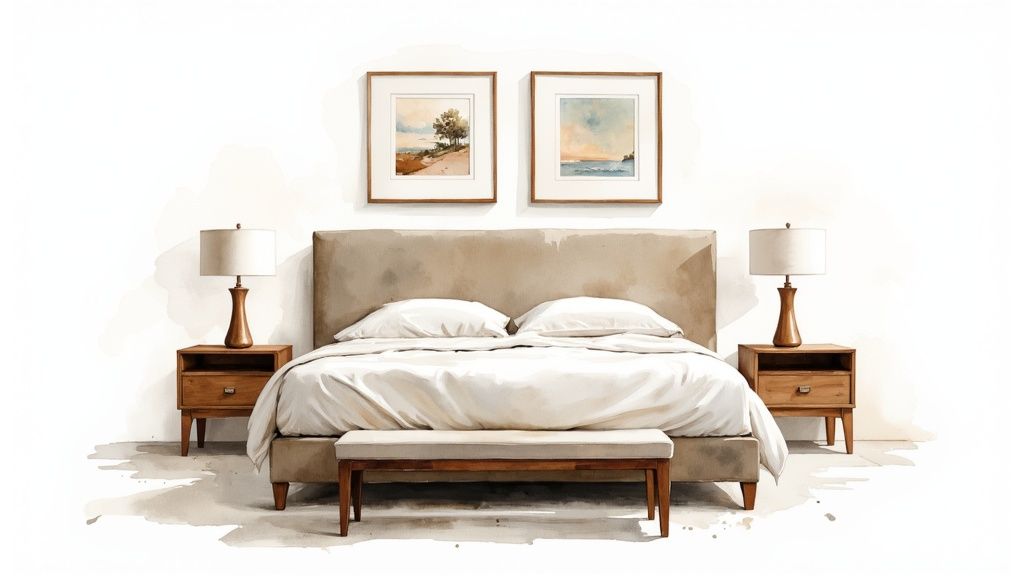
The whole process starts by finding your focal point. No surprise here: it’s almost always the bed. By centering your bed and headboard against the most prominent wall, you create a powerful anchor that the rest of the room naturally organizes itself around. This one simple move instantly gives the space a sense of purpose and calm.
Building Out from the Bed
Once your bed is perfectly centered, it’s time to build out from there by flanking it with identical pieces. This is how you achieve that classic, mirror-image effect that defines symmetrical design. The goal is simple: create visual equilibrium on both sides of that imaginary center line.
- Matching Nightstands: Grab a pair of nightstands that are identical in size, shape, and color. These become your next blank canvases for styling.
- Identical Lamps: Top each nightstand with a matching lamp. This move not only locks in the balance but also gives you even, ambient light, which is key to a restful atmosphere.
- Mirrored Decor: For the final touch, place similar decorative items on each table. You don’t have to be perfectly robotic here; a small plant on one side can easily balance the visual weight of a stack of books on the other.
This foundational trio—bed, nightstands, and lamps—creates an immediate sense of harmony. For a deeper dive into arranging your space, our guide to creating a functional bedroom layout plan has tons of practical tips for any room size.
Balancing Walls and Other Furnishings
Now, let’s look up. The wall above your headboard is prime real estate for reinforcing that symmetry. You’ve got a couple of great options. A single, large piece of art centered perfectly over the bed makes a bold, confident statement. Or, you could go for a pair of smaller, matching prints hung side-by-side for a look that’s just as balanced but a bit more delicate.
So, what about the rest of the furniture? A symmetrical bedroom doesn’t mean every single item needs a twin. It’s more about making sure the other pieces support the primary balance you’ve already established around the bed.
Symmetry in the bedroom is about creating a feeling of stability. The mirrored elements around the bed act as an anchor, allowing other parts of the room to feel organized and intentional, even if they aren’t perfectly matched.
A good rule of thumb is to place a long dresser directly opposite the bed, keeping it aligned with the room’s center line. If you have enough space for a seating area, two identical armchairs with a small table between them create a lovely secondary symmetrical zone, enhancing that overall feeling of order.
Once the big pieces are in place, you can explore inspiring luxury bedroom styling ideas to weave in texture and personality without throwing off the balance. When you carefully select and arrange every element, you end up with a peaceful, clutter-free atmosphere that just feels right—a space truly designed for rest and relaxation.
Making an Impression and Finding Your Focus
Symmetry is a powerhouse in two of the most critical zones in your home: the entryway and the home office. While one is all about welcoming guests and the other is for deep work, both thrive on the sense of order and calm that symmetrical balance interior design delivers.
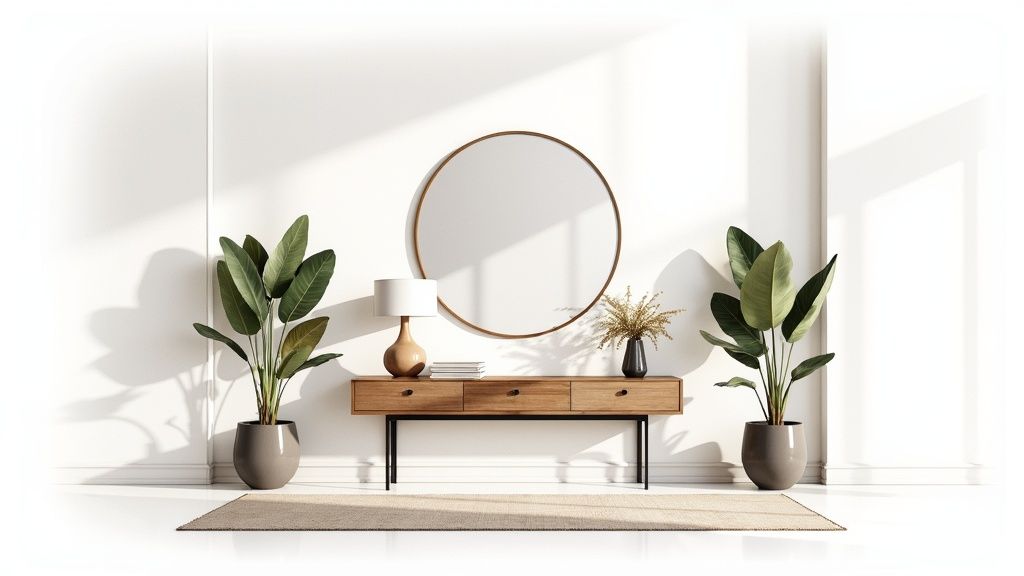
Your entryway is your home’s first handshake. You want it to be a strong one. This is where symmetry works its magic, immediately signaling a sense of intention and elegance. Even a tiny foyer benefits from this approach. Start by centering a console table on the main wall—that’s your anchor. From there, flank it with identical table lamps, a pair of matching art prints, or two tall vases to create that classic, mirrored look.
This isn’t just about looking good; it has a real impact on your home’s value. A Zillow analysis of 2 million listings found that homes with symmetrical entryways sell 22% faster and for 10% higher prices. Why? Because buyers walk in and instantly perceive the home as more refined and well-cared-for. It’s a fascinating look into the psychological impact of design harmony.
Carving Out a Distraction-Free Workspace
In a home office, the goal is focus, and a symmetrical layout is one of my favorite ways to eliminate visual clutter. Your desk is the undisputed star of the show here. Position it squarely against a wall or, if you have the space, float it in the center of the room to create a real command center.
Once your desk is set, building out the rest of the symmetrical space is straightforward.
- Bookcases & Shelving: Nothing says “serious workspace” like two identical bookcases standing guard on either side of your desk. It gives the room a polished, library-like vibe.
- Smart Storage: A matching file cabinet or set of drawers tucked under each side of the desk keeps your work surface clean and your mind clear.
- Balanced Lighting: Forget a single, harsh overhead light. A pair of matching sconces on the wall or two identical desk lamps will give you even, shadow-free light to work by.
The real magic of a symmetrical office is what it does for your mind. By getting rid of visual chaos, you’re freeing up mental bandwidth to actually concentrate on your work. It creates a sense of control over your environment.
And this isn’t just a feeling. A cross-cultural study discovered that symmetrical layouts can boost workflow efficiency by a staggering 35%. It’s a simple, powerful strategy that works whether you have a dedicated room or just a small corner, helping you design a space that’s as productive as it is beautiful.
Common Mistakes to Avoid in Symmetrical Design
Symmetry might seem like a straightforward concept, but it’s surprisingly easy to get wrong. There’s a fine line between a room that feels serene and sophisticated and one that comes off as stiff or uninspired. If you can steer clear of a few common pitfalls, you’ll be on your way to a space that feels both orderly and alive.
The most common misstep is taking the whole “mirror image” idea way too literally. When everything is perfectly matched—from the sofas right down to the coasters—the room can feel more like a sterile hotel lobby than a comfortable home. This level of exact duplication drains all the personality out, leaving you with a space that lacks warmth and character. Remember, the real elegance in symmetry comes from balance, not just a carbon copy on both sides.
Instead of matching every single item, focus on building a symmetrical foundation with your biggest pieces and then consciously introduce subtle variations.
The Pitfall of Poor Proportions
Another frequent mistake is completely ignoring scale and proportion. Imagine tiny table lamps perched on oversized end tables, or a massive fireplace flanked by two delicate, spindly armchairs. It just looks off. The elements might be mirrored, but if their visual weight is out of sync with their surroundings, the result is awkward instead of harmonious.
A truly successful symmetrical layout respects the room’s dimensions. Every piece of furniture and decor needs to feel like it truly belongs there.
- Rule of Thumb: Make sure flanking items, like lamps or chairs, feel proportionate to the central piece they’re balancing.
- Think Vertically: Don’t forget about height. In a room with soaring ceilings, a pair of tall, narrow bookcases will likely look far better than short, wide ones.
Getting the scale right is what makes a symmetrical design feel intentional and natural, not forced.
The goal of symmetry isn’t to create a rigid, museum-like display. It’s to build a calm, structured foundation that you can then layer with personal touches, textures, and slight variations to make the space feel genuinely inviting.
Forcing Symmetry Where It Doesn’t Belong
Finally, one of the biggest errors is trying to shoehorn a symmetrical layout into a room with inherently asymmetrical architecture. If your space has an off-center window, a doorway in a strange spot, or a structural column you can’t move, fighting against it is a losing battle. It’s far better to acknowledge the room’s quirks than to pretend they don’t exist.
Instead of forcing a layout that simply doesn’t fit, work with what you have. Create a symmetrical “zone” within the larger, asymmetrical space. You could arrange a perfectly balanced seating area on a large rug or center a console table on the longest uninterrupted wall.
By creating these smaller, balanced vignettes, you can bring a sense of order to the room without clashing with its fundamental structure. This approach lets you enjoy the calming benefits of symmetry while still honoring the unique character of your home.
Your Symmetrical Design Questions, Answered
Getting the hang of symmetrical balance in theory is one thing, but putting it into practice in your own home often brings up a few questions. How do you make it work in a tiny room? What if your house has some architectural quirks? And how do you keep it from looking… well, a little boring?
Let’s tackle some of the most common hurdles people face. Think of this as the practical advice you’d get from a designer over a cup of coffee.
Can Symmetrical Balance Actually Work in a Small Room?
Yes, and it’s a fantastic trick for making a small space feel larger and more intentional. Symmetry creates a sense of order that can calm a visually cluttered or cramped room, making it feel more spacious and serene. The trick is all about scale.
In a tight bedroom, for example, you can still have a nightstand and lamp on either side of the bed. You just need to opt for narrower tables and sleeker, more vertical lamps that don’t overwhelm the space. For a small living room, try flanking a central loveseat with two matching slim-profile armchairs instead of a bulky sofa.
Here’s a pro tip: Mirrors are your best friend in a small, symmetrical layout. Placing a pair of identical mirrors on either side of a console table or a fireplace not only enhances the symmetry but also bounces light around and creates an incredible illusion of depth.
How Do I Keep a Symmetrical Room from Feeling Boring or Sterile?
This is probably the biggest fear people have with symmetrical design, but it’s easily avoided. The symmetry applies to the placement and visual weight of your core furniture pieces, not to every single little detail. Personality comes from the layers you add on top.
A perfectly balanced room should feel calm, not clinical. Here are a few ways I love to add character:
- Play with Textiles: On your matching sofas, use throw pillows in different (but complementary) fabrics or patterns. The shapes are the same, but the textures add interest.
- Mix Up Your Accents: On one end table, place a small stack of beautiful books. On the other, a small vase or sculptural object. As long as they have a similar visual heft, the balance remains intact.
- Use Art to Add Nuance: You could hang two pieces of art on either side of a doorway. Keep the frames and dimensions identical, but choose different subjects or colors to bring your personality into the space.
These little tweaks introduce just enough variation to make the room feel lived-in and authentic without breaking that pleasing sense of harmony.
What if My Room’s Architecture Isn’t Symmetrical to Begin With?
Few rooms are perfect boxes. Many homes, particularly older ones, come with charming but challenging features like off-center windows, a fireplace that isn’t quite in the middle of the wall, or an awkwardly placed doorway.
The key is not to fight it. Instead of trying to force perfect symmetry on an asymmetrical space, create a balanced zone within the room.
For instance, you can use a large area rug to anchor a seating area in the middle of the room. Arrange your sofa and chairs symmetrically on the rug, and that zone will feel perfectly balanced, even if the room’s walls are not. Another great technique is to balance an architectural feature with furniture. If a window is off to one side, you can place a tall bookcase or a substantial piece of art on the opposite side of the wall to create a sense of equilibrium. It’s all about balancing the visual weight.
Ready to bring perfect symmetrical balance interior design to your home without the guesswork? RoomGenius uses AI to instantly generate balanced layouts tailored to your exact room. Upload a photo and see your space transformed in seconds. Discover your room’s true potential.