10 Smart Studio Condo Design Ideas to Maximize Your Space in 2025
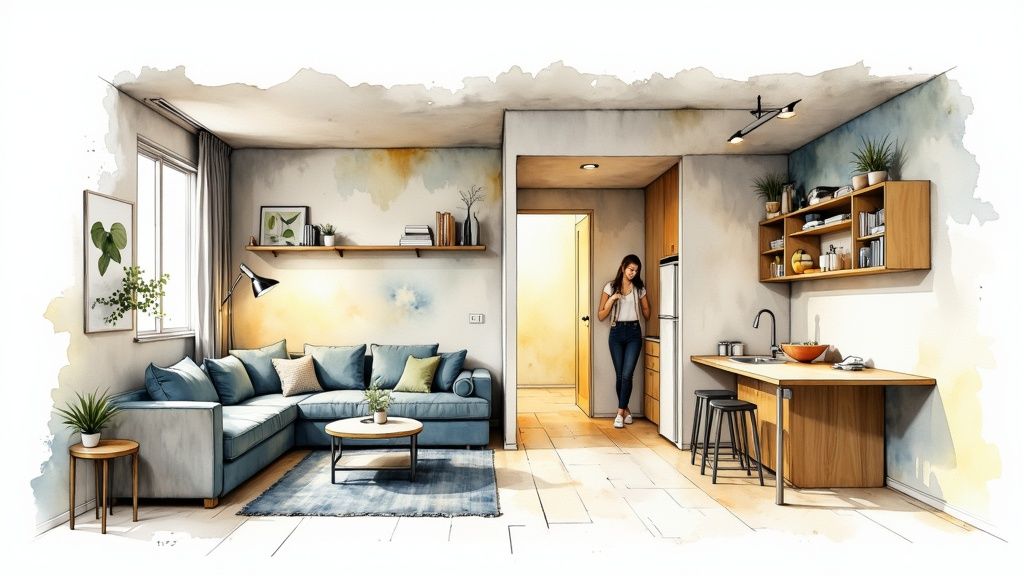
Living in a studio condo offers a unique blend of efficiency and style, but it also presents a significant design challenge: how do you create a functional, beautiful home within a single room? The key lies in strategic thinking and clever implementation. Gone are the days of feeling cramped or compromising on comfort; modern solutions can transform even the smallest footprints into expansive, multi-functional havens that cater to every aspect of your life. This guide is designed to provide you with expert-backed studio condo design ideas that go beyond generic advice, offering actionable strategies to help you maximize every square inch.
We will explore 10 distinct concepts that address the core challenges of single-room living. From creating dedicated “zones” within an open floor plan to integrating Murphy beds that disappear when not in use, each idea is crafted for practical application. You will learn how to leverage vertical space with innovative storage, select multi-functional furniture that works as hard as you do, and use light and mirrors to create an illusion of a larger area. To effectively maximize every square foot in your studio condo, consider implementing these smart apartment organization ideas alongside the design strategies we’ll cover.
This article moves beyond theory, providing concrete steps for implementation. For those who find it difficult to visualize how these changes will look in their own home, we will also discuss how design platforms like RoomGenius can bring these concepts to life. By simply uploading a photo of your space, you can experiment with different layouts, furniture arrangements, and color schemes digitally before committing to any physical changes. Prepare to rethink what’s possible and unlock the full potential of your studio condo.
1. Open Floor Plan with Zoning
An open floor plan with strategic zoning is one of the most effective studio condo design ideas for maximizing both perceived and actual space. Instead of relying on physical walls, which can make a small condo feel cramped and dark, this approach uses clever visual cues and furniture placement to create distinct, functional areas within a single, cohesive space. This design philosophy embraces the uninterrupted flow of an open concept while maintaining the organizational logic of separate rooms.
The core principle is to delineate zones for sleeping, living, and dining without erecting solid barriers. By doing so, you preserve sightlines and allow natural light to travel unimpeded throughout the condo, making the entire unit feel larger and more inviting. This technique is frequently seen in modern urban developments, from Manhattan micro-apartments to Toronto’s CityPlace condos, where efficient space utilization is paramount.
How to Implement Zoning in Your Studio
Creating effective zones requires a multi-layered approach that combines furniture, decor, and lighting.
- Area Rugs as Anchors: Use distinct area rugs to define the boundaries of your living and sleeping zones. A plush rug can anchor your sofa and coffee table, while a flatweave or jute rug might designate the dining area. The key is to ensure the rugs are large enough that the primary furniture in each zone fits comfortably on them.
- Strategic Furniture Placement: A well-placed piece of furniture can act as a natural divider. Position a sofa with its back to your sleeping area to create a clear separation. A tall, open-backed bookshelf, like an IKEA KALLAX unit, can function as a permeable wall, dividing the space while still allowing light to pass through.
- Lighting to Define Mood: Use different types of lighting to set the mood for each zone. Install bright, focused pendant lighting over a kitchen island or dining table, use softer ambient light like floor lamps in the living area, and place a dimmable task lamp on your bedside table.
Key Insight: The goal of zoning isn’t to hide different areas but to give each one a clear purpose and a sense of place. This creates a psychologically comfortable and highly functional living environment, even in a small footprint.
For those looking to explore this concept further, there are numerous resources available. To see detailed layouts and gain more inspiration, you can learn more about how to master the open floor plan with zoning for your small apartment.
2. Murphy Bed Systems
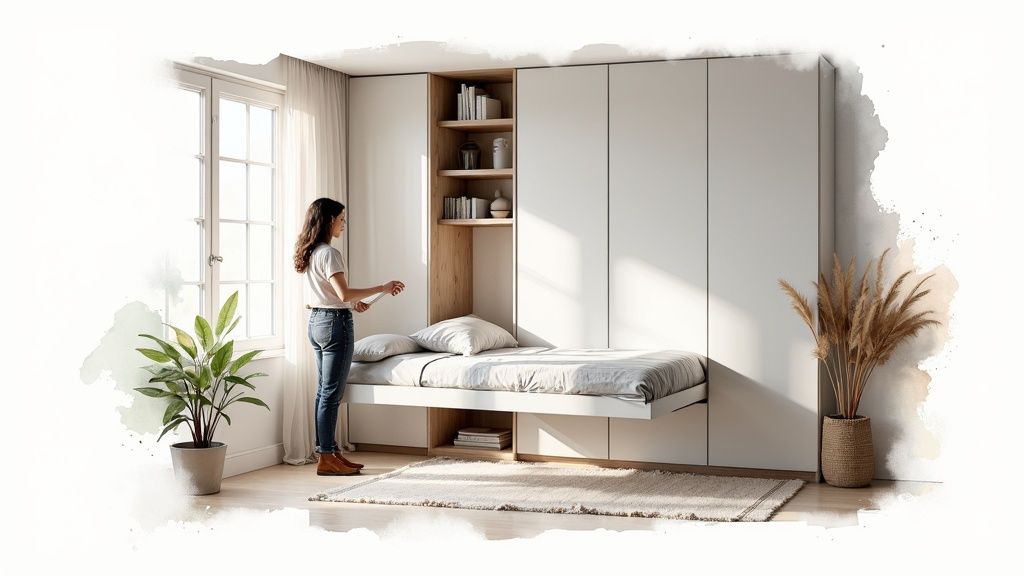
A Murphy bed system is a game-changing solution among studio condo design ideas for anyone looking to reclaim valuable floor space. This is a wall-mounted bed that folds vertically or horizontally into a cabinet or recessed wall cavity, effectively making the largest piece of furniture in your condo disappear. This transformative design allows you to convert a dedicated sleeping area into a functional living room, home office, or workout space during the day.
Modern Murphy beds are far from the clunky, spring-loaded contraptions of the past; today’s systems are sophisticated, easy to use, and highly customizable. They are a cornerstone of micro-living designs, prominently featured in innovative housing projects like NYC’s micro-apartments and San Francisco’s compact Blok flats. These systems are engineered to integrate seamlessly into a room’s aesthetic, often including built-in shelving, desks, or even sofas.
How to Implement a Murphy Bed System
Integrating a Murphy bed requires careful planning to maximize both its function and style.
- Choose the Right Orientation and Location: A vertical-tilt bed requires higher ceilings but has a smaller footprint when open. A horizontal (or side-tilt) bed is better for lower ceilings. For best results, install it near the entrance so you don’t have to walk across the living space to access it.
- Opt for Integrated Features: Select a system that includes features you need, such as a fold-down desk for a home office, a built-in sofa for a living room, or surrounding shelving for storage and display. This creates a multi-purpose hub rather than just a hidden bed.
- Simplify Your Bedding: To make daily conversion effortless, use lightweight bedding and a streamlined duvet or quilt that can be easily secured with straps before folding the bed away. This small habit makes the system much more practical for everyday use.
- Enhance with Lighting: Install LED strip lighting inside the Murphy bed cavity or around its frame. This adds a sophisticated, built-in look and provides soft, ambient light when the bed is down, eliminating the need for bulky bedside lamps.
Key Insight: A Murphy bed system fundamentally redefines the primary function of your space on demand. It’s not just about saving space; it’s about gaining the flexibility to live a larger life in a smaller footprint by instantly adapting your environment to your needs.
For those interested in high-end, customizable solutions, companies like Resource Furniture offer a wide range of innovative systems that blend engineering with sophisticated design.
3. Vertical Storage Solutions
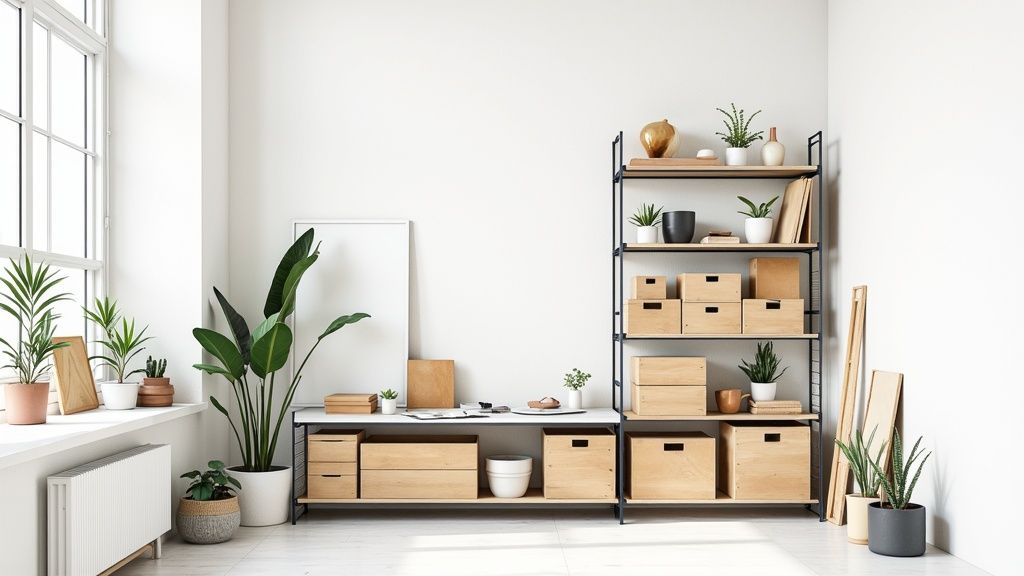
When floor space is at a premium, looking up is one of the most transformative studio condo design ideas you can implement. Vertical storage solutions leverage the often-neglected wall space from floor to ceiling, creating abundant room for your belongings without consuming a single extra square foot of your precious footprint. This strategy involves using tall shelving, wall-mounted units, and other creative systems to draw the eye upward and keep clutter off the floor.
This approach is about more than just adding shelves; it’s a design philosophy that reclaims unused vertical real estate to make your studio feel taller, more organized, and significantly more spacious. This technique is a cornerstone of efficient small-space living, evident in everything from minimalist Japanese apartments to functional Scandinavian studios, where every inch is designed with purpose.
How to Implement Vertical Storage in Your Studio
Effectively “going vertical” requires a mix of the right furniture and strategic organization to maintain a clean, uncluttered look.
- Floor-to-Ceiling Shelving: Install a tall, narrow bookshelf, like an IKEA BILLY or a ladder-style unit, to create a dramatic vertical line that also serves as a major storage hub. These are perfect for books, decor, and storage bins.
- Wall-Mounted Cabinets and Shelves: Floating shelves and cabinets free up floor space entirely, creating a lighter, more open feel. Use them above a desk, TV, or even your bed to store items you don’t need daily access to.
- Utilize Overlooked Spaces: Don’t forget the space above doorways and windows. A single long shelf installed in these high-up areas is perfect for storing seasonal items, extra linens, or a collection of decorative baskets.
- Pegboard Systems: A wall-mounted pegboard offers ultimate flexibility. Popularized by brands like The Container Store, it’s an ideal solution for a home office nook or kitchen area, allowing you to customize hooks, shelves, and containers as your needs change.
Key Insight: Vertical storage does two jobs at once: it provides essential storage and creates an illusion of height, making your entire studio condo feel grander and more open than its actual square footage suggests.
For those eager to maximize their wall space, exploring different systems and layouts is key. You can discover innovative ways to implement these ideas by viewing how to optimize your storage with vertical solutions.
4. Multi-Functional Furniture
Embracing multi-functional furniture is a cornerstone of effective studio condo design ideas, transforming a limited footprint into a versatile and highly efficient living space. Instead of filling your condo with single-purpose items, this approach prioritizes pieces that serve two or more functions, such as a bed that doubles as a sofa or a coffee table that rises to become a dining surface. This strategy is about making every square inch work harder for you, reducing clutter and maximizing utility.
The core principle is to select smart, convertible, or built-in storage pieces that adapt to your daily needs. By choosing furniture that can change its purpose on demand, you can seamlessly transition your studio from a bedroom at night to a home office during the day or a dining area for guests. This philosophy is championed by brands like IKEA and Muji and is heavily influenced by space-saving Danish and Japanese design principles.
How to Implement Multi-Functional Furniture in Your Studio
Integrating these pieces requires thoughtful selection to ensure they are both practical and stylish.
- Prioritize Primary Functions: Identify the activities you do most often. If you work from home, a convertible desk-console is more valuable than a guest-ready sofa bed. Choose pieces where the primary function is high-quality and comfortable for everyday use.
- Invest in Quality Mechanisms: For items that convert, like sofa beds or lift-top coffee tables, test the mechanism before buying. A smooth, durable conversion system will ensure the piece remains functional and easy to use over time, making it a worthwhile investment.
- Combine Seating and Storage: An ottoman with hidden storage is a classic choice for stashing blankets or magazines. You can also opt for a platform bed with built-in drawers underneath, which provides significant storage without occupying any extra floor space.
- Use Vertical and Nesting Pieces: Nesting tables are perfect for providing extra surface area when needed without cluttering the room when not in use. Similarly, a leaning desk can offer a workspace without the bulk of a traditional desk.
Key Insight: The goal of multi-functional furniture is to create a dynamic living environment that adapts to your lifestyle. It’s not just about saving space; it’s about adding layers of functionality that make small-space living more comfortable and organized.
For those looking to dive deeper into specific product recommendations and strategies, there are extensive guides available. To find the perfect pieces for your space, you can learn more about the best furniture for small apartments.
5. Light and Mirrors for Space Expansion
Using light and mirrors strategically is one of the most powerful and classic studio condo design ideas for visually expanding a small space. This technique manipulates perception, creating an illusion of depth and openness that can make even the most compact studio feel airy and bright. By reflecting both natural and artificial light, mirrors and reflective surfaces bounce illumination around the room, eliminating dark corners and enhancing the overall sense of volume.
The core principle is to amplify light and create false sightlines. A well-placed mirror can double the visual impact of a window, while layered lighting adds dimension and warmth, preventing the space from feeling flat or one-dimensional. This approach is frequently seen in Parisian apartments and high-end hotel rooms, where designers masterfully use reflective surfaces to craft an atmosphere of sophisticated spaciousness within a limited footprint.
How to Implement Light and Mirrors in Your Studio
A successful implementation relies on thoughtful placement and a balanced lighting scheme.
- Strategic Mirror Placement: Place a large, floor-length mirror opposite your main window. This will capture the incoming natural light and reflect it back into the condo, dramatically brightening the entire space. You can also use mirrored closet doors or a mirrored backsplash in the kitchen to achieve a similar effect without taking up wall space.
- Layer Your Lighting: Don’t rely on a single overhead fixture. Create a layered lighting plan with three types of light: ambient (general illumination from ceiling lights), task (focused light for activities, like under-cabinet lighting or a reading lamp), and accent (to highlight art or architectural features). Installing dimmer switches provides ultimate control over the mood.
- Incorporate Reflective Surfaces: Beyond mirrors, consider furniture and decor with reflective qualities. A glass coffee table, a high-gloss media console, or metallic accents like chrome or brass light fixtures can help bounce light around the room, contributing to a brighter, more open feel.
Key Insight: The goal is not just to add mirrors but to use them as architectural tools to reshape the perception of space. When combined with a multi-layered lighting strategy, this approach transforms a studio from feeling confined to feeling expansive and dynamic.
6. Minimalist Color Palettes
A minimalist color palette is one of the most impactful studio condo design ideas for creating an environment that feels spacious, serene, and cohesive. This approach involves limiting your color scheme to two or three base neutral colors, such as white, beige, or grey, and then introducing one or two accent colors for visual interest. By reducing visual noise, this strategy makes a small space feel larger, calmer, and more sophisticated.
The core principle is to create a unified backdrop that allows light to reflect and flow freely, enhancing the sense of openness. Instead of overwhelming the eye with competing hues, the focus shifts to texture, form, and subtle variations in tone. This philosophy is central to design movements like Scandinavian and Japanese minimalism, where simplicity and intentionality are prized over visual complexity.
How to Implement a Minimalist Palette in Your Studio
Successfully executing this look is about more than just painting your walls white; it requires a thoughtful balance of color, texture, and material.
- Establish a Neutral Base: Choose a dominant neutral color for your largest surfaces, like walls and major furniture pieces. Layer this with one or two other complementary neutrals to add depth. For example, pair crisp white walls with a light grey sofa and a natural wood coffee table.
- Introduce Texture for Warmth: To prevent a neutral space from feeling sterile, incorporate a variety of textures. Think of a chunky wool throw blanket, linen curtains, a jute area rug, or a velvet cushion. These elements add tactile richness without introducing new colors.
- Use Accents Strategically: Your accent color should be used sparingly but purposefully in smaller, easily swappable items. This could be through decorative pillows, a piece of art, a vase, or even a stack of books. This allows you to add personality and refresh the look without a major overhaul.
- Play with Finishes: Varying the finishes of your chosen colors adds subtle complexity. A matte black lampstand, a glossy white countertop, and a satin-finish wooden floor can all exist within the same neutral palette, each contributing a different visual quality.
Key Insight: A minimalist palette doesn’t mean a boring one. The design’s success lies in the deliberate interplay of light, texture, and subtle tonal shifts to create a space that is both visually restful and deeply engaging.
This approach is highly effective for creating a tranquil and expansive atmosphere in a compact home. To dive deeper into the nuances of this style, you can explore how to build a sophisticated achromatic color scheme for your condo.
7. Sliding Glass Partitions and Pocket Doors
For those seeking a more defined separation than zoning offers, sliding glass partitions and pocket doors are sophisticated studio condo design ideas that provide privacy without sacrificing space. Unlike traditional swinging doors, which require a significant arc of clear floor space to open, these solutions slide parallel to the wall or disappear into it entirely. This approach maintains an open feel while offering the flexibility to create a private bedroom or quiet workspace on demand.
The core benefit is the ability to transform a single open area into a multi-room layout without permanently shrinking the space. Glass partitions, in particular, allow natural light to flow freely, preventing the separated area from feeling like a dark, enclosed box. This method is prevalent in modern, high-density urban housing, from European compact apartments to San Francisco micro-lofts, where every square inch is optimized for function and style.
How to Implement Sliding and Pocket Doors
Installing these systems requires more planning than furniture-based dividers but offers a permanent and elegant solution.
- Glass Partitions for Light: Opt for floor-to-ceiling sliding glass panels to create a separate sleeping alcove. Use frosted or reeded glass to obscure views for privacy while still permitting light to pass through. This creates a distinct room that doesn’t visually chop the condo in half.
- Pocket Doors for Concealment: If you have non-load-bearing walls, a pocket door is the ultimate space-saver. It slides into a cavity within the wall, becoming completely invisible when open. This is ideal for separating a bathroom or a walk-in closet from the main living area, maximizing usable floor space.
- Frame and Mechanism Choices: The frame material (black steel, aluminum, natural wood) can significantly impact your condo’s aesthetic. Also, invest in high-quality hardware. A soft-close mechanism is a must-have feature to prevent slamming and ensure smooth, quiet operation for years to come.
Key Insight: Sliding partitions and pocket doors offer the best of both worlds: the spaciousness of an open concept and the privacy of a traditional floor plan. They are an investment that adds both functional and architectural value to a studio condo.
8. Strategic Kitchen Design
In a studio condo, the kitchen is often the most challenging area to design. A strategic kitchen design focuses on maximizing functionality and efficiency within a minimal footprint, ensuring it supports your culinary needs without overwhelming the living space. This approach moves beyond simply scaling down a traditional kitchen; it involves clever layouts, compact appliances, and smart storage solutions to create a cooking area that is both practical and visually integrated into the overall studio aesthetic.
The goal is to prevent the kitchen from dominating the condo. A well-designed compact kitchen feels intentional and seamless, blending into the background when not in use. This concept is perfected in European galley kitchens and Japanese compact designs, where every square inch is optimized. By prioritizing an efficient workflow and vertical space, you can create a highly capable kitchen that enhances your studio rather than detracting from it.
How to Implement a Strategic Kitchen Design
A successful small kitchen relies on smart choices in layout, appliances, and storage.
- Choose an Efficient Layout: The most common layouts for studios are the single-wall or galley kitchen, which keeps everything along one or two parallel walls, or an L-shaped design to tuck into a corner. A peninsula can also work, providing extra counter space while doubling as a dining area and a subtle divider for the living zone.
- Select Compact, High-Performance Appliances: Opt for appliances designed for small spaces. A slimline 24-inch refrigerator, an 18-inch dishwasher, and a two-burner cooktop offer full functionality without consuming valuable floor space. Brands like Bosch and IKEA offer entire lines of compact appliances perfect for this purpose.
- Maximize Vertical and Hidden Storage: Use the wall space above and below your counters. Install tall upper cabinets that reach the ceiling, use magnetic knife strips and spice racks to free up counter space, and incorporate pull-out pantries or lazy-susan cabinets to make corner storage accessible. Under-cabinet lighting is crucial for both task illumination and creating a sense of depth.
Key Insight: A strategic kitchen isn’t about sacrificing function; it’s about curating it. By selecting a layout and appliances that fit the scale of your studio, you create a space that is efficient, ergonomic, and aesthetically pleasing.
For those looking to dive deeper into optimizing their cooking area, exploring some valuable small kitchen remodel ideas can provide more specific guidance and inspiration.
9. Loft-Style Design with High Ceilings
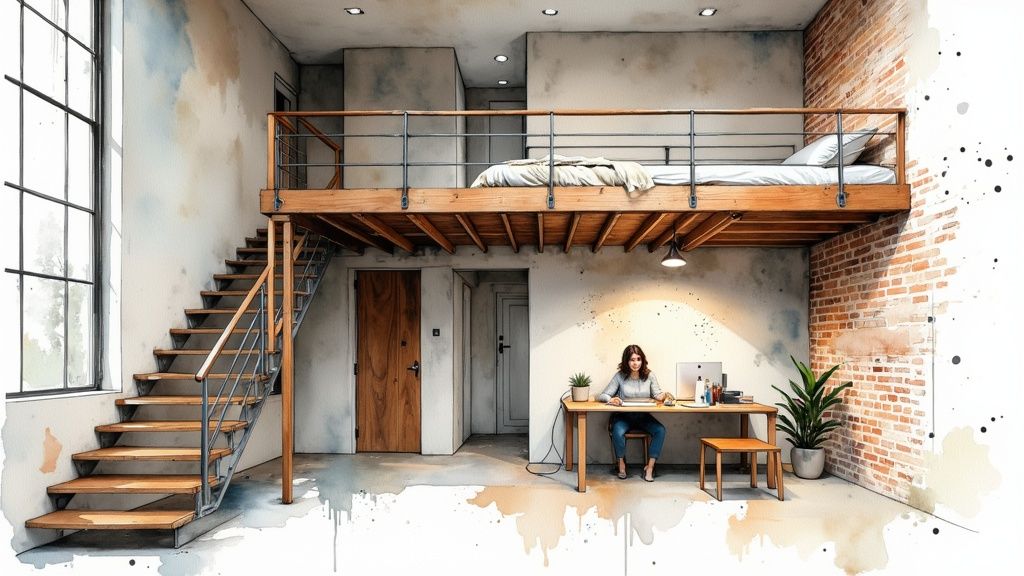
For studio condos blessed with generous vertical space, embracing a loft-style design is one of the most transformative studio condo design ideas available. This approach capitalizes on high ceilings by creating distinct levels, effectively doubling your usable square footage without altering the unit’s footprint. It separates private areas, like sleeping quarters, from the main living space, offering a level of privacy and spatial distinction that is typically impossible in a single-level studio.
This design is a hallmark of urban renewal projects, seen in conversions from Brooklyn industrial buildings to Chicago loft warehouses, where maximizing volume is key. By building upward, you create a dynamic, multi-dimensional living experience that feels both expansive and efficiently organized, turning a potential design challenge into your condo’s greatest asset.
How to Implement a Loft-Style Design
Successfully creating a vertical loft requires careful planning around structure, safety, and style to ensure the space is both functional and aesthetically pleasing.
- Install a Mezzanine or Loft Bed: The core of this design is a raised platform, most often used as a sleeping area. Custom-built mezzanines can be integrated seamlessly, while high-quality loft bed kits offer a more accessible solution. This immediately frees up the entire floor space below for a home office, a larger living room, or a walk-in closet.
- Utilize the Space Below: The area underneath the loft is prime real estate. Integrate a desk for a dedicated workspace, install modular shelving units for a library, or place a comfortable armchair and lamp to create a cozy reading nook. This strategic use of space is what makes the loft concept so powerful.
- Embrace Industrial Elements: Complement the loft’s architectural style with appropriate decor. Use large-scale, industrial-style pendant lights to draw the eye upward and illuminate the entire volume of the space. Leaving elements like exposed brick walls or visible ductwork can enhance the authentic loft feel.
- Prioritize Safety and Access: A sturdy, well-designed ladder or, if space permits, a compact staircase is non-negotiable. Ensure any lofted area has proper safety railings to prevent accidents. The access method should be both safe and convenient for daily use.
Key Insight: A loft-style design fundamentally changes the way you live in a studio. It separates functions vertically rather than horizontally, providing a clear psychological and physical division between public and private zones within a single open space.
10. Smart Technology Integration
Integrating smart home technology is a forward-thinking studio condo design idea that enhances functionality, comfort, and even the perception of space. This approach goes beyond mere gadgets, embedding automated and voice-activated systems into the fabric of your home to streamline daily routines and create a more responsive living environment. By automating tasks like lighting, climate control, and entertainment, you can reduce physical clutter and manual effort, making a small studio feel more sophisticated and efficient.
The core principle is to leverage technology to perform tasks that would otherwise require manual switches, multiple remotes, or physical movement. This not only adds a layer of modern convenience but also helps optimize energy usage and personalize your environment. This trend is increasingly standard in new urban developments, with tech-forward micro-apartments and condos from developers like those in Hudson Yards, NYC, showcasing the seamless blend of compact living and smart automation.
How to Implement Smart Technology in Your Studio
Getting started with smart technology is more accessible than ever and can be scaled to fit any budget or technical comfort level.
- Start with a Central Hub: Choose a smart home ecosystem to act as the brain of your operation. Popular choices include Amazon Alexa, Google Assistant, or Apple HomeKit. This ensures that new devices you add will work together seamlessly.
- Automate Lighting and Climate: Swap out traditional light bulbs for smart bulbs (like Philips Hue) and install a smart thermostat (like a Google Nest). This allows you to control brightness, color, and temperature with your voice or phone, and you can create “scenes” like “Movie Night” or “Good Morning” that adjust multiple settings with a single command.
- Optimize Entertainment: Mount a smart TV (like a Samsung Frame TV) on the wall to save floor space and double as digital art when not in use. Pair it with a compact smart speaker or soundbar to eliminate the need for bulky stereo systems, keeping your media setup clean and minimal.
Key Insight: Smart technology’s true power in a studio is its ability to make the space work for you. Automating routine adjustments frees up both mental and physical space, creating a more effortless and enjoyable living experience.
For those interested in exploring smart home possibilities, you can learn more about how to build a smart apartment from the ground up, starting with simple, high-impact devices.
10-Point Comparison: Studio Condo Design Ideas
| Option | 🔄 Implementation Complexity | ⚡ Resource Requirements | 📊 Expected Outcomes | 💡 Ideal Use Cases | ⭐ Key Advantages |
|---|---|---|---|---|---|
| Open Floor Plan with Zoning | Medium — minimal structural changes; planning and layout work | Low–Medium — furniture, rugs, lighting, minor partitions | Increased perceived space, better light distribution, flexible zones | Small studios wanting openness and entertaining space | Enhances light and flexibility; social, adaptable layout |
| Murphy Bed Systems | High — wall reinforcement and precise installation | High — expensive units ($2k–$8k+), hardware, possible motorization | Reclaims 40–60 sq ft; converts sleeping area to living area | Studios needing daytime living area or guest accommodation | Maximizes floor area; integrated storage and polished look |
| Vertical Storage Solutions | Medium — mounting, possible reinforcement for tall units | Medium — shelving systems, hardware; many affordable options | Substantially more storage without losing floor space; risk of visual heaviness if cluttered | Owners needing high-capacity storage while preserving floor plan | Efficient, adjustable storage; maintains open floor flow |
| Multi-Functional Furniture | Low–Medium — buying/testing mechanisms and placement | Medium — higher cost per piece vs single-use furniture | Fewer pieces, greater utility, flexible layouts; potential wear on mechanisms | Renters or frequent movers; small living areas requiring versatility | Space-efficient, versatile pieces that maintain minimalist aesthetics |
| Light and Mirrors for Space Expansion | Low — simple placement and installations | Low — mirrors, layered lighting fixtures; inexpensive fixes | Perceived larger, brighter spaces and improved mood; reflects clutter if unmanaged | Dark or cramped studios needing low-cost visual expansion | High impact for low cost; easy to implement and refresh |
| Minimalist Color Palettes | Low — selection and consistent application | Low — paint, textiles, small decor updates | Visual cohesion, calm atmosphere, perceived spaciousness; can feel sterile without texture | Those seeking calm, timeless interiors and easy updates | Simplifies decor, reduces visual clutter, versatile across styles |
| Sliding Glass Partitions and Pocket Doors | High — structural work for pockets or track systems | High — materials, professional installation, possible wall modification | Saves swing space, retains light while enabling privacy; less sound isolation | Studios needing occasional separation with daylight continuity | Space-saving separation, modern aesthetic, improved traffic flow |
| Strategic Kitchen Design | Medium — layout planning, cabinetry and appliance integration | Medium — compact appliances, cabinetry, plumbing/electrical work | Efficient workflow, reduced visual footprint; limited appliance capacity | Small-home cooks and studios prioritizing functional kitchens | Optimizes functionality in small footprint; energy and space efficient |
| Loft-Style Design with High Ceilings | High — structural, permits, mezzanine construction | High — construction costs, railings, stairs, HVAC considerations | Adds usable area and dramatic volume; heating/cooling challenges | Units with tall ceilings seeking distinct zones and extra square footage | Maximizes vertical space and character; creates distinct zones |
| Smart Technology Integration | Medium — device setup and ecosystem coordination | Medium–High — devices, reliable Wi‑Fi, ongoing updates | Improved convenience, energy savings, reduced physical clutter; privacy tradeoffs | Tech-forward occupants, accessibility needs, efficiency seekers | Automation, remote control, enhanced energy/security management |
Bringing Your Vision to Life
You’ve journeyed through a comprehensive collection of studio condo design ideas, each offering a strategic approach to transforming a compact space into a functional and beautiful home. The challenge of a studio is not its size but the opportunity it presents for thoughtful, innovative design. By moving beyond traditional concepts, you can create a living environment that feels expansive, organized, and perfectly tailored to your lifestyle.
The core principle weaving through all these strategies is intentionality. Every piece of furniture, every color choice, and every layout decision must serve a purpose, often multiple purposes at once. We’ve seen how a single room can be artfully divided into distinct zones without walls, how vertical space can become a storage powerhouse, and how light can be manipulated to create an illusion of depth and openness. These aren’t just tricks; they are foundational design principles applied with precision to the unique context of a studio apartment.
Recapping the Cornerstones of Studio Design
Let’s distill the most impactful takeaways from the ideas we explored. Mastering these concepts is the key to unlocking your studio’s full potential.
- Zoning is Non-Negotiable: The transition from an undefined box to a multi-functional home begins with clear zoning. Whether using area rugs, furniture placement, or subtle partitions like sliding glass doors, creating distinct areas for living, sleeping, and dining establishes order and psychological comfort.
- Embrace Multi-Functionality: In a studio, single-use items are a luxury you can’t afford. Prioritize pieces like a sofa that converts into a bed, a dining table that doubles as a desk, or an ottoman with hidden storage. This approach directly multiplies your usable space.
- Think Vertically and Visually: Your floor space is finite, but your vertical space is a blank canvas. Wall-mounted shelves, tall bookcases, and lofted beds draw the eye upward and free up valuable square footage. Similarly, strategic use of mirrors and light-bouncing color palettes are your most powerful tools for visual expansion.
- Technology as a Space-Saver: Smart home integration is more than just a convenience; it’s a design strategy. Wireless systems, smart lighting, and integrated entertainment hubs eliminate the clutter of cables, remotes, and bulky hardware, contributing to a sleek, minimalist aesthetic.
From Inspiration to Action: Your Next Steps
The journey from gathering studio condo design ideas to implementing them can feel daunting. The key is to start small and build momentum. Don’t feel pressured to overhaul your entire space overnight. Instead, identify your biggest pain point. Is it a lack of storage? A cluttered kitchen? A sleeping area that feels too exposed?
- Prioritize One Area: Choose one of the strategies discussed, such as implementing a vertical storage solution or redesigning your kitchen layout, and focus your energy there.
- Measure and Plan: Before purchasing anything, meticulously measure your space. Create a simple floor plan to understand the scale and flow. This step prevents costly mistakes and ensures every new piece fits perfectly.
- Visualize the Possibilities: This is where abstract ideas become tangible. It’s difficult to commit to a new layout or a bold color without seeing it first. Modern tools have completely removed this barrier, allowing you to experiment risk-free.
Ultimately, designing your studio condo is an exercise in personal expression and problem-solving. It’s about creating a sanctuary that supports your daily routines, reflects your personality, and maximizes every square inch. By combining the practical strategies we’ve covered with a clear vision, you can craft a space that is not just livable but truly inspiring. Your small space holds immense potential; it’s time to unlock it.
Ready to see these studio condo design ideas in your own home? Stop guessing and start visualizing with RoomGenius. Upload a photo of your studio and instantly experiment with different layouts, furniture arrangements, and design styles using advanced AI. Sign up for RoomGenius today and bring your perfect studio to life with confidence.