Radial Balance in Interior Design for a Harmonious Home
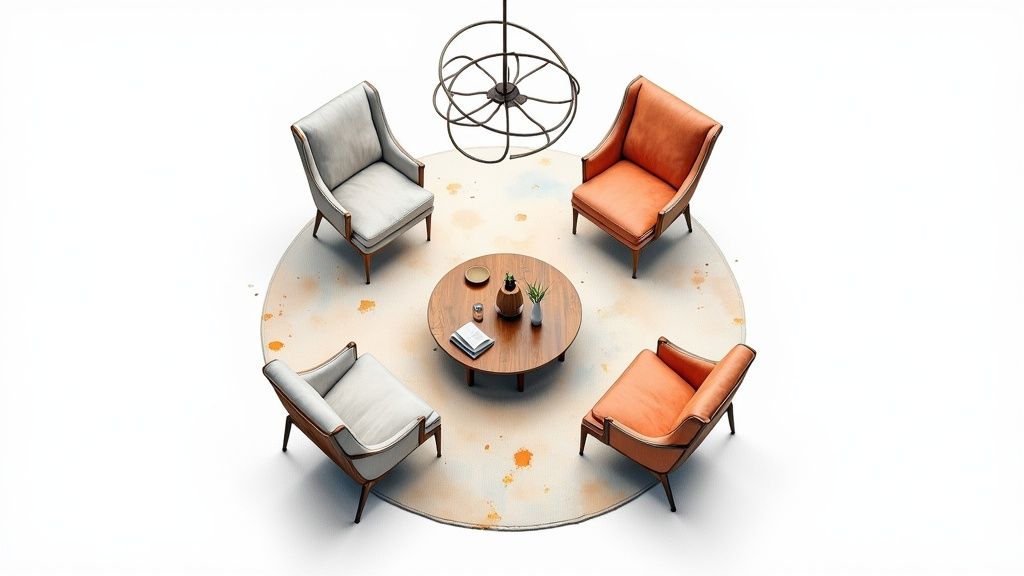
Think about the ripples that spread out when a single stone drops into a calm pond. That mesmerizing, outward-expanding pattern is the very essence of radial balance in interior design. It’s a powerful principle where every element in a space is arranged around one central point, creating a stunning sense of harmony and focus.

What Is Radial Balance and Why Does It Matter?
Radial balance is so much more than just putting furniture in a circle. It’s a sophisticated technique for crafting a space that feels both dynamic and stable all at once. It differs from symmetrical or asymmetrical balance, which are about mirroring items or balancing visual weight. Instead, radial balance pulls your eye inward to a central feature and then lets it travel back out along visual “spokes.”
The result is a unique mix of energy and calm. The central anchor gives your eye a place to rest, making a room feel grounded and intentional. At the same time, the radiating layout creates a subtle feeling of movement, keeping the space from feeling static or boring. It’s a design strategy that feels completely natural, echoing patterns we see everywhere in the world, from the petals of a flower to the spiral of a galaxy.
To get the full picture of how this fits into the grand scheme of design, take a look at our complete guide to the fundamental principles of interior design.
The Timeless Appeal of Radial Design
Using radial balance is hardly a new trend. In fact, this principle has been a cornerstone of art and architecture for thousands of years. Just look at the Roman Pantheon, a masterpiece of ancient engineering. Completed around 126 AD, its magnificent domed ceiling radiates flawlessly from a central oculus, evoking an awe-inspiring feeling of cosmic order.
This enduring legacy proves how radial design can achieve both structural integrity and a deep, profound visual harmony. You can explore even more about the history and application of radial balance at Design Your Way.
Key Characteristics of Radial Balance
Getting a handle on this concept is easy once you see its core parts. Every successful radial design hinges on three key elements working in concert.
Let’s break them down in this quick table.
Core Components of Radial Balance at a Glance
| Component | Description | Visual Effect |
|---|---|---|
| Central Focal Point | A single, dominant object or feature that serves as the anchor for the entire design. | Immediately captures attention and establishes a clear hierarchy in the room. |
| Outward Arrangement | All other furniture and decor items are positioned to radiate from the central point. | Creates visual pathways that guide the eye and reinforce the focal point’s importance. |
| Visual Repetition | Elements are repeated or mirrored around the center, like spokes on a wheel. | Builds a sense of rhythm, order, and cohesive harmony throughout the space. |
Think of these three components as the recipe for creating a perfectly balanced and engaging radial space. Without a strong focal point, the design has no anchor. Without the outward arrangement, there’s no sense of flow. And without repetition, the harmony falls apart.
The Psychology of Radial Balance in Your Home
Have you ever walked into a space and felt an immediate sense of peace and order? The way a room is arranged has a huge impact on our mood, and radial balance in interior design is a powerful tool that speaks directly to our subconscious. This principle works so well because it echoes patterns we’re already wired to find beautiful in nature.
Just think about a flower unfurling its petals, the ripples spreading out in a pond, or the sun’s rays fanning across the sky. These are all familiar, organic examples of radial balance. When we bring that same structure into our homes, it just feels right. Our brain instantly recognizes the pattern and registers it as harmonious.
Stability Meets Dynamic Energy
The real magic of radial balance is how it plays on two different psychological needs at once. The strong central focal point gives our eyes a place to land, creating a visual anchor. This delivers a powerful sense of stability, security, and calm. The room feels grounded and purposeful, which is a welcome relief in our often-hectic lives.
At the same time, the elements that radiate outward from that center point create a subtle but noticeable feeling of energy and movement. It’s not the frantic energy of a cluttered room, but a controlled, dynamic flow that draws you in. This outward push keeps the design from feeling flat or boring, adding a layer of visual excitement.
This interplay is key: radial balance provides the comfort of a stable center while offering the uplifting energy of expansion. It makes a space feel both secure and full of possibility.
This unique combination gives you a surprising amount of control over a room’s emotional tone. A dining room with chairs pulled up to a round table naturally encourages conversation to flow, creating a sense of unity. Likewise, a living room designed around a circular coffee table or ottoman becomes an inviting hub for family and friends to gather.
By understanding this psychological foundation, you can go beyond just placing furniture. You can start designing spaces that actually support the feeling you want to create—a room that is both peacefully grounded and refreshingly full of life.
Creating a Focal Point: The Heart of Your Design
Every great room designed with radial balance starts with a single, compelling focal point. It’s like the sun in your room’s solar system—everything else orbits around it, drawing its visual energy and direction from that central piece. Without that strong anchor, the whole design can feel aimless, and the harmony you’re trying to create just falls apart into a jumble of furniture.
So, the first and most critical decision is choosing that centerpiece. It doesn’t need to be huge, but it absolutely must have enough visual weight to grab and hold your attention. This is where you can get really creative. The focal point can be a piece of furniture, a striking decorative object, or even a feature that’s part of the room itself.
Selecting Your Central Anchor
The possibilities for a focal point are almost limitless, but most options fall into a few common categories. The key is to think about what you want the room to do or how you want it to feel, and then pick a centerpiece that brings that vision to life.
Here are a few classic examples to get you started:
- Lighting Fixtures: A dramatic chandelier suspended over a dining table or a sculptural pendant light in a soaring entryway are no-brainers. They naturally pull the eye upward and create an instant center.
- Furniture Pieces: Think of a large, round coffee table or a plush, circular ottoman. These pieces effortlessly anchor a living room seating area, creating a natural gathering spot for conversation.
- Decorative Elements: A bold, oversized circular area rug can single-handedly define a space, acting as the foundation from which all the other furniture radiates outward. Sometimes even smaller, curated items can work wonders, like beautifully arranged succulent terrariums for captivating focal points that draw the eye in.
- Architectural Features: In many homes, the focal point is already built right in. A gorgeous spiral staircase, a curved bay window, or an ornate circular ceiling medallion are perfect, ready-made starting points for a radial design.
Making Your Focal Point Shine
Once you’ve picked your star player, it’s time to make sure it gets the attention it deserves. Your goal is for it to be the very first thing people notice when they walk into the room. The best way to do that is by using contrast.
A focal point is not just an object; it’s a declaration of the room’s purpose and style. Give it the spotlight it deserves through strategic use of color, texture, and light.
It’s all about making it stand out. For example, place a dark, richly textured ottoman on a light-colored, low-pile rug to make it pop. Use spotlights or track lighting to wash a piece of art or a sculpture in light. If your focal point is a vibrant, patterned rug, keep the furniture around it more neutral so the rug’s colors and design can truly sing.
This kind of deliberate emphasis is a core principle of good space planning and visual hierarchy. By making your focal point impossible to ignore, you lay a rock-solid foundation for a beautifully balanced and captivating room.
Applying Radial Balance in Different Rooms
Now that we have the theory down, let’s talk about how to bring radial balance in interior design to life in your own home. This principle isn’t just for grand hotel lobbies or formal rotundas; it’s a surprisingly practical tool you can use to give your rooms a clear sense of focus, flow, and purpose. The real trick is learning how to adapt the core idea to the unique needs of each space.
Whether you’re working with a formal dining area or a cozy living room, creating a central anchor can completely transform how a room feels and functions. It all starts with finding a natural center and then letting the design ripple outward from there.
The Dining Room: A Natural Hub for Connection
If there’s one room that was practically made for radial balance, it’s the dining room. A round or oval table is the most obvious starting point, immediately establishing a central focal point. The entire layout naturally flows from this single piece, creating an atmosphere that just begs for good conversation and connection.
From there, you can arrange your dining chairs equally around the table to reinforce the circle. Want to take it a step further? Hang a stunning chandelier or pendant light directly over the center of the table. Even your place settings can get in on the action, with each charger and glass radiating out from the table’s core.
This diagram shows how a central element, like a chandelier or a table, becomes the anchor that all other design elements orbit around.

This approach gives the room a wonderfully cohesive and organized feel by constantly drawing your eye back to the central point before letting it travel outward.
The Living Room: Crafting a Conversational Circle
In the living room, radial balance is your best friend for creating seating arrangements that feel intimate and genuinely inviting. Your goal here is to establish a center of gravity that encourages people to gather. A large, circular coffee table or a plush, round ottoman often works perfectly as this anchor.
With your centerpiece in place, you can start arranging your furniture in orbit around it. This doesn’t mean you need a perfect, rigid circle. You could try a few different combinations:
- A gently curved sofa facing a pair of armchairs.
- Four comfortable chairs positioned to form a loose circle.
- A classic sofa with two chairs angled inward toward the center.
The key is simply that all the seating is oriented toward that central point, which fosters a cozy, connected atmosphere. For more specific layout ideas, check out our guide on how to arrange living room furniture. This method is fantastic for pulling a room together and avoiding that “furniture-pushed-against-the-walls” feeling that can make a space feel disconnected.
By arranging seating around a central table, you’re not just decorating; you’re designing a space for human connection. The layout itself invites conversation and shared experiences.
Beyond the Main Rooms
Don’t think radial balance is only for dining and living areas. You can use it to add a touch of elegance and order to all sorts of spaces throughout your home.
Think about a grand entryway—a round table right in the center, maybe topped with a dramatic floral arrangement, creates a powerful and welcoming first impression. In a home office, you could arrange your desk and shelving around a central point to create a focused, command-center-like workspace. Even a bedroom can benefit from this principle; a circular rug placed under the bed can act as a soft, grounding anchor for the entire room’s design.
Here is the rewritten section, designed to sound like an experienced human expert:
Common Mistakes to Avoid with Radial Balance
Getting radial balance right can create some truly show-stopping rooms, but a few common missteps can quickly turn a harmonious design into a bit of a mess. Knowing what to watch out for is half the battle, helping you create a space that feels deliberate and pulled-together, not awkward or chaotic.
The most common error I see is picking a weak focal point. If your central anchor—whether it’s a chandelier or a dining table—is too small or just doesn’t have enough visual weight for the room, the whole design falls flat. Everything else will feel like it’s floating aimlessly because there’s nothing strong enough to ground it. Your centerpiece needs to own its spot.
Overcrowding the Orbit
Another pitfall is simply trying to do too much. The magic of radial balance comes from its focused energy and flow, not from cramming as many pieces as you can around a central object. When you squeeze in too many chairs, side tables, or accessories, you kill the negative space that lets the arrangement breathe.
This just creates visual clutter, which is the exact opposite of the organized, calm feeling you’re going for. The “spokes” of your design get jumbled, and the eye doesn’t know where to go. Sometimes, what you decide to leave out is just as important as what you put in.
A great radial design should feel open and inviting, not cramped. Always protect the breathing room around your focal point to keep the space feeling clear and calm.
Forgetting About Variation
While this design principle is all about structure, it’s easy to become too rigid. If you insist that every single element radiating from the center is a perfect mirror image of another, the room can end up feeling stiff, overly formal, and just plain boring. A home needs to feel dynamic and lived-in, not like a static showroom floor.
Here’s how to sidestep that sterile look:
- Mix Up the Seating: Instead of four identical armchairs, why not try a two-seater sofa paired with a couple of chairs?
- Play with Textures: Use a variety of complementary fabrics and materials on the furniture pieces that circle your focal point.
- Vary the Scale: Not everything needs to be the same size. You can easily balance one larger piece with two smaller ones on the opposite side.
This is often called approximate radial balance, and it’s the secret to adding personality and visual interest. You get to keep that strong, centered structure while creating a more relaxed and sophisticated feel—a space that’s balanced but also full of life.
Bringing Your Radial Design to Life
Moving from a creative spark to a tangible plan is where the magic really happens. Before you start dragging heavy furniture across the room, it’s essential to visualize your radial balance in interior design. This crucial planning stage is your chance to play with layouts and test focal points without lifting a finger, making sure the final result feels perfectly intentional.

Sometimes the simplest tools are the most effective. Grab a piece of paper and sketch out a quick floor plan—it’s an incredibly useful way to see how different arrangements impact the flow of a room. You can instantly map out whether four armchairs feel more inviting than a sofa-and-chair combo around that central coffee table. This little exercise can uncover issues with scale and spacing you’d otherwise miss until it’s too late.
Using Modern Tools for a Clearer Vision
When you’re ready for a more detailed preview, modern design apps are a game-changer. Tools like our own RoomGenius let you upload a photo of your actual room and digitally experiment with furniture, rugs, and décor. This is risk-free design at its best. You can see exactly how a large circular rug anchors the space versus a smaller one, giving you the confidence to make the right purchase.
Visualizing your design first is like creating a blueprint for harmony. It bridges the gap between your idea and a functional, beautiful reality, saving you time and preventing costly mistakes.
To make sure your space feels both timeless and relevant, you could even play with incorporating elements from the current interior design trends. By testing these ideas digitally, you can perfect every detail before committing. This practical approach empowers you to fine-tune the scale, flow, and balance until your vision is ready to be executed flawlessly.
Still Have Questions? Let’s Clear Things Up
Got a few more questions rattling around about how to make radial balance work in your own home? You’re not alone. Let’s tackle some of the most common things people ask when they start playing with this design principle.
Can This Really Work in My Small or Rectangular Room?
Absolutely. You definitely don’t need a grand, circular room for this to be effective. In fact, radial balance can be a secret weapon in smaller spaces. Picture a round coffee table with four chairs tucked around it—it instantly creates a cozy, powerful focal point without eating up the whole room.
For a classic rectangular room, think in zones. You can create a pocket of radial balance within the larger layout. A great example is a seating area anchored by a circular rug at one end of the room. The trick isn’t the shape of the room, but your ability to establish a center point and arrange things around it.
The goal isn’t to force a circle into a square. It’s about creating a central point of gravity that organizes a specific area, bringing a sense of order and focus even within an irregular space.
Does Everything Have to Match Perfectly?
Not at all! In fact, most designers would tell you it’s better if it doesn’t. While the overall arrangement radiates from a central point, the individual pieces don’t have to be mirror images of each other. This is what we call approximate radial balance.
For example, you could easily balance a large sofa on one side of a circular coffee table with two smaller armchairs on the other. This creates a much more dynamic and interesting look than perfect symmetry, which can sometimes feel a bit stiff and formal.
What Are Some Simple Ways to Get Started?
You don’t need a massive budget or a full-on renovation to introduce radial balance. You can start small and see how you like it.
Here are a few easy and affordable ideas:
- A Statement Mirror: A large, round mirror, especially one with a sunburst frame, makes an instant radial focal point on any wall.
- An Area Rug: Simply placing a circular rug under your existing coffee table can completely redefine a seating area.
- Tabletop Decor: Group a few candles or small vases in a circular pattern on your dining table for a simple, elegant centerpiece.
- Wall Art: Try creating a gallery wall where smaller frames or decorative plates radiate outwards from a central piece.
Ready to see how a radially balanced layout could look in your own room? With RoomGenius, you can stop guessing. Just upload a photo of your space and start experimenting with different focal points, seating arrangements, and decor in seconds. See exactly how that round rug or statement light fixture will look before you make a move.
Visualize your perfect design and bring it to life with confidence at the official RoomGenius website.