Pet-Friendly Interior Design: Style That Survives Your Animals
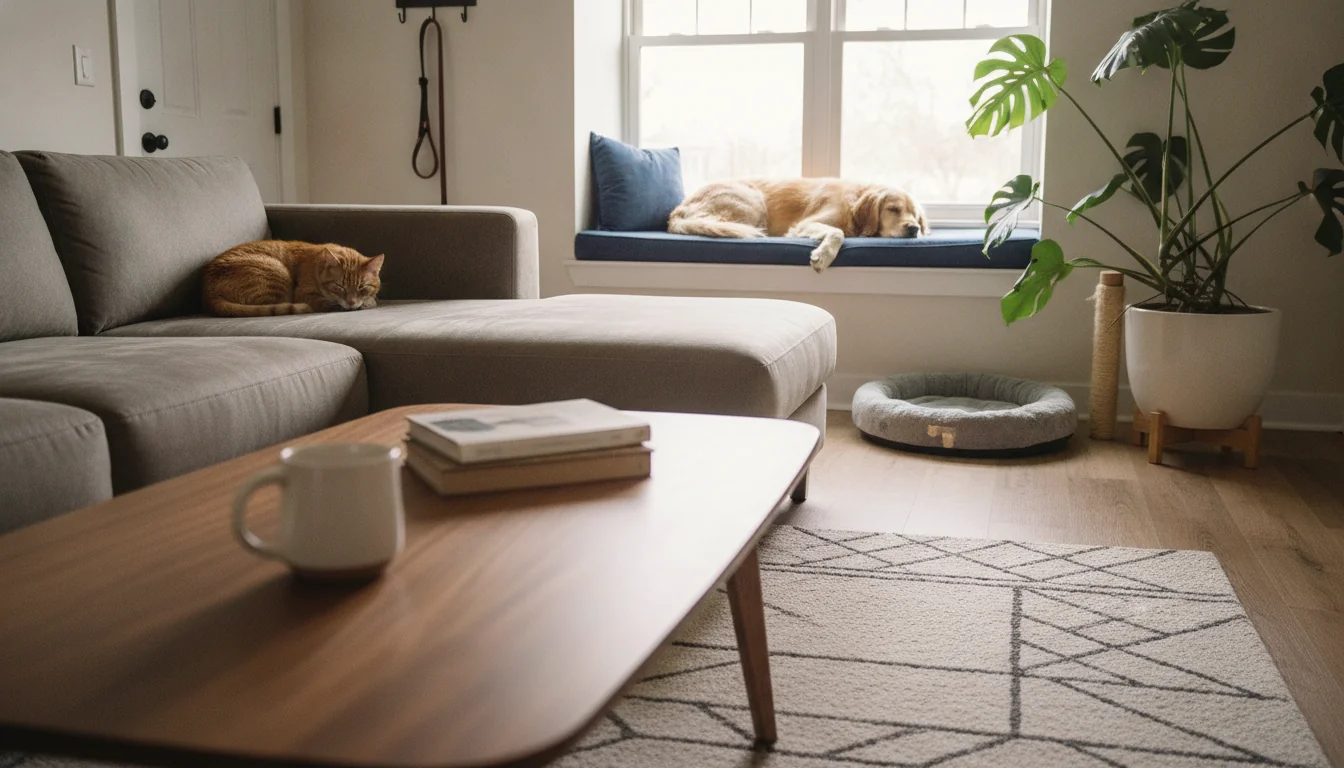
The honest thing about pets and furniture is that you can have nice things or you can have animals, and the choice is cultural, not practical. The practical truth is more interesting: the same materials, finishes, and layout choices that survive a 70-pound dog with muddy paws also survive kids, dinner parties, red wine, and the general wear of living in a house. Pet-friendly interior design isn’t a compromise category — it’s a durability discipline that makes any home better, whether or not you own a pet.
This guide covers why pet-friendly design is just good design applied honestly, the fabrics and finishes that actually survive claws and fur, the flooring and rug choices that hide and take abuse, the layout moves that make a room work for both animals and people, the furniture pieces that resist the sharp end of a dog’s enthusiasm, and how to preview every material swap on your actual room before you buy a thing.
What is pet-friendly interior design? Pet-friendly interior design is the practice of selecting materials, finishes, furniture, and layouts that withstand the specific wear patterns of living with animals — claws, fur, dander, mud, drool, accidents, and the daily traffic of a pet moving through the house — while maintaining the same visual standard as any other well-designed interior. It is not a distinct style but a material-and-layout discipline: performance fabrics instead of delicates, hard flooring instead of carpet, rounded corners instead of sharp ones, and zoning that gives both humans and animals comfortable territory. The best pet-friendly interiors are indistinguishable from non-pet homes to the casual visitor.
Why pet-friendly design is just good design
The most practical framing of pet-friendly design is that it’s simply good design tested against a higher standard of abuse. The same performance fabric that resists dog claws also resists the wear from a toddler crawling across the sofa. The same luxury vinyl plank that survives a cat’s hairball also survives the water ring from a forgotten glass. The same rounded-corner coffee table that doesn’t catch a dog’s tail also doesn’t catch a guest’s shin. The durability that makes a room pet-proof makes it people-proof too.
What changes when you design for pets is the material selection hierarchy. In a non-pet home, the first filter is usually aesthetic. In a pet-friendly home, the first filter is behavioral: “how will this material behave when a dog runs across it, a cat scratches it, or a wet animal lies on it?” The second filter is maintenance: “how many minutes does it take to restore this surface to its original state?” The third filter is still aesthetic — because you shouldn’t have to live in a room that looks like a kennel — but the aesthetic decision sits inside a practical constraint.
You’re not looking for pet-proof materials — nothing is proof against a determined dog with a bone. You’re looking for pet-resilient materials that recover quickly, clean easily, and don’t show every microscopic interaction. A dark charcoal sofa in performance velvet that vacuums clean in thirty seconds is more pet-friendly than a beige linen sofa that requires professional cleaning, even though the beige one is technically a more “durable” fabric. The resilience is in the relationship between the material and the maintenance routine.
The same principle applies to layout. A room that flows well for a dog — clear sightlines, a path from the dog bed to the door that doesn’t cross the coffee table, a landing zone for muddy paws near the entry — also flows well for people. The circulation improvements that accommodate a pet’s movement are the same improvements that make a room feel spacious and logical. Our room layout ideas guide covers the geometry of good traffic flow; pet-friendly design is that geometry plus a few specific animal-aware tweaks.
Fabrics and finishes that survive pets
Fabric is the single most vulnerable surface in any pet-occupied home. The sofa, the armchair, the ottoman, the curtains — all are at the pet’s level, and all are the first thing a dog climbs on or a cat scratches. Getting fabric right is the highest-leverage decision in a pet-friendly interior, and the options have expanded dramatically in the last five years.
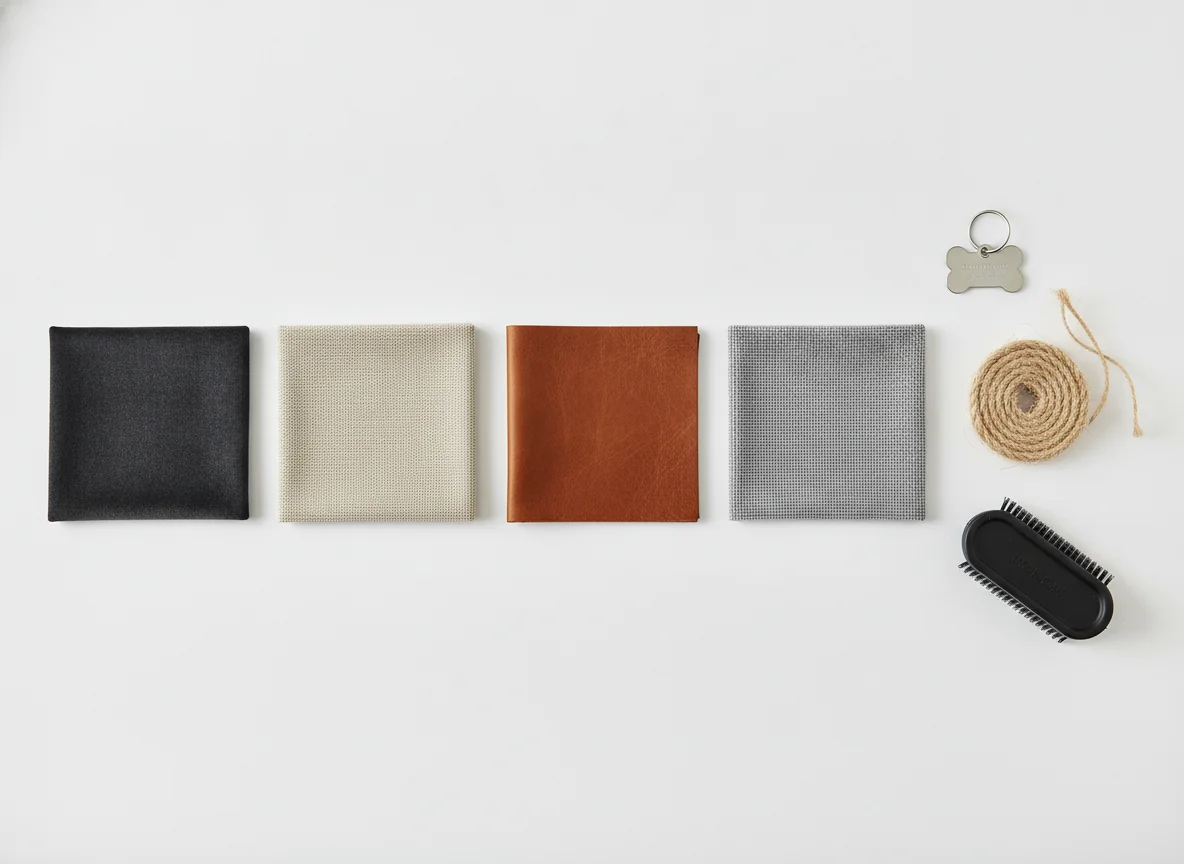
Performance fabrics are the foundation. Solution-dyed acrylic (Sunbrella and its competitors), polyester-olefin blends (Revolution, InsideOut, and the “performance velvet” category), and Crypton-treated cottons all resist moisture, staining, and abrasion at levels that were unheard of a decade ago. The key number is the Wyzenbeek abrasion rating — look for 50,000 double rubs or higher, which is the commercial-grade threshold. Most pet-friendly fabrics in the 100,000-double-rub range look and feel like normal upholstery.
| Fabric type | Claw resistance | Stain resistance | Fur removal | Best for |
|---|---|---|---|---|
| Performance velvet (polyester) | High — tight weave resists snagging | High — liquid beads on surface | Low — fur clings to nap | Sofas, accent chairs, headboards |
| Solution-dyed acrylic | Medium — snags if claws are sharp | Very high — bleach-cleanable | High — fur brushes off easily | High-traffic sofas, dining chairs |
| Microfiber / microsuede | High — very tight weave | High — spills clean with water | Medium — fur can embed | Family room sofas, basement rec rooms |
| Leather (full-grain, pigmented) | Very high — scratch-resistant | Very high — wipes clean | Very high — fur slides off | Accent chairs, low-claw households |
| Crypton-treated cotton | Medium — weave can snag | Very high — barrier treatment | High — smooth surface | Living room sofas, headboards |
| Linen (untreated) | Low — snags easily | Low — stains immediately | High — smooth surface | Avoid in pet homes |
| Chenille | Low — loops catch claws | Medium — absorbent | Low — fur sticks | Avoid in pet homes |
The “performance velvet” category — tightly woven polyester with a short, dense nap — is the current sweet spot. It looks like a normal velvet, feels soft to the touch, and resists claw snags better than any other fabric in the middle price band. Fur does cling to it, but a rubber pet-hair brush removes it in about fifteen seconds per cushion. That combination — high claw resistance, easy cleaning, normal appearance — makes it the most practical recommendation for a pet-owning home.
For the full furniture-buying guide beyond the pet angle, our furniture types and styles article is the companion read.
Flooring and rugs that hide (and take) abuse
Flooring in a pet home faces a different set of stresses than upholstery. Claws scratch, accidents stain, muddy paws track, and fur accumulates. The right flooring choice is the one that hides the wear between cleanings and cleans up fast when you do get to it.
Luxury vinyl plank (LVP) is the pet-friendly flooring winner for most homes. It’s waterproof, scratch-resistant (the better brands have a 20-mil or thicker wear layer), comfortable underfoot, and available in wood-look planks indistinguishable from engineered hardwood at a glance. The key specification is the wear layer: 20 mil for most homes, 28 mil for high-traffic or large-dog households. LVP is also quieter than tile or hardwood, which matters when a 70-pound dog trots across the room at 6 a.m.
Engineered hardwood with a high-quality aluminum-oxide finish is the second option, and it’s the right choice if you’re committed to real wood. The aluminum-oxide topcoat resists scratches better than site-finished hardwood, and the engineered construction is more dimensionally stable in humidity changes. The trade-off is that scratches on real wood are permanent — you need to be comfortable with visible wear over time.
Tile and stone are the most durable option, but also the coldest, hardest, and most expensive. Large-format porcelain tiles in 12-by-24-inch or larger planks minimize grout lines (grout is the weak point — it stains and absorbs), and rectified-edge tiles allow a tighter grout joint.
| Flooring type | Scratch resistance | Water resistance | Cleaning ease | Cost per sq ft |
|---|---|---|---|---|
| LVP (20+ mil wear layer) | High | Excellent | Sweep + damp mop | $3–$8 |
| Engineered hardwood (AlO finish) | Medium | Low — water between planks is a risk | Vacuum + wood cleaner | $6–$15 |
| Porcelain tile (large format) | Very high | Excellent | Mop + grout brush | $5–$15 |
| Carpet (low-pile, loop) | Low — loops snag | Very low | Vacuum + professional clean | $2–$7 |
| Strand-woven bamboo | High | Medium | Vacuum + damp mop | $4–$9 |
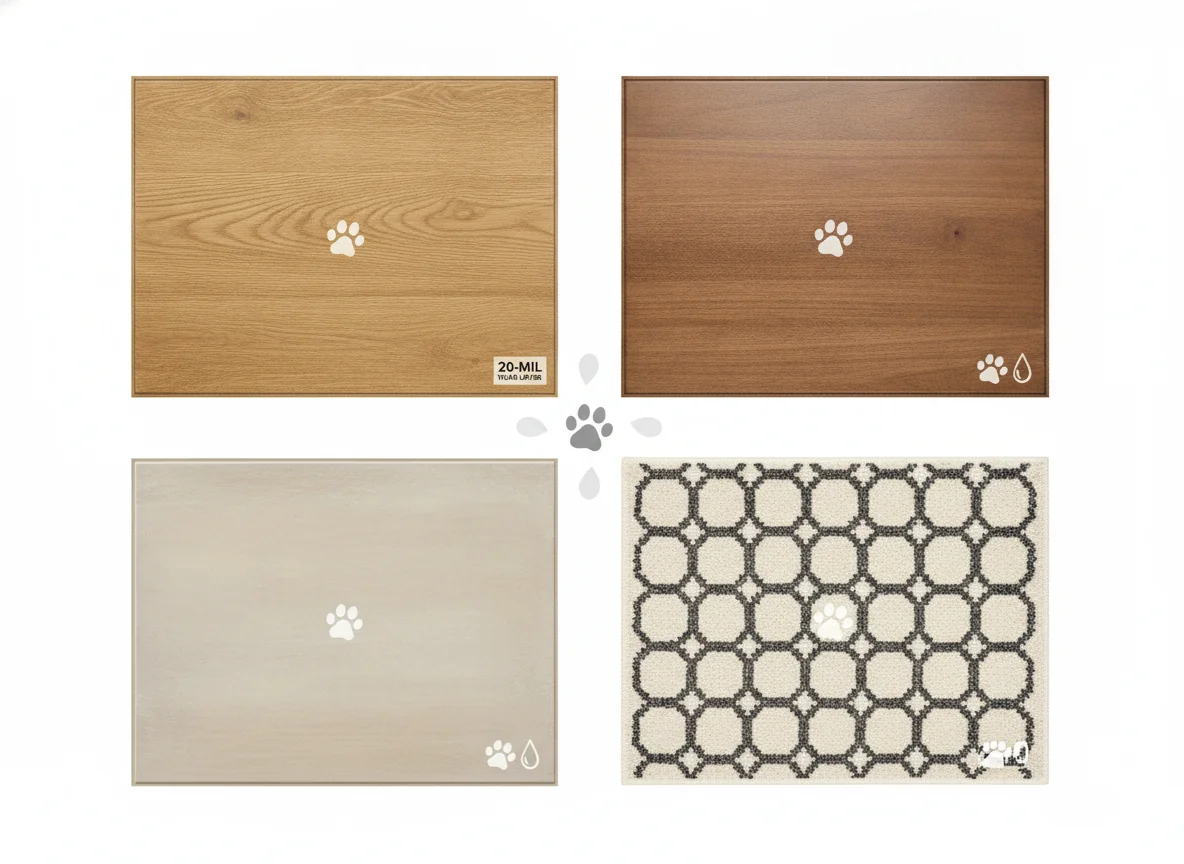
Rugs are the trickiest pet flooring decision because they get the most concentrated abuse. The right rug for a pet home is a low-pile wool or wool-blend in a pattern that hides fur. Wool is naturally stain-resistant (the lanolin repels liquids), and the low pile doesn’t trap dirt the way a shag does. Patterned rugs — geometric, striped, abstract, floral — hide fur, dander, and the occasional spot far better than solids. Our how to choose the right rug size guide covers the sizing geometry; the pet-friendly version adds “choose a pattern and a low pile.” Use a high-quality felt-and-rubber rug pad to prevent slipping under a running dog.
Layout: pet zones, sightlines, and traffic flow
The layout of a pet-friendly home is the invisible layer that most people miss. It’s not about choosing the right sofa; it’s about arranging the room so the sofa, the dog bed, the entry, and the outdoor access work together in a daily rhythm that doesn’t feel like an obstacle course.
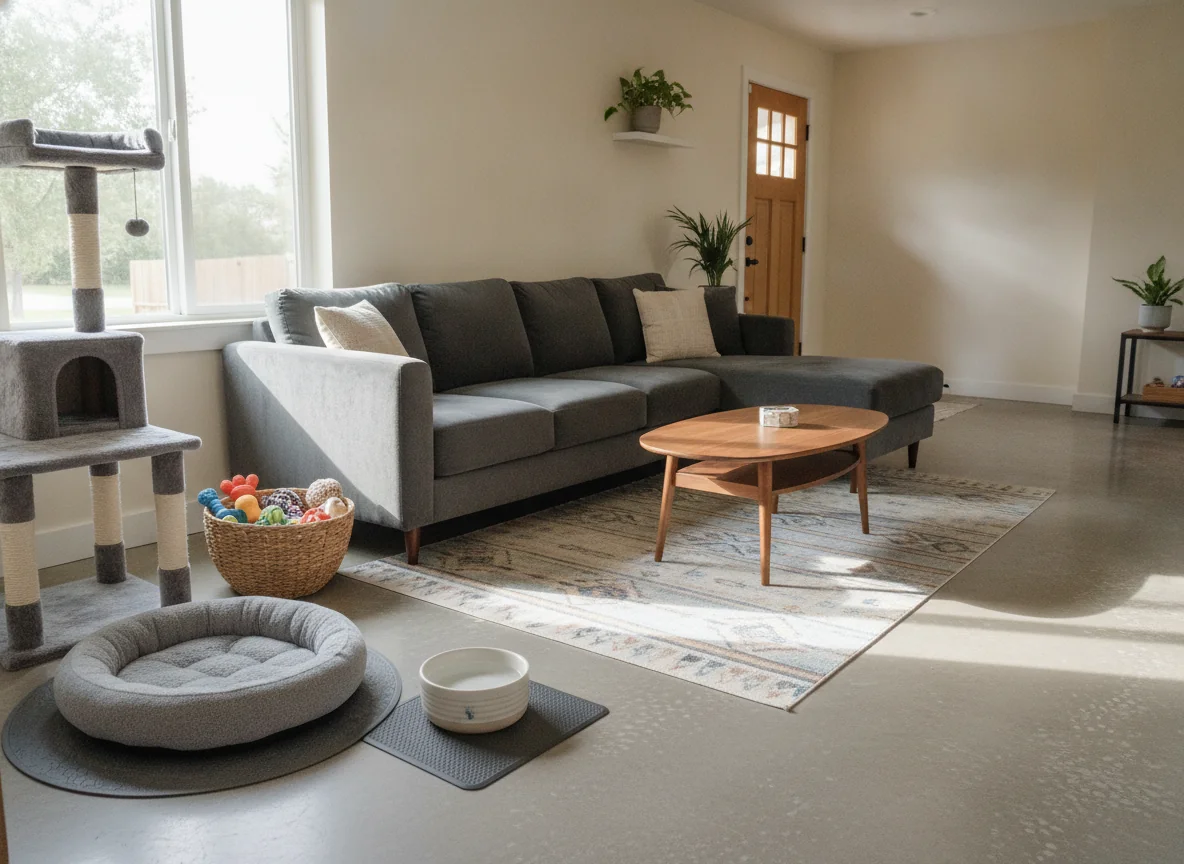
The pet zone is the single most important layout concept. Every room that a pet spends significant time in should have a designated pet zone — a corner with a bed, a water bowl, and a few toys — visually defined but not visually dominant. The pet zone should be off the main traffic lane, out of the way of feet, and adjacent to a wall or low furniture that gives the animal a sense of security. In a living room, the pet zone often works best next to the sofa or under a window, where the animal can see the room’s activity without being underfoot.
Sightlines matter more to pets than to people. A dog that can see the front door from its bed is calmer than one that hears the doorbell from a blind corner. A cat that can see a window from its cat tree will use it more than one that has to jump onto a piece of furniture. The layout should give each pet at least one sightline to the room’s primary activity point from its designated zone. This is often a small adjustment — a 15-degree rotation of the pet bed or a different placement of the cat tree — but it changes how the animal uses the space.
Traffic flow is the third layer. A pet-friendly room has clear, wide paths between the pet zone, the door, and outdoor access. The most common layout mistake in pet homes is furniture that creates a narrow choke point — a coffee table too close to the sofa, a side table in the path from the dog bed to the back door. The correction is usually to widen the primary path by six inches and reduce the furniture footprint by one piece. The room feels bigger for everyone.
For the full framework on arranging furniture, the how to arrange living room furniture guide is the practical companion — the principles transfer directly, with the pet-specific additions above.
Furniture choices that resist claws and fur
Beyond the fabric choice, the furniture itself has structural characteristics that determine how well it survives a pet. The frame, the finish, and the shape all matter.
Sofa frames. A sofa’s frame should be kiln-dried hardwood — oak, maple, ash, or beech — with double-doweled and glued joinery. The frame determines whether the sofa survives a 60-pound dog jumping onto it four times a day. The manufacturer’s warranty is a useful proxy: a brand that offers a lifetime frame warranty is building frames that can take the abuse.
Coffee table finish. The coffee table is the most-abused furniture surface in a pet home — dogs rest their chins on it, cats walk across it, and a tail sweeps across it at the perfect height. The best finish is a medium-to-dark wood tone with a catalyzed lacquer or conversion varnish finish. Avoid painted tables (they scratch and chip) and raw wood (it absorbs moisture and stains). A table with eased corners is safer for both pets and people.
Accent chairs. The best accent chair for a pet home is one that’s easy to clean and hard to tip over. A sturdy frame with a low center of gravity — a wide base, heavy legs, substantial mass — resists tipping when a dog leans against it. Wingback chairs, barrel chairs, and club chairs with a generous seat depth are all good choices. Avoid delicate exposed-leg frames and anything with a stretcher bar at ankle height.
Cat-specific considerations. For cat owners, the layout consideration is vertical: cats need paths up. A cat tree near a window, a shelf walkway above the sofa, a tall scratching post in the corner — these give the cat territory separate from the dog’s and from the human’s furniture. The most practical approach is to decide what surfaces you want the cat to climb and provide them, so the cat doesn’t decide independently. A cat tree with natural sisal rope wrapping is the most effective single purchase for protecting your sofa.
For the complete guide to furniture styles, the best furniture for small apartments post covers the space-efficiency angle that often overlaps with pet-friendly scaling.
Previewing pet-friendly material swaps
The hardest part of pet-friendly design is that the right material choice is often invisible on a showroom floor. A performance velvet sofa looks the same as a regular velvet sofa until a dog claws it. A luxury vinyl plank floor looks the same as a laminate floor until a water bowl spills. You can’t test resilience without buying, installing, and living with a material for six months — which is why most people learn pet-friendly design the hard way.
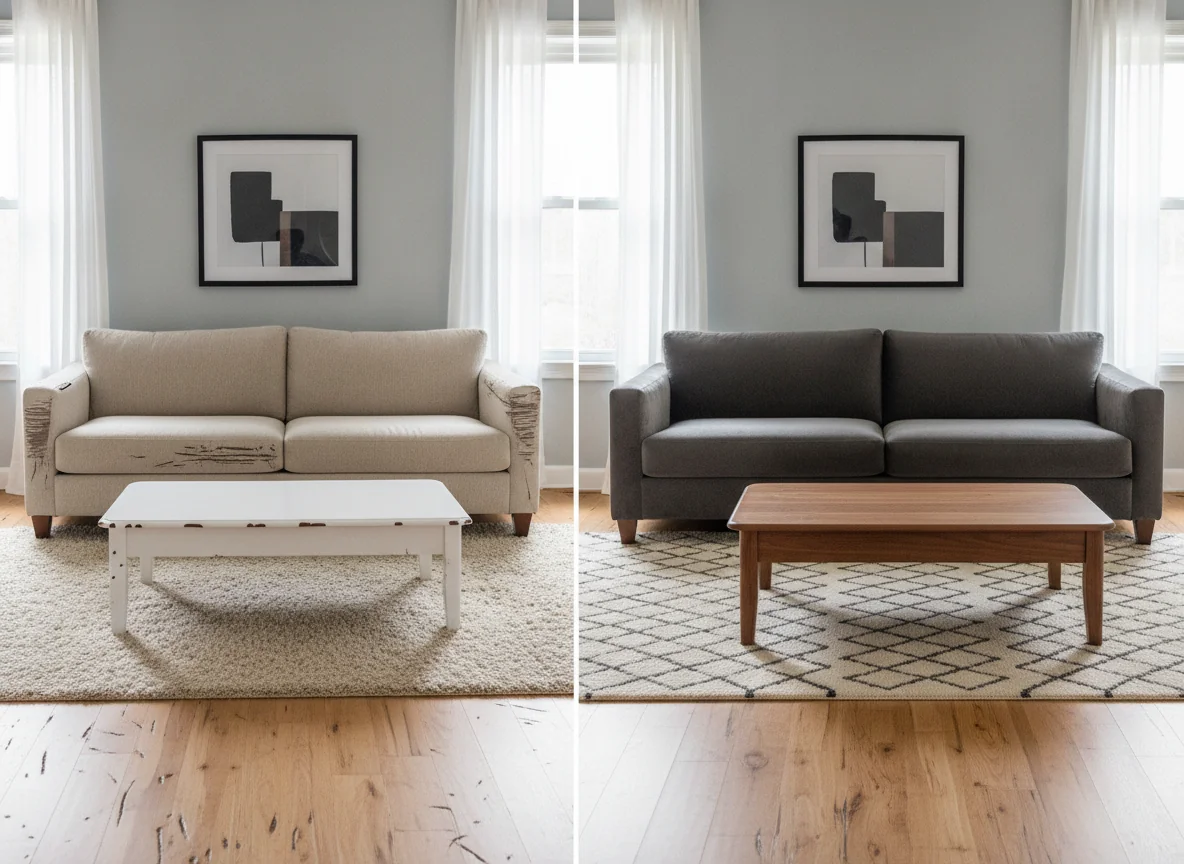
AI room design tools solve this by letting you preview material swaps on your actual room before you buy. The workflow is specific: instead of generating a completely new room, you ask the AI to keep your existing layout and swap only the material surfaces — the sofa fabric, the rug type, the flooring, the coffee table finish — into pet-friendly equivalents. The render shows you what the room looks like with a performance velvet sofa, a low-pile patterned rug, and luxury vinyl flooring, all while keeping the sofa’s position and the art on the wall exactly as they are.
The practical workflow runs in three passes:
Pass one — fabric swap. Upload a photo of your current living room and prompt the AI to render the same scene with the sofa reupholstered in a specific performance fabric — “charcoal performance velvet,” “oatmeal Sunbrella,” “cognac full-grain leather” — and the same change applied to accent chairs and ottomans. The render shows you whether the new fabric works with your existing wall color, rug, and accessories.
Pass two — floor swap. Using the same photo, prompt the AI to swap the flooring to LVP in a specific tone — “warm oak luxury vinyl plank” or “driftwood gray LVP” — and the rug to a low-pile patterned option. The render shows you whether the floor reads too dark or too light against the furniture.
Pass three — full room preview. Combine the swaps into one prompt: “the same room with charcoal performance velvet sofa, warm oak LVP flooring, a low-pile cream-and-charcoal geometric rug, and a medium walnut coffee table with a lacquer finish.” The render validates that all the material decisions work together.
The value of this workflow is that it kills bad decisions before they’re purchases. The charcoal velvet that looked great in the showroom may be too dark against your existing wall. The warm oak LVP may clash with the kitchen flooring visible through the doorway. Learning those from a render is free; learning them from a delivered sofa is a restocking fee and a week of waiting.
For the broader AI interior design workflow — how to photograph a room, write effective prompts, and evaluate results — the ai interior design post is the full guide. The material-swap workflow above is a specific application of the same tools.
FAQ
What’s the most pet-friendly sofa fabric for a home with a large dog?
Performance velvet in a medium-to-dark tone. It resists claw snags better than any other fabric in the same price range, cleans easily with a damp cloth, and the tight weave prevents fur from embedding. Dark charcoal, slate blue, or chocolate brown hide fur between vacuuming sessions. Avoid light beige, cream, and pale gray unless you’re committed to weekly cleaning.
Is leather a good choice for a pet-friendly home?
It depends on the pet. Leather is excellent for fur removal (it slides right off), stain resistance (wipes clean), and durability (full-grain pigmented leather resists scratches). However, cat claws can puncture it, and dog claws can leave visible scratches on aniline leather. The right choice is pigmented or protected leather, which has a surface coating that resists scratching better than uncoated aniline varieties.
What’s the best flooring for a home with dogs and cats?
Luxury vinyl plank (LVP) with a 20-mil or thicker wear layer. It’s waterproof, scratch-resistant, comfortable underfoot, and available in wood-look designs visually indistinguishable from hardwood. Maintenance is simple: sweep daily and damp-mop weekly. Avoid carpet in rooms where the dog spends significant time, and avoid real hardwood if the dog has long nails.
How do I keep pet fur off the furniture?
Three strategies: (1) Cover the furniture with a washable throw in a color that matches the pet’s fur, and wash it weekly. (2) Use a rubber pet-hair brush (the squeegee-style kind) for a thirty-second daily pass over each cushion. (3) Choose fabrics that don’t trap fur — leather, performance velvet, and microfiber are all easier to clean than linen, chenille, or bouclé.
Can I design a pet-friendly room that doesn’t look like a pet lives there?
Yes — the best pet-friendly rooms are indistinguishable from non-pet homes to the casual visitor. The key is choosing materials that are indistinguishable from their non-durable counterparts. A performance velvet sofa in charcoal reads exactly like a regular velvet sofa. A luxury vinyl plank floor in warm oak reads exactly like engineered hardwood. The durability is invisible until the dog jumps on the sofa.
What about the smell? Are there materials that resist pet odors?
Yes. Performance fabrics with moisture-barrier backings resist odor absorption from accidents. Wool rugs are naturally antimicrobial and odor-resistant. LVP flooring doesn’t absorb odors at all (unlike carpet, which traps them). For sofas, removable, washable cushion covers are the single most effective odor-control measure. A monthly vacuum of the sofa’s crevices with a crevice tool and a sprinkle of baking soda left for 15 minutes before vacuuming both help.
How do I preview a pet-friendly material swap before buying?
Use an AI interior design tool with the material-swap workflow described above. Upload a photo of your current room and prompt the AI to swap the sofa fabric, flooring, rug, and coffee table finish to pet-friendly alternatives while keeping the rest unchanged. The render shows you whether the material choices work together aesthetically before you commit any money. The workflow is free, takes about two minutes per render, and the cost of a wrong decision discovered in a render is zero.
Preview pet-proof material swaps on your actual rooms
The best pet-friendly interior design is the one that doesn’t look like pet-friendly interior design. The sofa is a performance velvet in a deep charcoal tone. The floor is a warm oak LVP with a matte finish. The rug is a low-pile geometric pattern in cream and charcoal. The room works for the dog, the cat, and the overnight guest, and nobody would look at it and think “pet home.”
The RoomGenius app lets you preview every material swap before you buy — the sofa fabric, the flooring, the rug, the whole room — on a photo of your actual space. Upload a photo of your living room, tell the AI to swap the sofa to charcoal performance velvet and the floor to warm oak LVP, and the render comes back in under two minutes. That’s the preview that kills bad purchases before they happen. Try it on the App Store or Google Play. Preview pet-proof material swaps on your actual rooms — it’s the most durable design habit there is.