AI Rental Apartment Design: Decorate Without Losing the Deposit
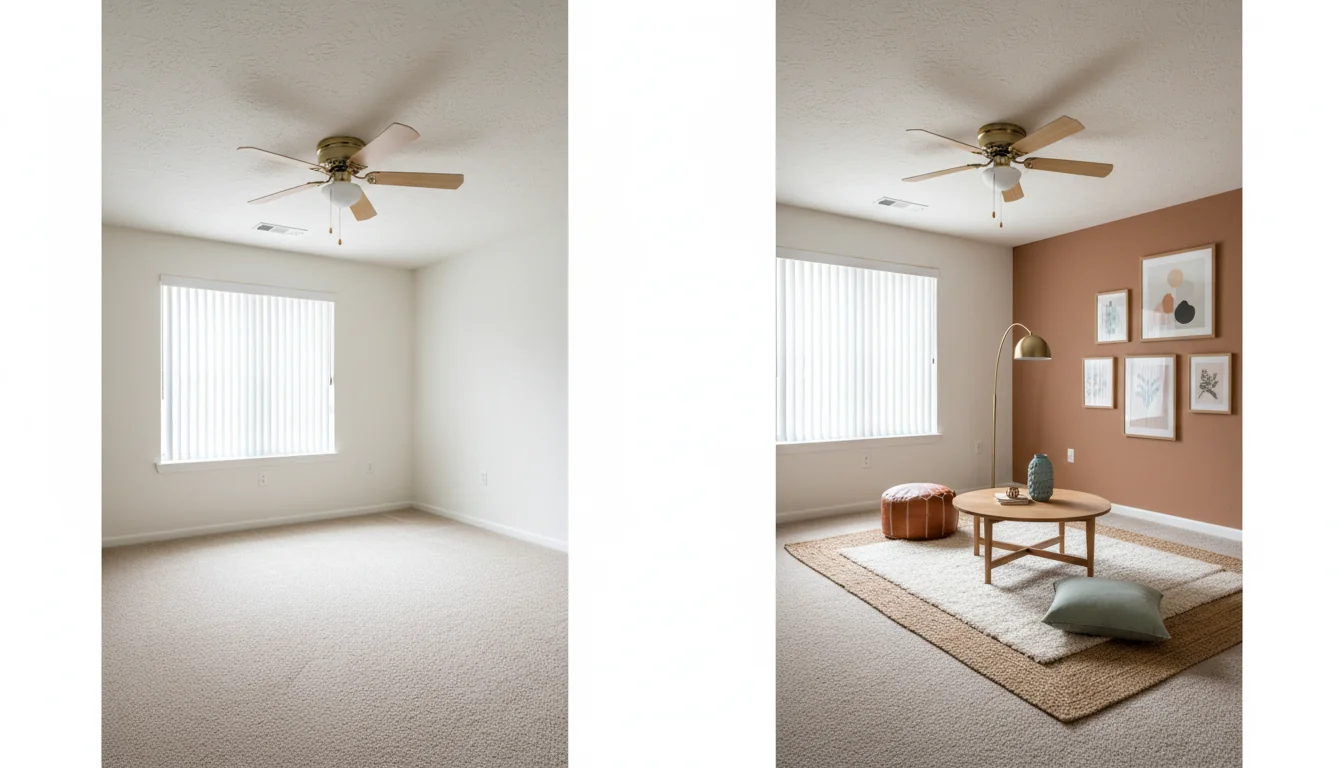
You signed the lease six months ago and the apartment still looks like a model unit at month nine of vacancy. The walls are the same flat off-white. The ceiling fan is the brass-accented one that came with the building in 2007. The carpet is “agreeable beige.” You want the place to feel like yours, but the lease has a clause about paint colors and another about anchors in the walls and a third about anything that “alters the unit,” and the deposit is two thousand dollars you’d rather not finance the landlord’s next refresh with.
AI rental apartment design is built for that exact tension — the renter who wants real style and the lease that wants the unit returned the way it left. It collapses the slow, anxious cycle of “would this even work? would I get my deposit back?” into a stack of photoreal renders showing what your apartment looks like with peel-and-stick wallpaper, plug-in lighting, freestanding furniture, and removable decor — and only those things. This guide is the lease-friendly playbook: what “rental friendly” actually means in 2026, the four reversible upgrade categories that move the needle, how to use AI to preview what comes off the wall as cleanly as it goes on, and the move-out test that tells you whether you’ll see your deposit again.
What is AI rental apartment design? AI rental apartment design is the use of generative AI tools to take a photo of a rental unit and produce photorealistic redesigns that only use removable, deposit-safe upgrades — peel-and-stick wallpaper, plug-in lighting, freestanding furniture, tension-rod hardware, and decor that doesn’t require anchors or paint. The point isn’t a fantasy redesign. It’s a render you can actually build, room by room, knowing every change is reversible at lease end. Renters use it to preview style directions before buying anything, to brief partners or roommates on shared spaces, and to make sure the cumulative cost of “small reversible upgrades” doesn’t quietly exceed what a real renovation would have cost in equity.
What “rental friendly” actually means
The phrase gets used loosely. Half the listings tagged “renter-friendly” on Pinterest and TikTok are nothing of the sort — they involve drilling, real paint, or adhesives that pull off the top layer of drywall on the way out. The strict definition that matters when the property manager does the move-out walk-through is narrower than most renters realize, and AI is only useful if it’s pointed at the strict version.
A rental-friendly upgrade is one that meets four tests at once. It installs without permanent fasteners — no screws into drywall, no nails through trim, no hardwired electrical work. It removes in under thirty minutes per room without specialty tools. It leaves no residue, no pulled paint, no pin holes larger than a sewing pin. And it doesn’t require landlord approval under the lease — meaning it sidesteps the clauses about painting, drilling, and “alterations.”
Most leases in the U.S., U.K., Canada, and Australia in 2026 allow tenant-installed decor that meets those four tests. A growing number now include a “removable upgrades schedule” — language that pre-approves Command strips, peel-and-stick wallpaper, and freestanding furniture on a deposit-protected basis. If your lease has that language, the working space for AI design widens; if it doesn’t, the strict four-test rule is the safer baseline.
The mistake that costs renters their deposit usually isn’t the obvious one. It’s the renter who used a “renter-friendly” peel-and-stick wallpaper with the wrong adhesive class, or who hung a heavy mirror on Command strips that exceeded the rated weight, or who installed a tension-rod shelf in a brick-fronted alcove where the rod left dimples. The AI render won’t catch those failure modes by itself, but pairing a render with a check of each product’s published reusability claim closes most of the gap.
Faux paint with removable wallpaper
The most visually impactful upgrade a renter can make is the wall, and the wall is also where the lease has the strictest rules. The 2026 workaround is mature: peel-and-stick wallpaper has gotten genuinely good, and AI redesigns now treat removable wallpaper as a first-class material rather than the awkward fallback it was five years ago.
The render should answer two questions before you spend a dollar on samples. First — does the wall actually need a treatment, or is it the lighting and furniture that’s flat? About 40% of “boring rental wall” complaints turn out to be a lighting problem in disguise. Second — if a treatment is the answer, which wall? The accent wall behind the sofa or the bed almost always wins; treating all four walls with peel-and-stick reads as a maximalist commitment most renters reverse within a year.
The categories that render well and remove cleanly in 2026, in roughly the order most renters cycle through them:
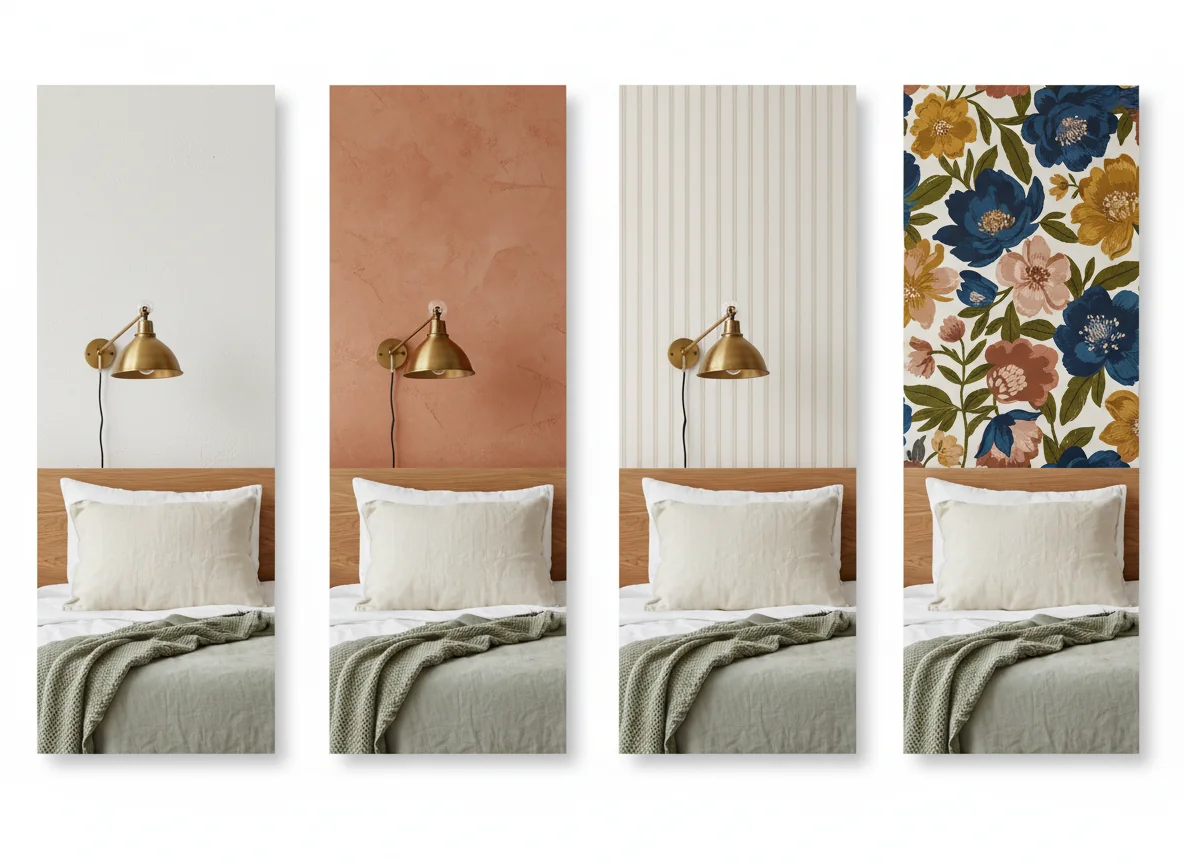
A warm-toned solid color in peel-and-stick — clay, terracotta, deep sage, soft navy — that mimics a paint accent wall without the lease violation. Most miscalculations on accent walls happen because the renter saw the color on a 4-inch sample; the AI render shows it at full wall scale before any adhesive touches drywall.
Architectural patterns at low contrast — vertical stripes, grasscloth-style textures, fluted-wood prints — that read as a permanent finish at six feet but come down in twenty minutes. These are the highest-ROI category in unfurnished rentals, because they make the wall do the work of trim, paneling, or a textured finish the unit will never have.
A statement print on one wall, paired with neutral elsewhere. A render with the print everywhere usually fails; a render with the print on one focal wall usually works. Test both before buying any rolls.
Our removable wallpaper for apartments post is the sister piece to this one — it goes deeper on adhesive classes, brand-specific reusability, and the exact removal sequence that protects your drywall.
Lighting swaps that look expensive
Lighting is where most rentals lose the most points and where renters can recover the most ground without touching a screwdriver. The standard issue: one builder-grade overhead fixture per room, often a brass-accented dome from a previous decade, plus whatever harsh ceiling light the kitchen and bathroom came with. The render’s job is to show you what the room looks like with that fixture neutralized — not removed, just visually retired — and replaced with layered, plug-in light.
The lease-safe lighting upgrade stack, in priority order:
A plug-in pendant or swag light that hangs from a ceiling hook (Command-brand ceiling hooks rated to 5 lb hold most pendants under 12 inches in diameter) and routes the cord along the ceiling and down the wall via cord-cover channels. The render is essential here — cord routing either reads as intentional or as a workaround, and AI tools render cord covers honestly so you can decide whether the visual cost is worth the upgrade.
Floor lamps with real presence — an arc lamp behind the sofa, a tripod next to a reading chair, a slim torchière in a corner. Renters under-buy floor lamps and then complain the room feels flat; the render answers the scale question before the lamp is in the cart.
Plug-in sconces flanking the bed or the sofa. The category exists at every price point in 2026, and a matched pair reads as architectural where a single sconce reads as decorative.
Smart bulbs in the existing fixtures, swapped for warm-white (2700K–3000K) tunable LEDs. The fixture is unchanged, so the lease isn’t touched, but the temperature shift from the cool bluish builder bulb to a warm dimming LED is the single most underrated upgrade in renter-friendly design.
The aggregate effect of three of these moves — a plug-in pendant, an arc floor lamp, and warm-white smart bulbs — is the visual jump from “I rent here” to “this is intentional,” and the all-in cost lands between $180 and $450 depending on brand. Compare that to the cost of the equivalent permanent-fixture upgrade in an owned home (electrician, fixture, install) and the renter version starts looking like a feature rather than a compromise.
Furniture-first redesigns
When the walls are off-limits and the lighting is fixed, the leverage moves to furniture — and the AI render’s strength is exactly here. Most renters either over-furnish (a couch, a loveseat, two armchairs, three side tables, two ottomans, in 600 square feet) or under-furnish (a sofa floating in a wide sea of beige carpet, no rugs, no side tables, no anchoring). The render fixes both problems by showing the room at scale before anything is delivered.
The furniture-first design loop most renters now use:
Step one — measure the room and import the dimensions, or sketch a rough floor plan. Most current tools accept a phone photo plus room dimensions and use both to scale the furniture correctly. Without dimensions, the renders are aspirational rather than accurate.
Step two — render two or three furniture configurations: a sofa-anchored layout, a rug-anchored layout where a large rug defines the conversation area, and a wall-hugging layout where furniture pushes to the perimeter to maximize floor space.
Step three — within the winning layout, render two or three style directions on the same pieces: warm contemporary, soft Japandi, slightly maximalist eclectic. The shapes stay the same; the textiles and finishes shift.
Step four — buy the largest pieces first (sofa, rug, bed frame), confirm fit, then layer in mid and small pieces. The render protects against the most expensive renter mistake — a sofa that won’t fit through the door, won’t sit right against the only available wall, or clashes with the rug you already own.
Our best furniture for small apartments post covers the specific pieces that earn their footprint, and our how to decorate small spaces post covers the visual tricks — vertical lines, mirror placement, leg-bared furniture — that make a 500-square-foot apartment read larger in both real life and AI renders.
| Renter mistake | What the render shows | Approximate savings |
|---|---|---|
| Buying a 92-inch sofa for an 11-foot wall | The sofa visually swallows the wall and the side tables don’t fit | $600–$1,800 returned |
| Skipping a rug to “save space” | The room reads as a hallway with furniture; a rug gives it a center | $200–$700 in regret avoidance |
| Matching all wood tones | Render flattens; the room reads as a furniture-store vignette | Style cost, not dollar cost |
| Mounting nothing on the walls | The walls amplify every blank surface; eye-level art breaks them up | Visual cost, recoverable later |
| Over-decorating the coffee table | Books and trays compete with the sofa; the eye doesn’t know where to land | Style cost, recoverable in five minutes |
The move-out test: previewing reversibility
The render that doesn’t think about move-out is half a render. The discipline that separates a confident renter-decorator from a nervous one is running the redesign in two states — installed and removed — before any product is bought. AI tools have caught up to this in 2026; you can prompt the render to show the room “before adhesive,” “with the upgrades installed,” and “after careful removal, returned to original,” and most current tools handle the third pass honestly.
The move-out test asks five specific questions of every upgrade in the redesign:
Does it attach without permanent fasteners? Drywall anchors are the most common deposit-killer because tenants forget how visible the holes are once the art is taken down. Tension rods, picture rails on Command-brand strips, and lean-against-the-wall mirrors pass; drilled hooks fail.
Is the adhesive class actually removable on this surface? Peel-and-stick wallpaper rated for “smooth, painted drywall” usually removes cleanly; the same product on textured walls, glossy paint, or flat paint that hasn’t fully cured can pull paint with it. The render won’t tell you; the manufacturer’s spec sheet will.
Will the removal be done carefully? This is the soft factor that ruins more deposits than any product flaw. Peeling wallpaper cold in November pulls paint; warming each panel with a hairdryer for ten seconds before peeling almost always doesn’t. Plan the removal weekend, not just the install weekend.
Are heavy items rated correctly? A 30-pound mirror on Command strips rated to 16 pounds is a deposit claim waiting to happen. The render shows the mirror; the spec sheet tells you which strip count actually holds it.
Does the cumulative spend exceed what a real, painted, drilled version would cost? Five years of peel-and-stick refreshes plus three sets of plug-in pendants plus an arc lamp can quietly outspend a real paint refresh and a hardwired sconce in a unit you owned. The math doesn’t kill the renter approach — reversibility is real value — but the render is a good moment to notice the trajectory.
For broader inspiration on how renters approach apartment design without breaking the lease, our apartment interior design ideas post covers the high-leverage moves by room type.
Frequently asked questions
Is AI rental apartment design worth it for a one-year lease?
Yes, often more than for a long lease. A one-year horizon punishes the wrong upgrade hard — there’s no time to recover from a regretted sofa or a wall treatment that ages badly — and AI renders are the cheapest way to pre-test a year’s worth of decisions in an evening. Most renters running the workflow above land their permanent decisions (sofa, rug, bed frame, lighting) in the first month and treat wallpaper and decor as a layer they iterate quarterly.
Will my landlord care if I use peel-and-stick wallpaper?
Most won’t, as long as it comes off cleanly. The lease language to read is the “alterations” clause, not the “painting” clause — peel-and-stick lives in a gray area in older leases and is increasingly named explicitly in newer ones. If the lease forbids alterations broadly, a one-paragraph email to the property manager describing the specific product and asking for written confirmation is worth the friction; landlords approve more often than renters expect, and a written approval is a deposit insurance policy you can’t replicate any other way.
What if the AI renders something that isn’t actually removable?
Treat the AI as a style brainstorm, not a procurement list — every product family it suggests should be cross-checked against an actual brand and its published reusability claim before purchase. The brand list for genuinely renter-safe products is short and stable: 3M Command (hooks, strips, picture-hanging), Tempaper and Chasing Paper (peel-and-stick wallpaper), specific tension-rod systems, and freestanding-only furniture brands. If the AI renders something outside that envelope, treat it as inspiration that needs a real-world substitute.
Do these tools work for a single rented bedroom in a shared house?
Often better than for whole apartments. A rented bedroom is a contained design problem — one entry door, one window, one bed wall, two side walls — and AI renders excel at small contained problems. Shared-house renters use this as a privacy and personality tool: the bedroom becomes a designed space without negotiating with housemates over the living room.
How much should I budget for a full AI-led rental refresh?
For a one-bedroom apartment in 2026, a complete renter-friendly refresh — peel-and-stick accent wall, plug-in pendant, arc floor lamp, smart bulbs, area rug, removable picture rail with art, and one or two freestanding furniture upgrades — typically lands between $700 and $2,200 depending on brand tier and whether you replace the sofa. The render cost itself is rounding error compared to the cost of the upgrades it helps you avoid buying wrong.
Design the rental you’d buy if you could
The rental apartment that feels like yours doesn’t require breaking the lease, repainting in secret, or financing the landlord’s next refresh with your deposit. It requires a small, repeatable cycle: render the room with reversible upgrades only, verify the products are actually reversible against their spec sheets, install confidently, document the install for your own records, and plan the careful removal months before you’ll need it. AI rental apartment design closes the loop by making the preview cheap, the regret rare, and the move-out boring — which is exactly what move-out should be.
Open RoomGenius, upload a photo of the room you’d most like to feel like yours, and have your three lease-friendly redesigns before the next time the leasing office calls about the renewal.