How to Pair Accent Chairs: Get the Look Without the Guesswork
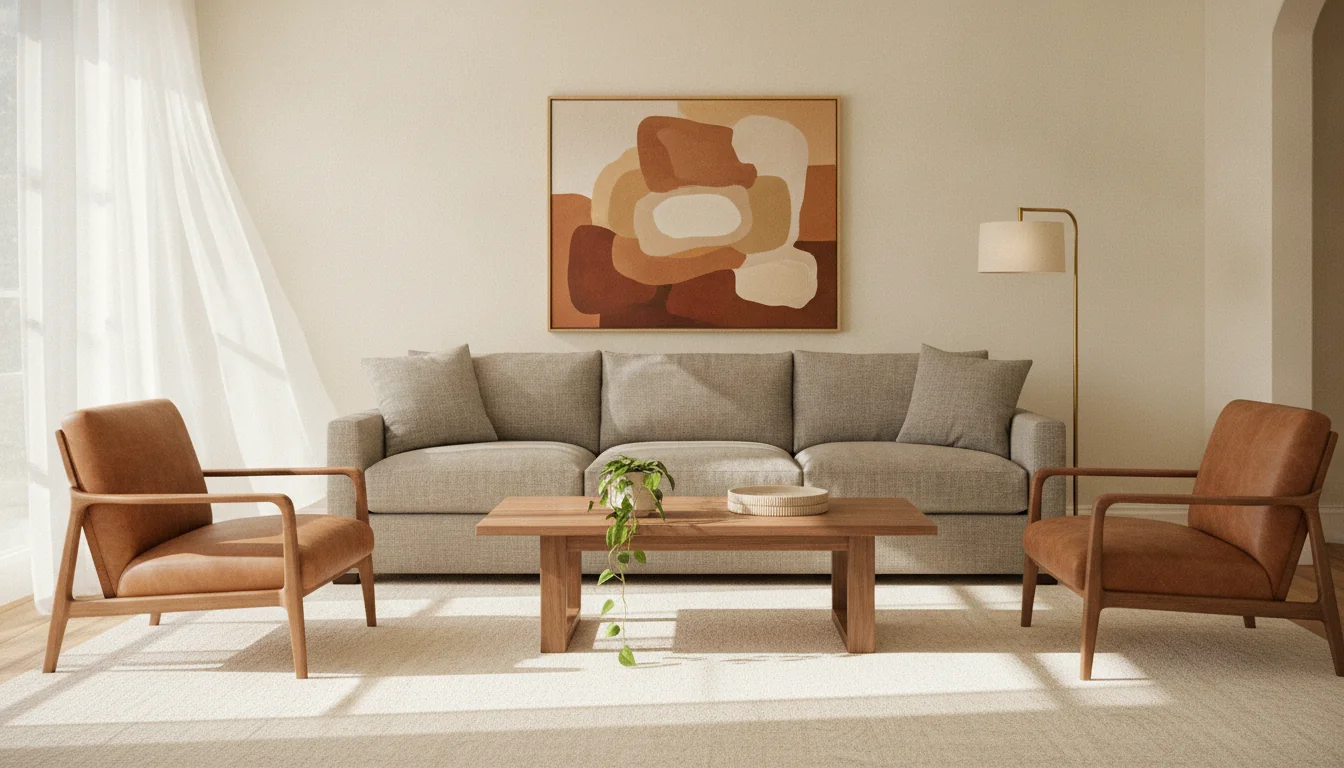
An accent chair is the most “I’ll know it when I see it” purchase in any room. You walk into a store, spot a chair in a color you love, sit in it for thirty seconds, and decide it’s the one. Then you bring it home, place it next to the sofa, and something feels off. The chair is too tall for the sofa’s back height. The scale is wrong — the chair reads as a toy next to the sofa. The color that looked perfect in the showroom clashes with the rug you already have. The chair that felt like a discovery in the store becomes a mistake in the room.
How to pair accent chairs is not a style question — it is a proportion, placement, and relationship question masquerading as one. The chair does not exist in isolation. It exists in relation to the sofa it sits beside, the coffee table it faces, the rug it anchors to, and the people who will sit in it. A chair that works perfectly in a solo photo may fail in the room because the scale relationship with the sofa is wrong, the distance between the chair and the coffee table is awkward, or the color temperature reads as warm when the room’s palette is cool. This guide walks through the decisions that matter — what an accent chair is supposed to do, how to match or contrast it with your sofa, the proportions that keep the pair from looking like a mismatch, and the AI preview workflow that lets you see every pairing in your actual room before you buy.
What is an accent chair? An accent chair is a secondary seating piece that complements the primary sofa in a living room. It is not a replacement for the sofa — it is a supplement that adds visual interest, additional seating, or a conversational anchor. The chair’s role is to balance the room’s seating arrangement, introduce a material or color that the sofa does not provide, and create a second focal point that draws the eye around the room. A well-paired accent chair makes the room look intentional. A poorly paired one makes the room look like a furniture showroom after a sale.
What an accent chair is supposed to do
An accent chair is not a sofa. This is the most common mistake people make when buying one. They pick a chair that is too large, too heavy, or too visually dominant — essentially a second sofa in miniature — and the room ends up with two competing anchors instead of one anchor and one supporting piece.
The accent chair has three jobs, and the chair fails if it does not do all three:
Add a seating option without dominating the room. The primary seating in a living room is the sofa. It is the largest piece, the most expensive piece, and the piece that determines the room’s layout. The accent chair adds a second seat — or two — without competing with the sofa for visual weight. A chair that is the same size, same color, and same material as the sofa does not add anything; it just duplicates. The chair should be visibly different in at least one dimension — size, material, color, or silhouette — so it reads as a deliberate choice rather than a matching set.
Create a conversational dynamic. Two people facing each other on a sofa and a chair have a different conversation than two people sitting side by side on a sofa. The chair creates an angle. It turns the seating arrangement from a row (everyone facing the TV) into a conversation pit (the sofa and the chair oriented toward each other). This is the difference between a room that feels like a theater and a room that feels like a living space. The angle between the chair and the sofa — typically 45 degrees — is the physical arrangement that makes the conversational dynamic work. Our how to arrange living room furniture guide covers the full geometry of conversational seating arrangements.
Introduce a material or color note that the room needs. The sofa is usually a neutral — gray, beige, navy, charcoal — because it is the largest piece and a neutral color keeps the room from feeling chaotic. The accent chair is the place to introduce the color, texture, or pattern that the room’s neutral base needs to feel finished. A caramel leather chair next to a gray linen sofa. A deep emerald velvet chair next to a beige cotton sofa. A bouclé chair in off-white next to a charcoal wool sofa. The accent chair carries the room’s personality while the sofa carries the room’s stability.
| Job | What it means | What to look for | What to avoid |
|---|---|---|---|
| Add seating without dominating | A secondary seat, not a second anchor | Chair clearly smaller than sofa; lighter visual weight | Same size and silhouette as the sofa |
| Create conversational dynamic | Orient the chair toward the sofa, not the TV | 45-degree angle; chair faces the sofa’s seating area | Chair pushed against the wall facing the TV only |
| Introduce a material or color note | Add what the sofa lacks | Contrasting color, texture, or material | Matching the sofa exactly (creates a set, not a pairing) |
Matching vs contrasting your sofa
The single most common question about accent chairs is: should the chair match the sofa or contrast with it? The answer is neither — the chair should complement the sofa, which is a different relationship from either matching or contrasting.
Matching means buying the same chair in the same color and material as the sofa. This creates a set — a sofa and two matching chairs that look like the manufacturer’s catalog page. The problem: a matching set makes the room look like a furniture showroom, not a lived-in space. It eliminates the visual interest that a deliberate pairing creates. The only exception is a formal living room where symmetry is the goal — two matching chairs placed exactly opposite the sofa in a traditional conversation arrangement. Even then, a better approach is to match the chairs to each other (two identical chairs) and let them contrast with the sofa, rather than matching everything.
Contrasting means choosing a chair in a color that is the opposite of the sofa — a bright yellow chair against a navy sofa, for example. High contrast works when the room’s palette is intentionally minimal and the chair is the single color note. It fails when the room already has multiple colors from rug, pillows, art, and curtains, because the high-contrast chair becomes one more competing element rather than a deliberate focal point. The risk of high contrast is that the chair reads as an afterthought — “I bought a yellow chair because I needed something to sit on” — rather than an intentional design decision.
Complementing is the middle ground that works for most rooms. A complementary chair shares a tonal family with the sofa but differs in material, shade, or texture. A warm gray sofa with a caramel leather chair. A charcoal sofa with a deep teal velvet chair. A beige sofa with a bouclé chair in off-white. The tonal relationship reads as coordinated without being matchy. The eye registers the two pieces as belonging together without registering that they are the same color.
| Approach | What it looks like | When it works | When it fails |
|---|---|---|---|
| Matching | Same color and material as sofa | Formal symmetrical rooms; very traditional interiors | Most casual living rooms; rooms with any other color elements |
| Complementing | Same tonal family, different material or shade | Most rooms; the safe choice that reads as intentional | Rooms where the sofa is already a very distinctive color |
| Contrasting | Opposite color or very different tone | Minimalist rooms with one color note; modern interiors | Rooms with multiple color sources; traditional interiors |
The complementing approach is also the safest strategy for people who are not professionally trained designers. Matching is too rigid and often looks like a store display. Contrasting is high-risk and fails unless the rest of the room is carefully controlled. Complementing — a caramel or cognac leather chair next to a gray sofa, an emerald velvet chair next to a beige sofa, a bouclé chair next to a charcoal sofa — creates a pairing that looks deliberate without requiring a designer’s eye. Our how to choose color schemes guide covers the broader color-relationship logic that applies to accent chair pairings as well.
Scale: the chair-to-sofa proportion rule
Scale is the invisible variable that decides whether an accent chair pairing works. More accent chair pairings fail on scale than on color. The chair is too tall for the sofa’s back height, so the sofa looks squat and the chair looks like a throne. The chair is too wide, so the two pieces overlap visually and the corner of the room looks crowded. The chair is too small, so it reads as a child’s chair next to the sofa’s adult scale.
The arm-height rule. The most important scale measurement is the arm height of the chair relative to the arm height of the sofa. The chair’s arm should be within one to two inches of the sofa’s arm height. If the chair’s arm is significantly higher than the sofa’s arm, the chair reads as visually dominant. If the chair’s arm is significantly lower, the chair reads as a low stool rather than a seating piece. A sofa with a 26-inch arm height pairs best with a chair whose arm height is between 24 and 28 inches.
| Sofa arm height | Chair arm height range | Best match type |
|---|---|---|
| 22–24 in (low modern) | 20–26 in | Low-profile accent chairs; mid-century shells |
| 25–27 in (standard) | 24–28 in | Most accent chairs; club chairs; barrel chairs |
| 28–30 in (high-back) | 26–30 in | Wingback chairs; high-back occasional chairs |
The seat-height rule. The seat height of the chair should be within one inch of the sofa’s seat height. A sofa with an 18-inch seat height paired with a chair with a 16-inch seat height creates a visual mismatch when someone sits in the chair — their knees are lower than the sofa sitter’s knees, and the two people are at different eye levels. The difference is subtle but noticeable in a room where the sofa and chair are used together for conversation. A discrepancy of more than two inches makes the pairing feel wrong even if the colors and materials match perfectly.
The visual-weight rule. Visual weight is not measured in inches — it is measured in how much of the room the piece occupies visually. A sofa in a light color like beige or cream has less visual weight than a sofa in charcoal or navy, even at the same dimensions. A chair in a dark color like deep emerald or burgundy needs to be smaller than a chair in a light color like cream or blush to balance the visual weight of the pairing. The rule of thumb: a dark chair should be no more than 60 percent of the sofa’s width, while a light chair can be up to 75 percent of the sofa’s width.
| Sofa color | Chair color | Max chair width (% of sofa) | Ideal chair width (% of sofa) |
|---|---|---|---|
| Light (cream, beige, light gray) | Light | 75% | 60–65% |
| Light (cream, beige, light gray) | Dark | 60% | 50–55% |
| Dark (charcoal, navy, olive) | Light | 75% | 60–70% |
| Dark (charcoal, navy, olive) | Dark | 65% | 55–60% |
The 45-degree placement. The accent chair should be placed at a 45-degree angle to the sofa, not parallel to it. The 45-degree angle turns the chair toward the sofa’s seating area, creating the conversational dynamic that the accent chair is supposed to provide. It also opens the room’s circulation path — a chair parallel to the sofa blocks the traffic flow between the sofa and the wall. A chair at 45 degrees leaves the path open while still anchoring the seating area. The chair’s front edge should align roughly with the sofa’s front edge, so the two pieces share the same depth plane.
Pairs vs singles vs mismatched sets
The number of accent chairs in a room — and whether they match each other — is a separate decision from the chair’s relationship to the sofa. The wrong number of chairs or the wrong matching strategy can undo a well-chosen chair.
Single accent chair. One accent chair is the simplest arrangement and the hardest to get wrong. A single chair at 45 degrees to the sofa creates a conversational L-shape that works for two people: one on the sofa, one on the chair. The single chair is also the best choice for small rooms where a second chair would crowd the space. The limitation: a single chair seats only one additional person, so a room with a three-seat sofa and one accent chair can seat four people total — three on the sofa, one on the chair — which is tight for hosting.
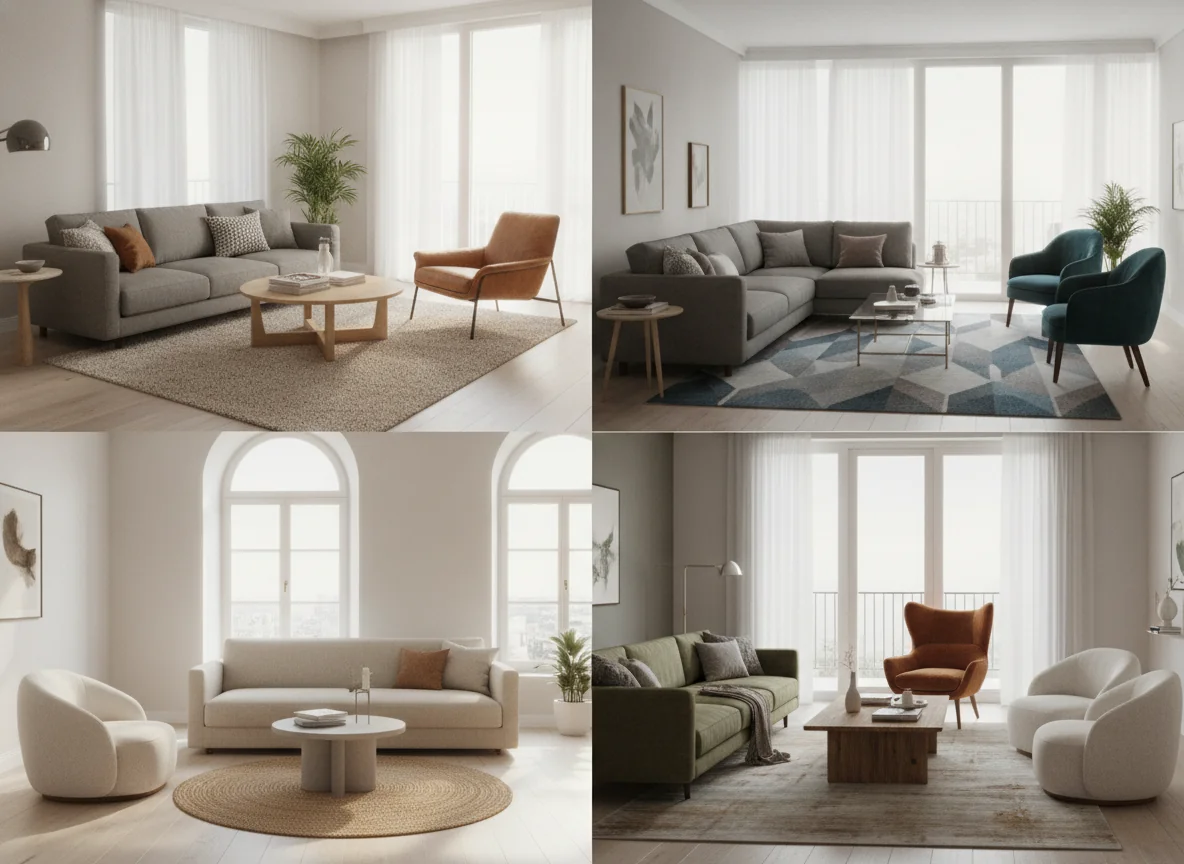
Pair of matching chairs. Two identical accent chairs placed opposite the sofa create a symmetrical U-shaped seating arrangement. This is the classic conversation setup — two people on the sofa facing two people on the chairs, with a coffee table in the center. The matching pair works best when the room is large enough to accommodate the second chair without crowding the traffic path. The chairs should be placed at 45 degrees to the sofa and at 90 degrees to each other, so the four-seat arrangement forms a rough U. A matching pair of chairs is also the best choice for a formal living room where symmetry is the organizing principle.
Mismatched pair. Two different accent chairs — different in shape, color, or material — create an intentionally curated look that reads as collected over time rather than bought in one afternoon. The mismatched pair is the hardest arrangement to execute because the two chairs need to relate to each other without matching. The rule for a successful mismatched pair: the chairs must share at least one design element. Same color, different shape. Same shape, different material. Same material, different color. If the chairs share nothing — a chrome-and-leather mid-century shell and a tufted velvet club chair — they read as two unrelated pieces that happen to be in the same room, not as a deliberate pair.
| Arrangement | Seats | Best room size | Design level | Risk |
|---|---|---|---|---|
| Single accent chair | 1 additional | Small to medium | Low — easiest to execute | Room feels lopsided if chair is too small |
| Matching pair | 2 additional | Medium to large | Medium — symmetry is straightforward | Can look like a catalog if too matchy |
| Mismatched pair | 2 additional | Medium to large | High — requires design intuition | Reads as random if chairs share no common element |
The sofa-table connection. The accent chair arrangement also affects the sofa table — the table that sits behind the sofa or beside it. A single accent chair next to the sofa’s end creates a natural spot for a sofa table with a lamp, books, or a tray. A pair of chairs opposite the sofa moves the sofa table to the back of the sofa, where it anchors the seating area. The relationship between the chair, the sofa, and the sofa table is a triangulation: the lamp on the sofa table provides task lighting for the chair, and the chair provides a visual counterweight to the sofa table’s mass. Our what is a sofa table guide covers the placement logic for tables in living-room seating arrangements.
Color and pattern: when to be bold
The accent chair is the piece in the room where you can be bold. The sofa is the neutral anchor. The rug is the foundation. The coffee table is the functional center. The accent chair is the personality piece — the place where a color, a pattern, or a texture that would be overwhelming on the sofa becomes a deliberate accent. But boldness needs constraints, and the constraints are different for color and pattern.
Color: one jump, not two. The accent chair’s color should be one jump away from the room’s dominant color — not two. If the room’s dominant color is warm gray, a jump to caramel, cognac, or rust (one step: warm neutral to warm earth tone) works. A jump to emerald green (two steps: warm neutral to cool saturated color) requires the room to have a second cool element — a rug, a pillow, or wall art with green in it — to anchor the chair’s color. A jump to a bright yellow or hot pink (three steps: warm neutral to high-saturation accent) almost always fails unless the room is designed around that single color note. The safest strategy: let the accent chair’s color appear in at least one other element in the room — a pillow, a throw, a vase, or a piece of art — so the color reads as intentional rather than random.
The 60-30-10 rule. The classic interior design color distribution applies directly to accent chair selection. The 60 percent is the dominant color (walls, floor, large furniture). The 30 percent is the secondary color (the sofa, the rug, the curtains). The 10 percent is the accent color (the accent chair, the pillows, the art). The accent chair falls in the 10 percent category, which means it should be the most saturated, most colorful, or most textured piece in the room. A chair that is the same color as the 60 percent or the 30 percent is not an accent — it is a neutral piece that happens to be smaller than the sofa. The accent chair earns its name by being the color that pops against the room’s neutral base.
| Room palette | Sofa color | Accent chair colors that work (one jump) | Colors that risk clashing (two jumps) |
|---|---|---|---|
| Warm neutrals (beige, cream, tan) | Beige linen | Caramel leather, rust velvet, warm brown bouclé | Emerald, navy, cool gray |
| Cool neutrals (gray, charcoal, slate) | Charcoal linen | Deep teal, blush velvet, cream bouclé | Orange, yellow, warm red |
| Earth tones (olive, terracotta, sand) | Olive cotton | Terracotta, rust velvet, cream bouclé | Purple, magenta, bright blue |
| Light and airy (white, pale gray, blush) | White cotton | Blush velvet, warm oak, caramel leather | Black, dark navy, charcoal |
Pattern: one pattern per room. A patterned accent chair — a floral, a stripe, a geometric — is a high-risk, high-reward choice. The rule: one pattern per room, and the pattern must be the smallest surface area in the room. A patterned accent chair on a solid rug with solid curtains and a solid sofa works. A patterned accent chair on a patterned rug with solid curtains and a solid sofa may work if the two patterns are different scales (a large-scale floral on the rug and a small-scale geometric on the chair). A patterned accent chair on a patterned rug with patterned curtains looks like a fabric store. The safest pattern choice: a small-scale, low-contrast pattern — a tone-on-tone stripe, a subtle herringbone, a small-scale geometric — that reads as texture from a distance and as pattern only up close.
Texture as a substitute for pattern. Texture is the safest way to add visual interest to an accent chair without the risk of pattern. A bouclé chair adds the nubby texture of looped yarn. A velvet chair adds the depth of a short dense pile. A leather chair adds the smoothness of a natural hide. A cane or rattan chair adds the open weave of natural fiber. Texture reads as intentional without requiring the coordination that pattern demands. A room with a flat-weave sofa, a flat-weave rug, and a flat-weave curtain needs a textured accent chair to break the monotony. A room with a bouclé sofa, a shag rug, and velvet curtains needs a smooth leather or cane chair to provide visual rest.
Previewing accent chair pairings with AI
The entire framework above — matching vs complementing, scale rules, pair vs single, color and pattern — is intellectual work that narrows the field. But the final decision is visual, and the visual relationship between an accent chair and the sofa it sits next to is something no dimension sheet, no color swatch, and no catalog photo can fully convey. The chair’s back height against the sofa’s back height. The chair’s arm curve against the sofa’s clean lines. The chair’s leg finish against the coffee table’s metal. The chair’s color temperature against the room’s north-facing afternoon light. These are relationships that require seeing the chair in the room.
What a render reveals that a showroom visit cannot. A showroom visit shows you the chair in isolation — on a blank floor, under uniform lighting, with no other furniture touching it. The showroom is designed to make every chair look good. Your living room is not. An AI render of the chair in your actual room shows you:
-
The scale relationship. The chair at 30 inches wide next to a sofa at 84 inches wide. Is the chair reading as proportional, or is it swimming next to the sofa? The render puts both pieces in the same frame at the correct scale, with your room’s wall dimensions and ceiling height as the reference grid.
-
The color temperature interaction. The caramel leather chair that looked warm in the showroom may read as orange against your cool gray wall. The blush velvet that looked subtle in the catalog may read as pink against your warm beige floor. The render captures the color interaction under your room’s actual light — the combination of your window orientation, your bulb temperature, and your wall color.
-
The leg and base relationship. The chair’s oak legs next to the sofa’s black metal legs. The chair’s exposed wood arm next to the sofa’s upholstered arm. A showroom chair’s legs are usually invisible because the chair is on a raised platform. In your room, the legs are the connection point between the chair and the floor, and they matter for the visual continuity of the seating area.
-
The back-height silhouette. The chair’s back at 32 inches next to the sofa’s back at 28 inches. The four-inch difference creates a visible silhouette step — the chair’s back rises above the sofa’s back, and the eye registers the two heights as related or disconnected. The render shows the profile.
| Variable | What to compare | Number of renders |
|---|---|---|
| Chair color | Caramel vs blush vs teal | 3 |
| Chair material | Leather vs velvet vs bouclé | 3 |
| Chair scale | 28-inch vs 32-inch width | 2 |
| Chair placement | 45-degree vs 90-degree vs parallel | 3 |
| Number of chairs | Single vs pair | 2 |
The AI preview workflow. Modern AI room design tools — RoomGenius included — can render an accent chair in a photo of your actual living room in about a minute. The workflow is simple: take a photo of the room from the typical viewing angle (standing at the doorway or opposite wall), describe the chair you are considering (dimensions, shape, color, material, and style), and the AI generates a rendered version of the room with the chair in place at the correct scale.
The furniture-matching layer in RoomGenius connects the rendered chair to an actual in-stock product — dimensions, material, color options, price, and a purchase link — so the chair you see in the render is the chair you can order. You can test a single chair in three colors, or a pair of chairs in two different styles, or a single chair vs a matching pair, all in one afternoon. The render captures the chair’s relationship to the sofa, the coffee table, the rug, the floor, and the wall color in a way that no mental visualization can.
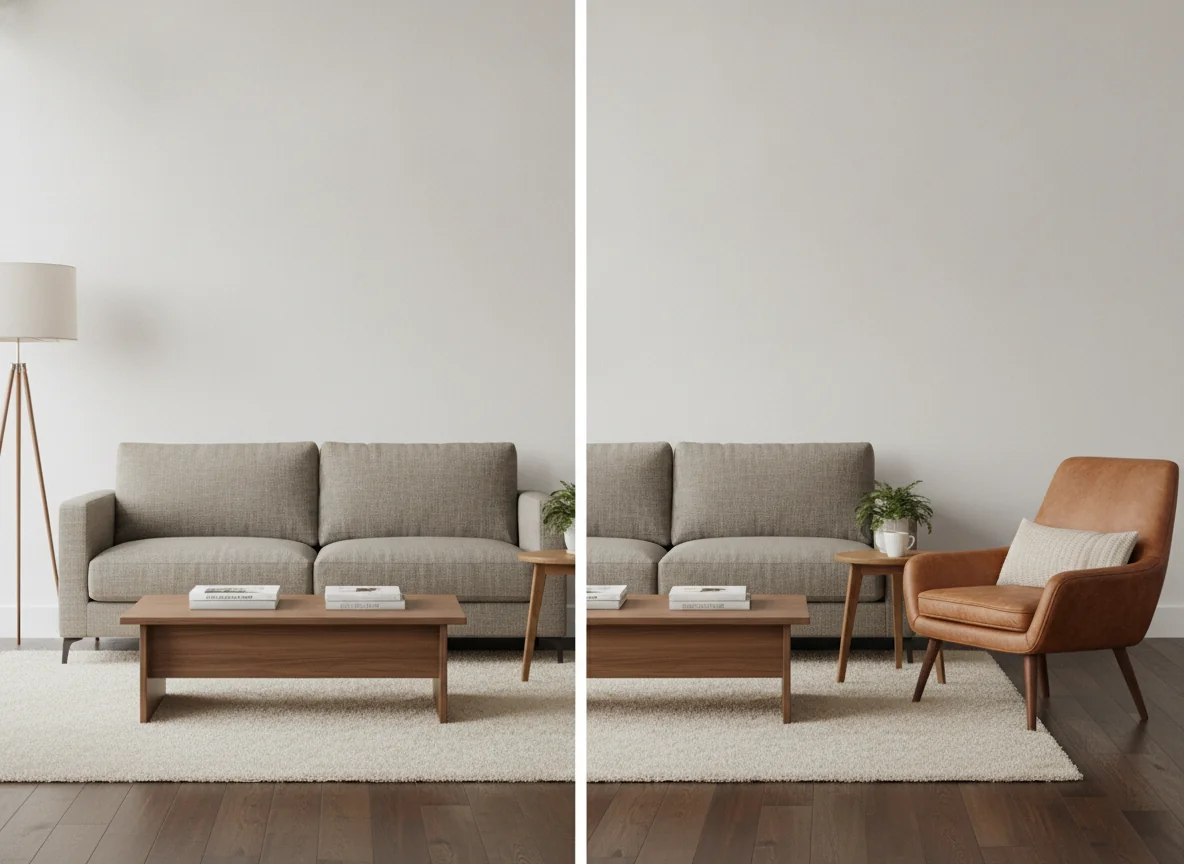
The preview tool is the same tool that handles sofa previews, dining table previews, and the full AI room makeover workflow — which means you can use it to preview the accent chair and the sofa together, or preview the chair against the coffee table and rug you already own. For more on how the tool works across furniture categories, the ai interior design app guide covers the full workflow from photo to render to purchase, and our furniture types and styles overview covers the broader coordination logic across a room’s furnishings.
FAQ
How many accent chairs should I put in a living room?
One accent chair per seating area is the minimum. A single chair at 45 degrees to the sofa creates a conversational L-shape. A pair of matching chairs opposite the sofa creates a U-shaped conversation arrangement. A third chair works only in very large rooms (over 300 square feet) where the sofa and first two chairs do not fill the space. The risk of too many accent chairs is that the room looks like a waiting area — every piece is a chair and no piece is the anchor.
Should accent chairs match the sofa or the rug?
Neither — the accent chair should complement the sofa, which is a different relationship from matching either the sofa or the rug. The chair’s color should be one jump away from the room’s dominant color (typically the sofa’s color). The chair’s material should contrast with the sofa’s material — a fabric chair next to a leather sofa, a leather chair next to a fabric sofa. Matching the chair to the rug is a common mistake that makes the chair recede into the floor rather than stand out as an intentional piece.
What size accent chair goes with a standard sofa?
A standard sofa (78 to 90 inches wide) pairs best with an accent chair that is 28 to 34 inches wide and 30 to 36 inches deep. The chair’s arm height should be within two inches of the sofa’s arm height, and the chair’s seat height should be within one inch of the sofa’s seat height. The chair’s back height can be higher than the sofa’s back height — a chair that rises above the sofa creates visual interest — but the difference should be no more than four inches, or the chair reads as visually dominant.
Can I use two different accent chairs in the same room?
Yes, but the two chairs must share at least one design element — same color, same shape, same material, or same style period. A pair of chairs that share nothing — a mid-century shell in chrome and walnut, and a tufted club chair in velvet — reads as accidental rather than intentional. The safest mismatched pair: same color in two different materials (caramel leather and caramel bouclé), or same material in two different colors (teal velvet and blush velvet).
What is the best angle for an accent chair next to a sofa?
45 degrees. The 45-degree angle turns the chair toward the sofa’s seating area, creating a conversational dynamic. It also opens the room’s circulation path — a chair at 90 degrees to the sofa (parallel to the wall) blocks the traffic flow between the sofa and the wall. A chair at 45 degrees leaves the path open while still anchoring the seating area. The chair’s front edge should align roughly with the sofa’s front edge.
What color accent chair goes with a gray sofa?
Caramel or cognac leather is the most common and most successful choice for a gray sofa. The warm earth tone of the leather contrasts with the cool gray of the sofa without clashing — the relationship is one jump (cool neutral to warm earth tone). Other options: blush velvet (adds a soft warm note), deep teal velvet (adds a saturated jewel tone), cream bouclé (adds texture without color). The worst choice: another gray in a different shade, which reads as a mismatch rather than a deliberate pairing.
Should I buy an accent chair before or after the sofa?
After the sofa. The sofa is the anchor of the room — it determines the room’s scale, layout, and color direction. The accent chair is a supporting piece that should respond to the sofa’s decisions. Buying the chair first means you are choosing a secondary piece before the primary piece is in place, and the risk of a scale or color mismatch is high. The ideal sequence: choose the sofa first, choose the rug and coffee table second, and choose the accent chair last — as the finishing piece that brings the room together.
Can I use an AI tool to preview an accent chair in my room?
Yes. RoomGenius’s furniture preview workflow accepts a description of the chair you are considering — dimensions, color, material, shape, and style — and renders it at true scale in a photo of your living room. The preview shows the chair’s relationship to the sofa, the coffee table, the rug, and the wall color. You can test multiple chair colors, materials, and placements in a single afternoon. If the chair is from a supported brand, the rendered piece is also shoppable — you confirm the fit and click through to purchase. The preview takes about a minute per render.
Try accent chair pairings on your actual sofa first
An accent chair is the finishing piece in a living room — the element that turns a functional seating arrangement into a deliberately designed space. Getting the pairing right means understanding what the chair is supposed to do (add without dominating, create a conversational angle, introduce a material or color note), deciding whether to complement or contrast the sofa, matching the chair’s scale to the sofa’s proportions, choosing the right number of chairs for the room, and picking a color or texture that fits the room’s palette. Those are all decisions you can make with a design framework and a tape measure. The one decision you cannot make on paper is whether the chair looks right next to your actual sofa, in your actual room, with your actual lighting — and that is the decision AI previews solve in under a minute.
RoomGenius is the AI room design app that lets you preview any accent chair pairing in your actual living room before you order. Shoot a photo of the room from the doorway, describe the chair you are considering — dimensions, color, material, and style — and a scaled photoreal render comes back in about a minute. See how the chair’s scale relates to the sofa, how the color reads against your wall and floor, and how the placement affects the room’s circulation. The furniture-matching layer connects the rendered chair to a real, in-stock product, so you go from preview to purchase without the guesswork. The free tier covers your first few previews. Try it on the App Store or Google Play. Try accent chair pairings on your actual sofa first — it is the most confident furniture decision you will make all year.